
Choose the Wide-Fan Tip That Actually Matches Your Washer
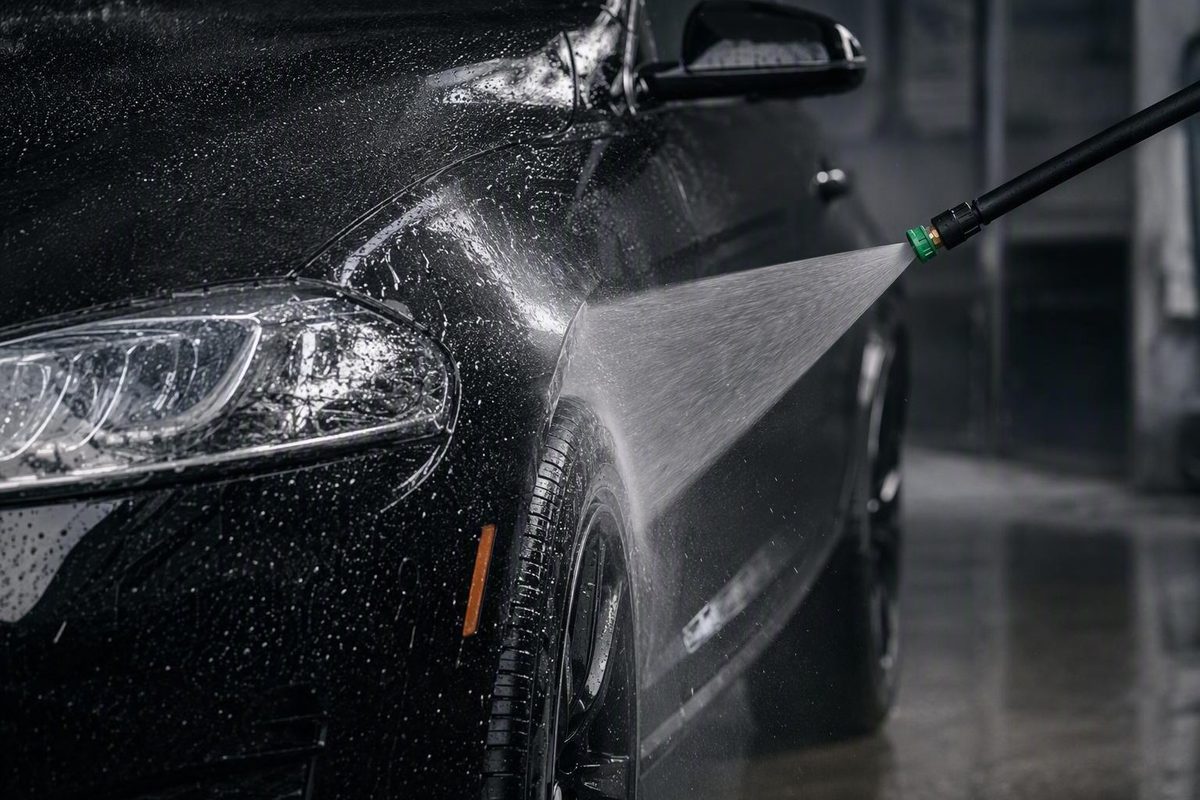
A 40-degree pressure washer nozzle is a sensible starting point for rinsing broad vehicle panels. Its wide fan is generally less concentrated than narrower patterns, but it is not a universal solution for every component, contaminant, or surface.
The angle alone does not establish whether a nozzle will work with your machine. Before buying, separately verify the orifice size, pressure-washer flow, intended operating pressure, fitting, water-temperature rating, and condition of the surface you intend to clean.
This is a compatibility and buying checklist, not a substitute for the sizing chart in your washer or nozzle documentation. When selecting an orifice, use manufacturer-supported data for your pump’s rated GPM and intended operating PSI rather than an unsourced universal formula.
Related: Spray Nozzles Set Pressure and Coverage.
What a 40-degree pressure washer nozzle does
The 40-degree specification describes the nominal angle of the flat-fan spray. It is not the pressure setting, orifice size, or connector diameter.
As the spray travels away from the tip, it opens into a relatively broad fan. That distributes water across more area than a 25-, 15-, or 0-degree pattern, making the stream less concentrated when the other variables are comparable.
White is the conventional color for a standard 40-degree tip. The familiar pattern code is:
- White: 40 degrees
- Green: 25 degrees
- Yellow: 15 degrees
- Red: 0 degrees
Treat color as a quick visual aid, not proof. Check the angle and size stamped on the nozzle, together with its documentation. A white shell does not establish that the orifice suits your pump, and guards or specialty caps may use different colors. Alkota’s pressure-washer nozzle guide documents the conventional color scheme while emphasizing that nozzle size must match the washer’s volume and pressure.
Typical roles for a correctly sized 40-degree nozzle include:
- General rinsing of intact vehicle paint
- Clearing detergent from broad body panels
- Rinsing windows, patio doors, and some painted surfaces
- Cleaning large areas of siding
- Light cleaning where a narrower fan is unnecessarily concentrated
These are possible applications, not guarantees. Manufacturers and vendors commonly recommend the pattern for broad or comparatively delicate surfaces, but suitability still depends on the specific machine, nozzle, material, and surface condition.
A wide fan is less aggressive, not damage-proof. Pressure, flow, orifice size, working distance, surface condition, spray direction, and technique all affect risk.
For routine vehicle rinsing, use a properly sized 40-degree tip as a cautious first choice on broad, sound panels. Inspect first, begin farther away, and do not assume the same setup belongs near every badge, seal, sensor, vent, fabric roof, or repaired area.
For more general context on fan patterns and chemical application, see this guide to spray nozzles for car cleaning.
Angle, orifice, PSI, and GPM are different specifications
Pressure-washer listings often compress several unrelated numbers into one product name. Separating them is the first step toward buying the correct tip.
| Specification | What it means | What it does not mean |
|---|---|---|
| 40 degrees | Nominal flat-fan spray angle | Orifice size, connector size, or operating pressure |
| Size 2.5, 3.0, 4.0, 4.5, or 7.5 | Nozzle-size or orifice designation | Degrees or fitting diameter |
| Washer GPM | Pump flow rating in gallons per minute | Pressure |
| Operating PSI | Pressure produced under the operating setup | Maximum nozzle rating or surface impact by itself |
| Maximum nozzle PSI | Component pressure limit published for the tip | Recommended cleaning pressure or proof of compatibility |
Consider this hypothetical listing description:
40-degree, size 4.0, 1/4-inch quick-connect, 4,000 PSI maximum
It communicates four separate specifications:
- 40 degrees: the fan angle.
- 4.0: the nozzle-size designation.
- 1/4 inch: the stated connection format or dimension.
- 4,000 PSI: the component’s maximum pressure rating.
None substitutes for another. In particular, “4.0” does not mean 4 degrees, 4 GPM, or a 4-inch fitting.
Why orifice size matters
The pump moves water through the nozzle, and the selected orifice helps determine the pressure at which the system operates for the available flow.
A nozzle that is oversized or worn may reduce pressure and cleaning performance. These are diagnostic possibilities rather than one-symptom, one-cause rules because supply restrictions, leaks, pump condition, the unloader, and other components can also affect operation.
The correct orifice depends on the pump’s rated GPM and the intended operating pressure. It does not follow from the 40-degree angle. A specialist retailer listing for a General Pump size-7.5 nozzle directs buyers to select nozzle size from flow and pressure using established sizing methods and its linked nozzle-size calculator.
Use sizing information in this order of preference:
- The pressure-washer manual or replacement-parts specification
- The washer manufacturer’s nozzle chart
- The nozzle manufacturer’s chart
- A reputable calculator using rated pump GPM and intended operating PSI
- Manufacturer or qualified dealer support when specifications are missing
A proper worked sizing calculation requires pump-flow and operating-pressure data plus a supported chart or calculator. Without those inputs, choosing between sizes such as 2.5, 4.0, and 7.5 would be guesswork.
Machine PSI is not surface impact
A washer’s advertised PSI does not fully describe what reaches the target. Orifice size, available flow, fan pattern, working distance, pump behavior, and nozzle condition all contribute. Moving the tip closer also places the fan over a smaller area.
Likewise, a nozzle marked “5,000 PSI maximum” is not recommending that pressure for paint. It states a component limit under the product’s specified conditions. It does not prove that the orifice is correct for your pump, that the fitting matches, or that the resulting spray is appropriate for a vehicle.
A compatibility-first checklist before you buy
Start at the washer, not the shopping results. Locate the data plate and manual, then record:
- Rated GPM
- Rated pressure and any documented operating range
- Permitted water temperature
- Wand or lance connection
- Existing coupler type
- Recommended replacement-nozzle size
- Any restrictions on aftermarket accessories
Next, compare those details with the individual nozzle—not merely with a multi-tip set described as “universal.”
1. Match the orifice to the pump
Use the washer or nozzle maker’s chart to select an orifice for the pump’s rated flow and intended pressure. Do not choose a 2.5, 4.0, or 7.5 because it resembles the old tip or because the new component has a high maximum-PSI rating.
If the original nozzle is still present and legible, its markings may help identify the intended replacement. Verify them against the manual because an old tip could be worn, incorrect, or inherited from another machine.
2. Confirm both sides of the connection
Many consumer spray tips use a 1/4-inch quick-connect plug that inserts into a female coupler on the wand. Other systems use male or female NPT threads, proprietary fittings, or manufacturer-specific adapters.
Check:
- Whether the nozzle has a plug, socket, male thread, or female thread
- The nominal size
- The thread standard when threaded
- Whether the wand presents the corresponding connection
- Any pressure, temperature, or installation requirements for the coupler or adapter
Marketplace terminology can be inconsistent. One Erie Tools listing advertises a 1/4-inch quick connection in its title but identifies the inlet type as National Pipe Tapered in the product details. That conflict should be resolved with the seller or manufacturer before ordering; it does not mean quick-connect and NPT are interchangeable.
3. Check the water-temperature limit
Do not assume that every stainless-steel tip accepts hot water. One SurfaceMaxx model is listed for cold water only, while the compared General Pump size-7.5 model publishes a maximum fluid temperature of 300°F.
Verify the permitted temperature for the nozzle and every other part of the pressure-washing system. Follow the limits and operating instructions supplied for the washer, pump, hose, gun, coupler, seals, and target surface.
4. Read the warranty scope
A warranty headline is not enough. Determine whether coverage is:
- Residential, commercial, or both
- Limited by water temperature or pressure
- Conditional on approved equipment or operating practices
- Supported by accessible full terms
For example, McKillans advertises a one-year residential warranty for its rinsing nozzle. That does not establish coverage for professional use.
Pre-purchase checklist
Before clicking “buy,” confirm all eight items:
- [ ] Stamped angle: 40 degrees
- [ ] Orifice size: matched to rated GPM and intended operating PSI
- [ ] Fitting: exact plug, socket, or thread needed
- [ ] Maximum component pressure: suitable for the system
- [ ] Temperature limit: compatible with the equipment and water source
- [ ] Material: documented rather than inferred from appearance
- [ ] Warranty: appropriate for residential or commercial use
- [ ] Application: consistent with manufacturer instructions and the intended task
A nozzle rated to 4,000 or 5,000 PSI can potentially operate on a lower-pressure washer, but only when its orifice, fitting, flow requirements, temperature rating, and other manufacturer requirements also match. “Rated higher” does not mean “fits everything below it.”
Representative 40-degree nozzle specifications compared
Specifications checked August 30, 2026. The following comparison is based on published manufacturer, retailer, and marketplace specifications. The products were not physically tested, and the table is not a best-to-worst ranking.
| Model | Listed angle and size | Connection | Pressure and temperature | Construction and other details | What remains to verify |
|---|---|---|---|---|---|
| SurfaceMaxx 2.5 | 40°, size 2.5 | Standard 1/4-inch quick-connect coupler | Listed for 1,600–4,500 PSI pressure washers; cold water only | Manufacturer-recommended for automobiles and several broad or relatively delicate surfaces; two-year limited warranty advertised (manufacturer listing) | Pump-flow compatibility, material, and full warranty terms |
| Erie Tools 4.0 | 40°, size 4.0 | Title advertises a 1/4-inch quick connection | 4,000 PSI maximum | Stainless steel (marketplace listing) | Listing also identifies an NPT inlet; confirm the actual fitting |
| McKillans rinsing nozzle | 40°, size 4.0 | Not provided in the supplied specifications | Not provided | Stainless-steel internals, rubberized guard, and one-year residential warranty advertised (manufacturer listing) | Connection, pressure limit, temperature rating, flow requirements, and commercial coverage |
| General Pump GEN-32351 | 40°, size 7.5 | 1/4-inch quick-disconnect plug | 5,000 PSI maximum; 300°F maximum fluid temperature | Stainless-steel body and hardened stainless-steel orifice (specialist retailer listing) | Whether size 7.5 matches the pump’s GPM and intended pressure |
The SurfaceMaxx applications and performance descriptions are manufacturer claims rather than independent test findings. Its published pressure-washer range also does not establish that size 2.5 is correct for every machine within that range.
The Erie Tools connection description remains ambiguous because “quick connection” and “NPT inlet” identify different connection concepts. Obtain an exact connection drawing or manufacturer part specification if the marketplace page cannot resolve the discrepancy.
The McKillans rubberized guard may cushion accidental physical contact between the nozzle and a vehicle. The supplied evidence does not establish that it prevents damage caused by the water stream. Its missing pressure, temperature, connection, and flow specifications should be settled before purchase.
The General Pump model has the highest published pressure and temperature limits in this small comparison, but those component limits do not make size 7.5 appropriate for an unmatched pump.
Marketplace results also show 40-degree tips in sizes 3.0 and 4.5. The practical lesson is that visually similar white tips are not necessarily interchangeable.
Choose by profile rather than by a declared winner:
- Documented cold-water consumer option: SurfaceMaxx 2.5, if its orifice matches
- Guarded, detailing-oriented option: McKillans 4.0, after missing compatibility details are confirmed
- Conventional stainless replacement tip: Erie Tools 4.0, once the connection conflict is resolved
- High-temperature industrial specification: General Pump 7.5, for a suitably matched system
Prices, stock, ratings, and review counts can change and do not establish cleaning quality, durability, or value. Fit, sizing, pressure limit, temperature limit, and documented suitability matter more.
How to use a 40-degree nozzle on a car
A correctly sized 40-degree tip is commonly recommended for general paint rinsing because its fan is less concentrated than narrower patterns. That makes it a cautious default, not a guarantee against damage.
Published guidance varies on fixed pressures and distances, while machine-rated PSI alone does not describe surface impact. A more adaptable method is to begin conservatively and adjust only after observing the specific washer, nozzle, and vehicle.
A cautious startup protocol
- Inspect the vehicle. Look for peeling paint, rust, failed clear coat, recent repairs, lifted decals, loose trim, cracked glass, and deteriorated seals.
- Inspect the nozzle. Confirm the stamped angle and size, then check for visible damage, contamination, or a misshapen outlet.
- Verify compatibility. Match the orifice to the washer and confirm the fitting, maximum pressure, and temperature rating.
- Follow the washer’s shutdown procedure. Before installing or changing a tip, use the manufacturer-prescribed process for stopping the machine and releasing retained pressure.
- Test away from the car. Direct the spray toward a suitable drainage area and verify that the fan is even and the machine behaves normally.
- Begin farther back. Do not place the nozzle close to the panel at startup.
- Test an inconspicuous area. Watch the finish and the way water behaves around nearby seams.
- Move closer only if necessary. Reduce distance gradually while keeping the spray moving.
Vehicle-washing guidance from equipment suppliers and automotive publications supports using a 40-degree tip for general rinsing while calling for extra care around paint defects, window seals, badges, trim, and delicate components (vehicle nozzle guidance; car-washing precautions).
Use smooth, overlapping passes rather than dwelling on one spot. If rinsing does not remove a contaminant, improve the cleaning chemistry or use an appropriate contact-wash method instead of automatically moving the nozzle closer.
Around panel edges, seals, badges, trim, and openings, direct the fan across the area rather than straight into a gap. Be particularly cautious around:
- Mirror housings and window seals
- Loose badges, decals, and film edges
- Parking sensors and cameras
- Grilles, vents, and fascia openings
- Electrical components exposed under an open hood
- Radiators, condensers, and other heat exchangers
- Fabric convertible roofs
- Repaired or repainted panels
Vehicle-specific restrictions take priority. A warning for one model’s fascia or heat exchanger cannot be generalized to every car, but it illustrates why the owner’s manual should be checked before spraying sensitive openings.
When to stop and hand-wash
Choose a lower-force hand method when you find:
- Peeling, bubbling, cracked, or recently repaired paint
- Exposed rust or weakened substrate
- Loose trim, badges, decals, or protective-film edges
- Failed weather seals
- Chipped or fragile glass
- A delicate fabric roof
- Components the vehicle manufacturer prohibits pressure-washing
- Any surface that changes, lifts, leaks, or flexes during the test
Hand washing is the appropriate method when the surface cannot tolerate pressurized water or when close control matters more than speed.
A practical wash sequence
- Pre-rinse loose material with the correctly sized 40-degree nozzle where appropriate.
- Apply compatible vehicle detergent with the black low-pressure soap tip or a suitable foam cannon.
- Allow the detergent to work for the time stated on its label without letting it dry.
- Agitate with a lubricated contact-wash method if the product and finish call for it.
- Rinse broad panels with the 40-degree tip while keeping the wand moving and managing runoff around openings.
Commercial vehicle-washing guides commonly identify the black nozzle as a low-pressure detergent tip and the white 40-degree nozzle as the broad rinsing pattern (vehicle nozzle guide).
A 25-degree tip may sometimes be used on durable wheels, tires, wheel wells, or undercarriage areas when the equipment and surface instructions permit. Do not transfer that setup automatically to painted panels because the narrower fan is more concentrated when other variables are comparable.
Door jambs pose a different problem: a broad fan can produce substantial splashback in a confined opening. Some detailers use a larger-orifice, lower-pressure specialty nozzle for more control, but that accessory is optional. A gentle hose nozzle or careful hand cleaning may also be appropriate.
Using the wide fan on glass, siding, wood, and other surfaces
Manufacturers and vendors include windows, patio doors, vinyl siding, painted brick, stucco, wood, and painted surfaces among possible 40-degree applications. Treat these as product recommendations subject to inspection, not independently proven safe categories.
The same tip can behave differently on another washer or at another distance. Fan angle controls spray geometry, while orifice size, flow, operating pressure, temperature, and technique affect how the water interacts with the surface.
| Surface | Major hazards | Cautious starting method | Reasons to stop |
|---|---|---|---|
| Windows and patio doors | Cracked glass, failed seals, water intrusion, loosened glazing | Begin well back, use the lowest practical machine setting, approach at an angle, and test a small area | Cracks, movement, leaking seals, damaged frames, or uncertain glazing condition |
| Vinyl siding | Water entering laps or openings, loose panels, oxidation, damaged joints | Use broad passes and avoid directing water into laps, vents, joints, or penetrations | Loose or brittle panels, open joints, or visible water entry |
| Painted brick | Peeling coating, weak mortar, moisture entry | Inspect closely and test a hidden area with a distant, moving fan | Flaking paint, crumbling joints, or persistent water entry |
| Stucco | Cracks, soft or delaminated finish, water intrusion | Test a concealed section and avoid concentrating spray on cracks or penetrations | Softness, widening cracks, shedding material, or failed coating |
| Wood | Fiber erosion, raised grain, splintering, coating removal | Use a distant, oblique pass on a hidden area and let suitable chemistry do more of the work | Fuzzing, gouging, lifted stain or paint, or decayed wood |
| Other coated surfaces | Peeling, discoloration, or loss of adhesion | Identify the coating, follow its care instructions, and test discreetly | Unknown coating, visible change, blistering, lifting, or color transfer |
SurfaceMaxx’s model-specific window instructions call for its washer’s lowest setting, an angled approach, and 3–5 feet of separation for non-detachable windows. Those figures are guidance for that product rather than a universal safe threshold for all nozzles, washers, or glazing (SurfaceMaxx instructions).
On siding, avoid aiming upward behind overlapping courses or into vents, joints, and deteriorated sections. On wood, stucco, painted brick, and coated surfaces, inspect for cracks, softness, peeling, decay, or failed coatings before starting. Manufacturer guidance also recommends beginning with a wide pattern, maintaining distance, and testing an inconspicuous area (40-degree nozzle application guide).
If the surface manufacturer’s instructions are more restrictive than general nozzle advice, follow the surface manufacturer. If you cannot identify the material or coating, do not rely on a product page’s reference to a superficially similar application.
40-degree vs. 25-degree, soap, 15-degree, and 0-degree tips
The conventional color code helps organize common patterns, but angle is only one part of aggressiveness. Every high-pressure tip still requires the correct orifice for the washer.
| Conventional color | Nominal angle | Relative concentration | Typical role | Vehicle-specific caution |
|---|---|---|---|---|
| White | 40° | Broad, comparatively low concentration | General rinsing, paint, large areas | Can still lift weak paint or drive water into openings |
| Green | 25° | Narrower and more concentrated | Stubborn contamination; sometimes wheels, tires, wheel wells, and undercarriage | Not the automatic choice for painted panels |
| Black | Commonly 65° or a designated low-pressure soap pattern | Low-pressure chemical application | Drawing or applying detergent | Not a substitute for a correctly sized rinsing tip |
| Yellow | 15° | Highly concentrated | Heavy cleaning on suitable hard materials | Inappropriate as a default for vehicle paint |
| Red | 0° | Pencil stream; most concentrated conventional tip | Specialized cutting or dislodging tasks | Do not use as a routine vehicle-cleaning tip |
The white 40-degree nozzle is the broad general-rinsing choice. The 25-degree green tip trades width for concentration and may be useful for stubborn contamination on suitable, durable areas.
The black soap nozzle performs a different job. Apply detergent with the nozzle or foam cannon specified for the machine, then change to the correctly sized rinsing tip after following the product instructions.
The 15-degree and 0-degree patterns become increasingly concentrated and are poor defaults for vehicle finishes. The zero-degree nozzle is commonly characterized as the most aggressive conventional tip, with substantial cutting and damage potential.
There is an important exception to angle-only comparisons: a specialty 25-degree tip with a much larger orifice may produce lower operating pressure while retaining useful flow. It could therefore behave more gently than a standard 40-degree tip on a particular setup. That does not make 25 degrees inherently gentler; it shows why angle cannot predict performance without orifice, GPM, and operating pressure.
Use this escalation rule:
- Start with the widest correctly sized option capable of the task.
- Improve detergent choice, dilution, and dwell time before moving closer.
- Add suitable agitation where the surface permits.
- Use a narrower pattern only when the equipment and material instructions allow it.
- Return to the broad fan for final rinsing.
Troubleshooting fit, pressure, spray quality, and wear
Avoid diagnosing the system from one symptom.
Before inspecting or changing a tip, stop the machine and follow the washer manufacturer’s shutdown and pressure-release procedure.
Diagnostic sequence
- Verify the water supply. Check it against the washer manufacturer’s inlet requirements.
- Inspect the coupler and seal. Look for incomplete engagement, contamination, corrosion, or visible damage.
- Read the nozzle markings. Confirm both the angle and orifice size.
- Compare the orifice with documentation. Check it against the washer’s rated GPM and intended operating pressure.
- Inspect the outlet. Look for debris, corrosion, impact damage, or a visibly misshapen opening.
- Follow approved maintenance instructions. Resume testing only after the identified problem has been corrected.
Weak cleaning pressure
Possible causes include:
- An oversized nozzle
- A worn or enlarged orifice
- A system leak
- Inadequate inlet-water supply
- An obstruction that distorts the fan
- Pump, unloader, hose, or injector problems
- A mismatch between the machine and accessory
Do not assume that a smaller nozzle is the answer. It may conceal a supply or maintenance problem and create a different compatibility issue.
Excessive pressure, bypassing, or machine strain
An undersized or obstructed nozzle may increase pressure or bypass activity. Alkota specifically warns that an undersized nozzle can send water through the unloader and contribute to equipment wear (nozzle sizing and troubleshooting guidance).
Stop operating a washer that behaves abnormally and follow its manufacturer’s troubleshooting procedure. Do not continue spraying in the hope that an obstruction will clear itself.
Pulsing
Check the supply and documented nozzle requirements first, then follow the washer manufacturer’s diagnostic sequence.
Uneven or distorted fan
A 40-degree tip should produce a recognizable flat fan.
Use only the cleaning procedure approved by the nozzle manufacturer. The supplied sources do not establish that improvised drill bits, needles, or metal picks are safe for a precision orifice, so do not use them without explicit manufacturer authorization.
There is no supported universal replacement interval for every nozzle and water condition. Replace or professionally evaluate the tip when you find:
- A damaged or deformed plug
- Persistent leakage after the correct seal and fit have been verified
- A distorted fan that approved cleaning does not correct
- Corrosion, cracks, impact damage, or a damaged outlet
- Abnormal performance after supply, sizing, and maintenance checks
Frequently asked questions
Is a 40-degree pressure washer nozzle always white?
No. White is the conventional color for a standard 40-degree tip, but color alone is not conclusive. Guards, caps, specialty nozzles, and nonstandard products may differ.
Verify the angle and orifice stamped on the nozzle, then compare the full specifications with your washer.
What orifice size should I choose for a 40-degree nozzle?
Choose the orifice from the washer’s rated GPM and intended operating PSI using its manual, a manufacturer nozzle chart, or a reputable calculator. The spray angle does not determine the size.
A 2.5, 4.0, or 7.5 nozzle is not inherently better. Each represents a different flow-and-pressure relationship. If the required pump data are missing, ask the washer or nozzle manufacturer rather than guessing.
Can I use a 4,000- or 5,000-PSI nozzle on a lower-pressure washer?
Potentially. The marked figure is a maximum component rating, not a required operating pressure.
A lower-pressure washer may use the nozzle only if the orifice size, pump flow, fitting, temperature rating, and other manufacturer requirements all match. A higher maximum rating does not compensate for a wrong orifice or connector, and it does not establish surface safety.
Is a 40-degree nozzle safe for car paint and trim?
It is a commonly recommended, comparatively gentle pattern for general vehicle rinsing, but it is not universally safe. Weak paint, loose trim, failed seals, repaired areas, delicate roofs, and sensitive openings can still be damaged.
Inspect first, verify nozzle sizing, test the spray away from the car, begin farther back, and test an inconspicuous area. Keep the wand moving and use a hand-wash method where the vehicle or component manufacturer restricts pressure-washing.
Can a 40-degree nozzle apply soap?
A conventional 40-degree high-pressure nozzle is primarily a rinsing tip. Some systems may deliver chemical through a different arrangement, but many downstream detergent systems use a black low-pressure soap nozzle.
Use the soap tip or foam cannon specified for the machine and detergent. Let the product work according to its instructions without drying, then rinse with the correctly sized 40-degree nozzle.
The final buying decision should follow a fixed order: verify washer GPM and intended pressure, select a manufacturer-supported orifice, confirm the exact fitting and temperature rating, inspect the target surface, and begin with a cautious test from farther away. If any detail remains unknown, consult the washer, nozzle, vehicle, or surface manufacturer rather than choosing by color, maximum PSI, price, or review score.