
Choose the Right Spray Gun Without Mismatching the Pressure, Flow, or Fittings
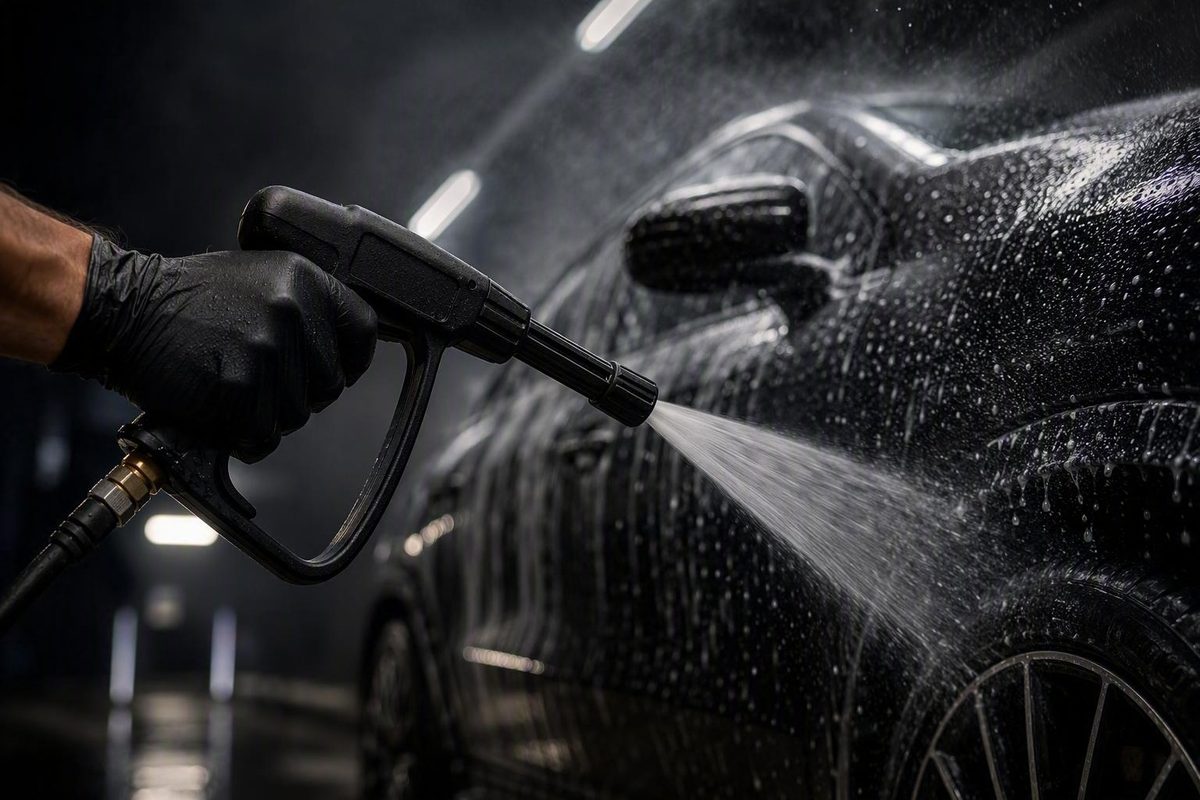
The phrase may describe a replacement pressure-washer trigger gun, an industrial or agricultural liquid gun, a garden-hose nozzle, or a pneumatic gun that atomizes coatings. These tools can use different pressure sources, fluid paths, connections, nozzles, and support equipment.
This guide is therefore a category and compatibility explainer—not a substitute for the manual, a manufacturer-approved parts list, or comprehensive high-pressure safety guidance. Start by identifying what you will spray, where the pressure comes from, and what surface you will treat. Then map the system from pump or compressor to nozzle and have the manufacturer confirm pressure, flow, temperature, fittings, materials, and accessory compatibility.
Related: Spray Nozzles Set Pressure and Coverage.
First identify what “high pressure spray gun” means for your job
Use this four-path selector before comparing models:
- Powered pressure-washer trigger gun: Choose this category for pressurized-water cleaning when a pressure washer or separate pump supplies the water. The gun normally sits between a high-pressure hose and a lance, nozzle, or compatible accessory.
- Industrial or agricultural liquid-spray gun: Choose this for high-flow water or a documented compatible liquid supplied by a pump. Products in this category may have pipe-thread or hose connections, long extensions, adjustable patterns, or specialized shutoff controls.
- Garden-hose nozzle or foam gun: Choose this for lower-pressure rinsing or soap application from a domestic water supply. “High pressure” in a product name does not establish pressure-washer-equivalent output.
- Pneumatic coating gun: Choose this for atomizing paint, stain, primer, or another approved coating with compressed air. Selection depends on the compressor, feed system, coating, and nozzle.
These categories overlap in search results because sellers use similar language, but they are not interchangeable. A pneumatic coating gun must match compressor airflow and pressure, fluid feed, coating requirements, and nozzle size.
For example, RONGPENG describes its 4001G as a gravity-feed coating gun with a paint cup. Its listed operating pressure is 3.0–4.0 bar, air consumption is 4.6–7.1 CFM, and its standard fluid nozzle is 1.4 mm. Those specifications identify a compressor-fed coating system, not a replacement pressure-washer trigger gun. See the manufacturer’s 4001G description and specifications.
These are published manufacturer limits rather than independent performance results, but they illustrate how different an industrial pumped-liquid gun can be from a pneumatic coating gun. Review the GunJet high-pressure range.
Garden-hose products create another source of confusion. A marketplace result may use “high pressure” in its title without publishing a PSI figure. In that case, the wording alone does not demonstrate equivalence to a powered pressure washer. A visible Amazon example was also marked as sponsored seller content, so it should be treated as marketing rather than independent test evidence. See the marketplace category and labeling.
Use three questions to route your purchase:
- What will be sprayed? Water, detergent, agricultural liquid, paint, stain, primer, or another coating?
- What supplies the pressure? Domestic plumbing, a pressure-washer pump, an industrial pump, or an air compressor?
- What receives the spray? Vehicle paint, concrete, machinery, vegetation, fencing, furniture, or a coating substrate?
Only after answering those questions should you compare individual guns.
Map the complete spraying system before choosing the gun
A spray gun is one component in a chain.
For a pressure-washer or pumped-liquid system, map the assembly in this order:
Pressure washer or pump → high-pressure hose → trigger gun → lance or extension → nozzle → optional foam cannon or accessory
For a coating system, the chain is different:
Compressor → regulator and suitable air line → gun air inlet → trigger and controls → cup or pressure feed → fluid nozzle and air cap → coating
Write down the specifications of the equipment you already own before shopping.
For a water or pumped-liquid system, record:
- Washer or pump make and exact model
- Maximum rated output
- Rated operating flow
- Maximum permitted fluid temperature
- Hose rating and both hose-end connections
- Required gun inlet and outlet
- Lance or extension interface
- Nozzle interface and required orifice
- Quick-connect size, profile, and orientation, if applicable
- Intended spray medium
- Desired accessories, such as a foam cannon, swivel, or extension
For a pneumatic coating system, also record:
- Compressor-delivered airflow at the required pressure
- Air fitting and hose requirements
- Gravity, suction, or pressure feed
- Cup or pressure-pot capacity
- Standard and optional fluid-nozzle sizes
- Coating type and viscosity requirements
- Coating-maker instructions
Treat fitting labels as exact purchasing identifiers
Listings may use labels such as FPT, MPT, NPT, BSPT, HB, GHT, or a nominal quick-connect size. Do not treat these labels as interchangeable or assume that the same nominal inch measurement proves two components will mate.
The supplied product listings use several different connection descriptions but do not establish universal compatibility between them. The safest purchasing process is to compare exact manufacturer part numbers, dimensional specifications, and approved connection diagrams.
An adapter may allow two parts to connect physically. That does not establish that the resulting assembly has compatible:
- Thread standards
- Pressure and flow ratings
- Temperature limits
- Seal and body materials
- Spray-medium approval
- Lance, nozzle, or accessory requirements
Use an adapter only when the manufacturers responsible for the connected equipment confirm the complete assembly.
Fill-in compatibility worksheet
Take this worksheet to the manufacturer or retailer:
| Item | Your system |
|---|---|
| Existing machine make and model | |
| Pressure source | Pump / pressure washer / compressor / garden hose |
| Maximum rated output | |
| Rated liquid flow or compressor airflow | |
| Maximum fluid temperature | |
| Existing hose rating | |
| Hose connection at gun | |
| Required gun inlet | |
| Required gun outlet | |
| Desired lance or extension | |
| Lance connection | |
| Nozzle or quick-connect system | |
| Required nozzle orifice | |
| Spray medium | |
| Required body and seal compatibility | |
| Required reach | |
| Desired accessory | |
| Manufacturer confirmation or reference |
Photographs of the existing hose ends and lance can help identify the arrangement, but they do not replace model numbers, connection specifications, or written manufacturer confirmation.
Read pressure, flow, nozzle, and distance as one system
Maximum rated pressure is a model-specific ceiling. It is not a target setting, a measure of cleaning quality, or proof that a gun fits a particular pump.
Spray behavior depends on several interacting variables:
- Pump pressure
- Flow rate
- Nozzle-orifice size
- Fan angle or adjustable pattern
- Distance from the surface
- Angle of incidence
- Time spent over one area
- Surface material and condition
The model-specific nature of pressure limits is clear in the GunJet catalog: the AA30A is listed at 1,500 PSI, AA60 at 2,500 PSI, AA70 at 5,000 PSI, AA80 at 3,000 PSI, and PW4000A and PW4000AS at 4,000 PSI. The same manufacturer reports flow capacities of 5–10 GPM across the range. These figures are catalog limits, not evidence that the highest-rated model is the best choice for every pump or task. See the model-by-model GunJet ratings.
The nozzle then affects how that output is delivered. A wide fan distributes water over more area, while a narrow pattern or concentrated stream focuses it into a smaller area. Surface suitability cannot be determined from fan angle alone because distance, flow, pressure, dwell time, and surface condition remain relevant.
Also distinguish between two nozzle systems:
- Adjustable mist-to-stream design: The user changes the pattern through a control built into the gun or nozzle.
- Interchangeable fixed-angle tips: The user changes removable nozzles to select a different angle or orifice.
Adjustability can be convenient when moving between tasks. Fixed tips can make the selected configuration easier to identify.
For additional context on how fan patterns and foam attachments differ, see this overview of spray nozzles for car cleaning. Always defer to the current instructions for the specific washer, gun, lance, and nozzle being assembled.
Be cautious with seller pages. A large PSI number in a product name may describe only a component ceiling. A page titled “spray gun” may primarily show specifications for complete pressure washers. Neither presentation establishes the gun’s normal operating setting or its compatibility with your machine.
Choose fittings, construction, reach, and controls for the task
Once the operating category and essential compatibility are settled, compare physical features.
| Feature | What to verify | Why it matters |
|---|---|---|
| Inlet and outlet | Exact type, standard, size, and orientation | Determines whether the hose and lance connect correctly |
| Gun length | Overall and functional reach | Affects access and handling |
| Construction | Documented body and wetted materials | Helps determine whether the model fits the intended application |
| Weight | Complete operating weight, where available | Influences fatigue and control |
| Pattern control | Adjustable pattern or fixed-nozzle system | Determines how spray patterns are selected |
| Swivel | Location, rating, and serviceability | May help with hose management |
| Trigger lock | Intended locking function and operation | Affects handling and storage procedures |
| Shutoff | Documented valve behavior | Matters for controlled spraying |
| Extensions | Approved lengths and interfaces | Adds reach when the system supports them |
| Replaceable parts | Nozzles, seals, valves, filters, and triggers | Affects serviceability |
| Temperature rating | Maximum approved fluid temperature | Essential for heated-liquid systems |
| Fluid compatibility | Body, seals, valve, hose, and fittings | Essential for detergents and treatment liquids |
Retail listings demonstrate the available variation without proving comparative performance. Examples include a 7.25-inch adjustable Hypro gun, 17- and 21-inch Hypro versions, and TeeJet GunJet configurations from 13 to 24 inches. The same retailer lists a 2.5-pound brass TeeJet AA2A and a 1-pound aluminum AA2A-AL. It describes the Valley SG-PC-025 with mist-to-stream adjustment, a no-drip shutoff, trigger lock, 2.5 mm orifice, and 800 PSI rating. These are retailer-reported configurations and attributes, not independent test findings. Compare the listed dimensions, weights, connections, and features.
Reach can be useful for wheel wells, undercarriages, machinery, vegetation, or targets from which the operator needs additional distance. Extra length can also be less convenient in a confined space and can change leverage and handling. Choose it for a defined access problem rather than assuming longer is always better.
Interpret material descriptions narrowly. A listing that mentions brass, aluminum, nylon, or stainless steel establishes only the stated construction. Obtain current documentation for every wetted component.
Spraying Systems Co. identifies the PW4000AS as the swivel-equipped GunJet model and lists extensions, adapters, and swivel connectors as available accessories. Confirm that an accessory is approved for the exact gun and complete system before installation.
Before paying extra for a material or control feature, request documentation covering:
- Seal and wetted-part materials
- Approved fluids
- Maximum temperature
- Replacement seals, valves, triggers, and nozzles
- Inspection and service procedures
- Shutdown and depressurization instructions
- Storage and winterization requirements
Match the gun category to the application
Use application fit—not the largest PSI number—as the primary filter.
| Application | Pressure source | Spray medium | Essential specifications | Useful features | Primary mismatch risk |
|---|---|---|---|---|---|
| Vehicle and household pressure washing | Powered pressure washer | Water and approved detergent | Pressure and flow rating, temperature, hose inlet, lance outlet, nozzle interface | Wide-nozzle support, swivel, manageable length, foam-cannon support | Proprietary connections or excessive concentration on sensitive surfaces |
| Industrial high-flow spraying | Pumped system | Water or documented compatible fluid | Model pressure ceiling, flow capacity, inlet/outlet, temperature, approved medium | Long reach, swivel, approved extensions, serviceable valve | Choosing by PSI while overlooking flow, fittings, or fluid compatibility |
| Lawn care or pest control | Agricultural or transfer pump | Approved treatment liquid | Fluid and seal compatibility, inlet, orifice, shutoff, flow, reach | Trigger lock, adjustable pattern, longer wand | Assuming intended use proves compatibility with every chemical |
| Garden and light washing | Domestic water supply | Water or hose-compatible wash solution | Hose connection, supply requirements, pattern control | Simple shutoff, adjustable pattern, low setup burden | Assuming “high pressure” means pressure-washer output |
| Coating application | Air compressor | Paint, stain, primer, or approved coating | Feed type, nozzle size, airflow, pressure, cup capacity, coating requirements | Pattern and fluid controls, alternate nozzle sets | Buying a coating gun as though it were a water-cleaning gun |
Vehicle and household cleaning
For a replacement pressure-washer gun, prioritize the washer model, hose and lance interfaces, rated pressure and flow, maximum temperature, and nozzle support. A compact gun may be easier to handle around a vehicle, but it must still accept the existing hose and an approved lance or nozzle system.
For broader household cleaning, decide whether one compatible gun with interchangeable lances will cover the work or whether delicate and heavy-duty tasks need different setups. A longer wand or narrower nozzle is not automatically more effective.
Industrial high-flow spraying
Start with the pump’s documented output and the required operating flow. Then select a gun whose manufacturer confirms the applicable pressure, flow, connections, temperature, fluid, and nozzle arrangement.
The range of ratings within a single industrial product family shows why model selection must be specific. A maximum PSI figure alone does not tell you whether the gun will pass the required flow, accept the intended nozzle, tolerate the fluid temperature, or connect to the rest of the system.
Lawn care and pest control
Verify every wetted material and seal against the exact treatment liquid. Also confirm the inlet, hose retention method, orifice, shutoff design, desired pattern, and reach. A retailer’s description of a gun as suitable for lawn care or pest spraying does not demonstrate compatibility with every treatment chemical.
Paint and coatings
A coating gun is selected according to feed type, coating requirements, fluid-nozzle size, compressor-delivered airflow, and cup or pressure-feed capacity. RONGPENG’s 4001G illustrates how these specifications are presented: a 1.4 mm standard nozzle, optional 1.8 and 2.0 mm nozzles, 4.6–7.1 CFM air consumption, and a 600 cc cup. Review the listed 4001G coating-gun specifications.
Check those requirements against the coating maker’s instructions and the compressor’s delivered output at the required pressure—not merely tank size or a headline compressor rating. Pressure-feed catalogs also include HVLP, conventional, pressure-reduced, and specialty designs, reinforcing that “paint gun” is itself a broad category. See examples of pressure-feed coating-gun categories.
Coating work requires a separate setup and safety process. The available evidence is not sufficient to prescribe ventilation, respiratory protection, grounding, ignition control, flammability precautions, or solvent handling. Follow the coating safety data, gun manual, compressor instructions, and applicable workplace requirements.
Do not compare prices across these categories as though the products perform the same job. Configurations vary, prices and availability change, and some retailer pages display paired prices without explaining what each amount represents. Verify the current payable amount, selected configuration, and included parts directly with the seller. Check the current retailer listings rather than relying on an undated price comparison.
Use a high-pressure spray gun cautiously on a vehicle
The following is limited, general starting guidance. It is not a comprehensive high-pressure safety procedure and does not establish universally safe settings. The pressure-washer manual, gun and nozzle instructions, vehicle condition, and guidance for fresh repairs or aftermarket coatings take priority.
Before use:
- Read the equipment manual.
- Inspect the visible condition of the gun, hose, lance, couplers, and nozzle.
- Secure connections according to the equipment instructions.
- Wear eye protection, waterproof gloves, and non-slip footwear.
- Keep children, pets, and unnecessary bystanders away from the work area.
- Confirm that the vehicle’s windows, doors, hood, and trunk are closed.
- Inspect paint, trim, badges, seals, sensors, vents, and repaired areas.
General vehicle guidance recommends reading the manual, wearing eye and hand protection, using non-slip footwear, starting with a wider fan, and keeping the spray moving. One cited guide identifies 25- or 40-degree patterns as general vehicle-cleaning options and advises against a concentrated 0-degree nozzle on painted bodywork. These are general recommendations, not universal guarantees of safety. Review the vehicle pressure-washing precautions.
A cautious wash sequence is:
- Inspect the vehicle and equipment. Look for peeling paint, chips, loose trim, damaged seals, fresh bodywork, exposed wiring, or known leaks.
- Begin from a conservative distance. Use a wide fan and assess the result before moving closer.
- Pre-rinse. Remove loose contamination without dwelling on one area.
- Apply a compatible detergent or foam if desired. Follow its dilution and dwell instructions, and do not let it dry.
- Agitate when necessary. Foam coverage alone may not remove bonded contamination.
- Rinse from the top downward. Keep the spray moving.
- Dry promptly with a suitable clean drying material.
Use additional restraint around:
- Aging, chipped, cracked, peeling, or poorly bonded paint
- Loose moldings, emblems, decals, or badges
- Window, door, lamp, roof, and convertible-top seals
- Cameras, parking sensors, radar covers, and exposed connectors
- Grilles, vents, and openings where water could be driven inward
- Fresh paint, body filler, wraps, film, or recent repairs
- Rust-prone, known-leaky, classic, or partially restored vehicles
Increase distance, reduce force, choose a gentler tool, or avoid pressure washing the area. Do not hold a concentrated stream in one place to work on a stain. Stop if paint, trim, seals, badges, or attachments move, lift, flutter, leak, or show distress.
Why there is no universal safe distance or PSI
Published commercial guidance conflicts. One general article suggests approximately 12–18 inches, while Chemical Guys recommends beginning 4–5 feet away and moving to about 3 feet only if more force is needed. Chemical Guys also gives a general vendor guideline of 1,200–1,900 PSI for vehicle exteriors. None of those figures is a validated universal limit; suitability still depends on output, flow, nozzle, angle, surface condition, seals, accessories, and machine behavior. Review the commercial pressure and distance recommendations.
The conservative response is not to average conflicting figures. Begin farther away with a wide fan, test an inconspicuous sound area, keep the gun moving, and approach only when the result is inadequate and the equipment instructions permit it.
Decide whether you need a foam cannon, foam gun, hose nozzle, or pressure washer
These tools solve overlapping but different problems:
- Foam cannon: Connects to a compatible pressure washer and mixes pressurized water, soap solution, and air.
- Foam gun: Generally connects to a garden hose and applies a soap-and-water mixture at available hose pressure.
- Hose nozzle: Provides rinsing and selectable patterns from domestic water pressure.
- Pressure washer: Supplies powered water pressure and accepts a compatible trigger gun, lance, nozzle, and potentially a foam cannon.
Foam cannons commonly provide controls for foam output, spray width, and pattern orientation. Use soap labeled for the equipment and mix it according to the soap maker’s directions. Do not substitute forum dilution recipes for product instructions.
Foam can improve detergent coverage and dwell time. Available evidence does not establish that visually thicker foam alone cleans better or that it reliably replaces contact washing. Accessible or replaceable internal mesh filters can also be a useful maintenance feature when comparing foam cannons. Read the foam-cannon operating overview.
Use the task to choose the equipment:
| Need | Practical starting choice |
|---|---|
| Light maintenance wash with minimal setup | Garden hose and suitable nozzle |
| Hose-applied soap before hand washing | Hose-end foam gun |
| Dense foam with an existing compatible pressure washer | Foam cannon |
| Mud, salt, bugs, wheels, or wheel wells | Pressure washer may be more useful |
| Sensitive, leaky, rust-prone, or compromised vehicle | Gentler hose or low-pressure method may be preferable |
| Limited storage or low tolerance for setup and noise | Hose-based setup |
| Frequent heavy cleaning beyond the vehicle | Pressure washer may justify the extra equipment |
Forum participants report that pressure-washer cannons produce thicker, longer-clinging foam than hose-end guns, but that comparison is anecdotal rather than controlled evidence. The same discussions generally indicate that foaming does not eliminate the need for hand washing. See the foam-cannon and hose-end foam-gun discussion.
Users also disagree about whether a pressure washer is worthwhile for routine washing. Some value it for mud, salt, bugs, wheels, and wheel wells; others prefer the lower setup burden of a garden hose. Noise, storage, hose and cable management, and setup time can influence the decision. These are user preferences, not comparative performance findings. See the detailing-community discussion of pressure washers and regular sprayers.
Do not assume that pressure washing saves water without comparing the actual flow rates and operating times of the two setups.
For a foam cannon, verify:
- Pressure-washer connection
- Required pressure and flow range
- Orifice compatibility
- Bottle and fitting materials
- Soap instructions
- Access to the internal mesh filter
- Availability of seals, bottles, orifices, and connectors
Run a final safety, compatibility, and evidence check before buying
Use this checklist before placing an order:
- [ ] Correct equipment category
- [ ] Intended spray medium identified
- [ ] Pump or compressor requirements met
- [ ] Gun maximum pressure suitable for the system
- [ ] Required flow or airflow supported
- [ ] Maximum fluid temperature verified
- [ ] Hose pressure, flow, and temperature ratings verified
- [ ] Inlet and outlet labels match exactly
- [ ] Thread or connection family confirmed
- [ ] Quick-connect profile and orientation confirmed
- [ ] Lance or extension interface confirmed
- [ ] Nozzle interface and orifice confirmed
- [ ] Body and seal compatibility confirmed for the fluid
- [ ] Reach and operating weight suitable
- [ ] Trigger, shutoff, lock, and swivel fit the task
- [ ] Accessories approved for the exact model
- [ ] Replacement parts available
- [ ] Inspection, shutdown, service, and storage documentation available
Do not rely on the gun rating alone.
Before use, inspect the visible condition of the gun, hose, connections, lance, and nozzle. Follow the manufacturer’s procedures for shutdown, depressurization, nozzle changes, maintenance, and storage; general commercial guidance also recommends regular inspection of the gun, hose, and nozzles. Review the cited general inspection and maintenance guidance.
This article does not provide a complete injury or emergency-response protocol. Keep unnecessary bystanders clear and control the direction of the gun before pressurizing the system.
Weigh the evidence correctly
Different source types answer different questions:
- Manufacturer documentation can establish published model ratings, dimensions, connections, accessories, and operating requirements.
- Retailer listings can show available configurations and displayed prices, but may omit critical technical details.
- Seller claims and sponsored placements are marketing evidence rather than independent verification.
- Forum reports can reveal setup annoyances and preferences but do not establish safe limits or comparative performance.
- General how-to articles can offer starting practices but do not override equipment or vehicle instructions.
The available evidence contains no independent head-to-head testing of these gun categories. A responsible choice must therefore be based on application fit and documented compatibility rather than a universal ranking.
Send these questions to the manufacturer before ordering:
- Will this exact gun model accept my hose and lance without an unapproved adapter?
- Are the gun, couplers, lance, nozzle, and accessories all rated for my pump’s maximum output and permitted fluid temperature?
- Is the intended water, detergent, agricultural liquid, or coating compatible with the body, valve, seals, hose, and fittings?
- Which nozzles, swivels, extensions, seals, and replacement parts are approved?
- Which shutdown, depressurization, inspection, maintenance, and storage procedures apply?
The durable decision rule is category first: identify the spray medium and pressure source, map every component from pump or compressor to nozzle, and buy only after the manufacturer confirms pressure, flow, temperature, fitting, and material compatibility. For vehicle use, favor a wide fan, conservative distance, continuous movement, and restraint around compromised surfaces. The right gun is not the one with the largest PSI number; it is the one documented to fit the complete system and intended task.
Frequently asked questions
Can I connect any replacement spray gun to any pressure washer?
No. Match the washer’s maximum pressure and flow, permitted fluid temperature, hose connection, gun inlet, gun outlet, lance interface, and nozzle or quick-connect system. Proprietary interfaces may also matter.
A higher pressure rating alone does not prove compatibility. Confirm the complete assembly with the equipment manufacturers.
Is a higher maximum PSI rating always better?
No. Maximum PSI is a component ceiling, not a recommended setting or performance score. The correct gun must support the pump’s documented pressure and flow while matching its temperature, fittings, lance, nozzle, and spray medium.
Spray behavior also depends on flow, nozzle orifice, fan angle, working distance, dwell time, and surface condition. Excess pressure capacity provides no automatic benefit if another part of the system is incompatible.
What nozzle angle should I use to wash a car?
A 25- or 40-degree fan is commonly suggested as a general starting pattern for vehicle bodywork, while a concentrated 0-degree nozzle is discouraged on painted panels. These are general commercial recommendations rather than universally safe settings. See the vendor’s nozzle-angle guidance and qualifications.
Start from a conservative distance, test an inconspicuous sound area, keep the spray moving, and adjust for the washer’s output and the condition of the paint, trim, seals, repairs, and coatings. No nozzle angle makes every pressure and distance safe.
What is the difference between a foam cannon and a foam gun?
A foam cannon generally connects to a compatible pressure washer and mixes pressurized water, soap solution, and air. A foam gun generally connects to a garden hose and works at the available hose pressure.
Forum users often report thicker, longer-clinging foam from pressure-washer cannons, but that is anecdotal rather than controlled evidence. Foam can improve detergent coverage and dwell time; foam thickness alone does not prove better cleaning or eliminate the possible need for contact washing.
Is a pneumatic paint spray gun the same as a high-pressure water spray gun?
No. A pneumatic paint gun uses compressed air to atomize a coating and must be selected for compressor airflow, feed type, coating requirements, nozzle size, and material instructions. A high-pressure water or liquid gun handles pump-fed fluid and must match pressure, flow, temperature, hose, lance, nozzle, and wetted-material requirements.
The categories can share the phrase “high pressure spray gun,” but their operating regimes, fluid paths, fittings, support equipment, and safety requirements are materially different.