
When Wheel Acid Is Justified—and When to Walk Away
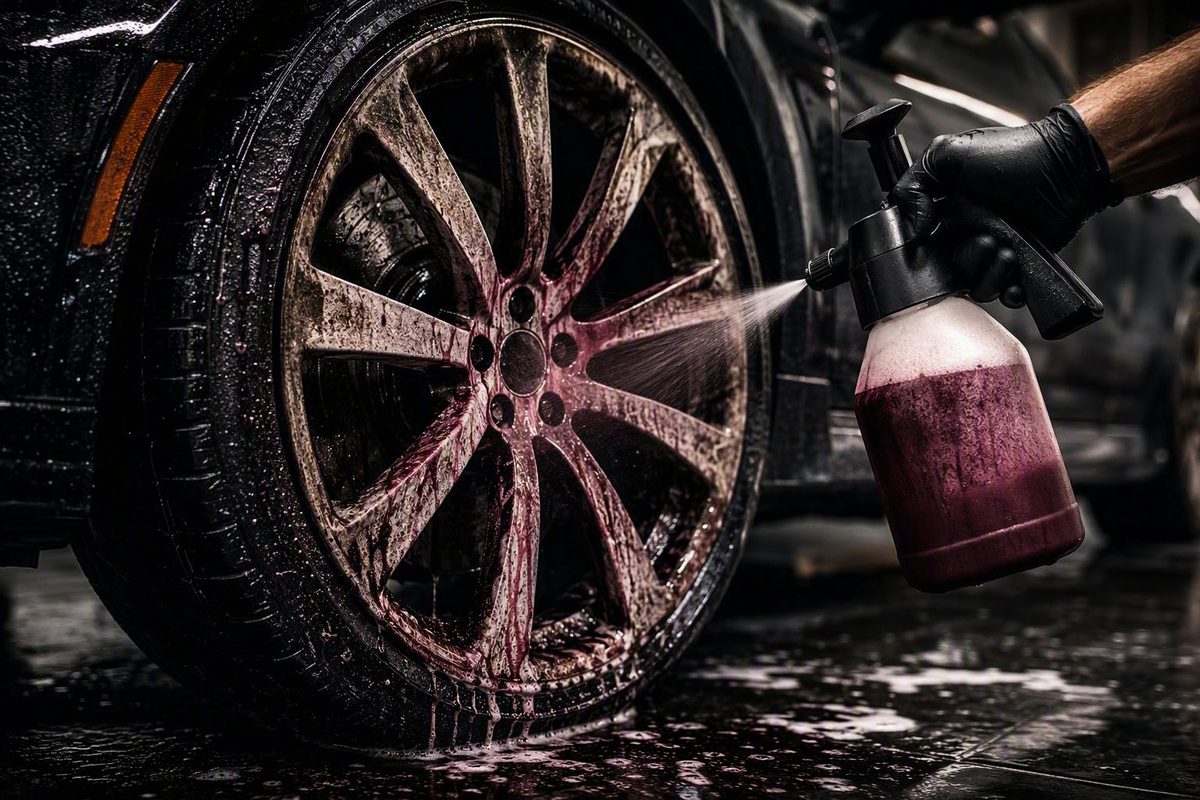
The short answer: use acid only for the right deposit on a known, compatible finish
Reserve acid wheel cleaner for severe or neglected contamination that an appropriate gentler cleaner has not removed—and only when the exact product permits use on the wheel’s known, intact finish.
Acid wheel cleaners are marketed primarily for stubborn deposits such as baked-on brake dust, oxidation, rust staining, iron residue, road salt, hard-water scale, and other mineral buildup. They are corrective products for difficult contamination, not the default choice for every wheel wash.
Maintained wheels with loose dirt or moderate brake dust usually do not justify starting with acid. Car shampoo, a finish-compatible neutral wheel cleaner, or another acid-free formula may remove the soil with fewer acid-related compatibility concerns. If the residue is oily or greasy, a compatible detergent or degreaser may be a better chemical match. In a detailing-forum discussion, named contributor Mike Phillips distinguishes acid’s usefulness against brake dust from the action of detergents against oily road grime; that is practitioner guidance, not controlled comparative testing (Auto Geek discussion).
Acid is therefore not automatically the strongest or best answer for every type of dirt.
Make the decision using three variables:
- Contaminant type: Is the residue loose soil, grease, bonded metallic brake dust, oxidation, rust staining, or mineral scale?
- Wheel finish and condition: What material is exposed, what coating or treatment is present, and is that protective layer intact?
- Exact product instructions: Does the current label permit that finish, and can you satisfy its dilution, dwell-time, protective-equipment, ventilation, rinsing, storage, first-aid, and disposal requirements?
Do not let marketing language replace those checks. A cleaner described as “safe,” “mild,” or “light acid” may still be labeled corrosive, carry significant exposure warnings, or exclude specific finishes. The category name does not identify the acid, concentration, complete formulation, or surfaces the product can safely contact.
Decision rule: If an appropriate gentler cleaner has not been tried, the finish is uncertain, the coating is damaged, or the exact product does not expressly permit the surface, do not use acid.
Match the cleaner to the contamination before escalating
The useful comparison is not simply acid versus non-acid. Wheel contamination includes different materials, and cleaner selection should begin with the soil that is actually present.
| What is on the wheel? | What it may look or feel like | Sensible starting cleaner | When to escalate |
|---|---|---|---|
| Loose dust, mud, and ordinary wash soil | Light film that rinses or wipes away readily | Car shampoo or a finish-compatible neutral wheel cleaner | Escalation is usually unnecessary if routine cleaning works |
| Oily road film or grease | Slick or smeary residue, often concentrated in recesses | Finish-compatible detergent or degreaser | Use stronger degreasing chemistry only if its label permits the finish |
| Fresh or moderate brake dust | Gray or brown surface film that has not become heavily bonded | Shampoo, neutral wheel cleaner, or compatible acid-free cleaner | Consider a finish-compatible iron-reactive product if metallic residue remains |
| Bonded metallic brake dust or iron fallout | Rough speckling or deposits that remain after washing | Finish-compatible iron remover or acid-free wheel cleaner | Consider acid only if contamination remains severe and the exact label permits the finish |
| Baked-on brake dust, rust staining, or oxidation | Hard deposits or persistent brown and rusty staining | Least aggressive compatible product likely to work | A label-approved acid cleaner may be considered on a known, intact finish |
| Road-salt or mineral scale | Crusty, chalky, or spot-like deposits | Compatible mineral-deposit cleaner, starting with the gentlest suitable option | Consider acid only when scale remains and the exact product permits the surface |
| Tar or adhesive-like contamination | Dark, sticky spots that smear rather than dissolve in wash solution | Product specifically labeled for tar or adhesive residue | Do not assume wheel acid is the appropriate solvent |
This supports a practical escalation ladder:
- Shampoo or a compatible neutral cleaner
- A soil-specific detergent, degreaser, iron remover, or other acid-free cleaner
- Acid only when the remaining deposit and exact product compatibility justify it
Iron-reactive and other acid-free cleaners are commonly presented as intermediate options for metallic contamination. Their compatibility still depends on the particular formula and finish. Detailing-forum users also disagree about how well such products perform on severely neglected wheels, so anecdotal reports do not establish that one category is consistently faster, safer, or more effective (Auto Geek wheel-cleaner discussion).
The same evidence limitation applies to claims that acid is always stronger or quicker. Most available comparisons come from sellers promoting their own products or from personal detailing experience. Those sources help describe intended uses, but they do not provide controlled rankings of cleaning performance or material safety.
Regular cleaning can change the decision. Removing brake dust while it remains a manageable surface film may allow routine shampoo or a compatible neutral cleaner to work. Letting deposits accumulate until they are heavily bonded can turn maintenance cleaning into a more difficult correction.
Identify the wheel finish—and inspect its condition—before choosing acid
Finish identification is a prerequisite. “Alloy wheel” describes neither the surface the cleaner will contact nor the condition of its protective coating.
Ask three separate questions:
- What is the underlying material?
- What coating, paint, plating, or treatment covers it?
- Is that protective layer intact everywhere?
Across the supplied product directions and commercial guidance, repeatedly excluded or high-risk surfaces include:
- Raw or bare metal
- Polished aluminum
- Uncoated aluminum
- Anodized aluminum
- Exposed aluminum
- PVD finishes
- Matte finishes
- Magnesium
This is not a universal exclusion list for every formula. It demonstrates why a universal list of “acid-safe wheels” would be unreliable: one product may claim compatibility with a finish that another expressly prohibits.
Chrome, painted, powder-coated, custom-coated, clear-coated, and factory-finished wheels must also be treated as label-dependent. One commercial guide presents intact factory clear-coated wheels as possible candidates for occasional acid cleaning while excluding raw, polished, anodized, and uncoated wheels. That is seller guidance, not proof that every factory finish tolerates every acid cleaner (Jimbo’s acid-versus-non-acid guide).
Condition matters as much as nominal finish type. Inspect for:
- Curb rash
- Stone chips
- Deep scratches
- Peeling or lifting clear coat
- Corrosion around lug recesses or the valve stem
- Previous refinishing or spot repairs
- Cracks or damage around the rim
- Abraded spoke edges
- Metal exposed beneath paint or coating
A wheel that is mostly clear-coated or painted may still have vulnerable points where the substrate is exposed.
If the finish is uncertain, check available wheel specifications, purchase or refinishing records, or ask the wheel manufacturer or a qualified refinisher. Do not identify compatibility from appearance alone.
Before use, confirm all of the following:
- [ ] The wheel is cool.
- [ ] The underlying material and visible finish are known.
- [ ] The coating appears intact.
- [ ] No exposed substrate is visible.
- [ ] Previous repairs or refinishing are understood.
- [ ] Nearby sensitive surfaces can be avoided or protected as the label requires.
- [ ] The current product label explicitly permits the finish.
- [ ] The product instructions and current safety data sheet are available.
- [ ] A small test area can be observed and rinsed immediately.
Stop rather than proceeding if:
- The finish is unknown.
- The coating is chipped, peeling, deeply scratched, or visibly corroded.
- Bare metal is exposed.
- The wheel manufacturer and cleaner seller provide conflicting guidance.
- Instructions or safety documentation are missing.
- The product excludes the finish.
- A test area changes color, gloss, or texture.
Acid wheel cleaners are not interchangeable
Commercial products differ in acid chemistry, concentration, dilution, dwell time, exclusions, and intended user. The comparison below is not a ranking or recommendation. It records information supplied on the sellers’ product pages; the evidence pack does not include independently verified current labels or safety data sheets, so the entries should not be treated as complete safety documentation.
| Product | Format | Disclosed chemistry | Seller-stated dilution | Wheel dwell | Prohibited finishes or surfaces | Hazard statement or controls | Professional-use restriction |
|---|---|---|---|---|---|---|---|
| Nanoskin Heavy Duty Acid Aluminum Brightener & Wheel Cleaner | Concentrate | Hydrofluoric acid and sulfuric acid listed | 1 part product to 4 parts water; add product to water | No more than 30 seconds | PVD, anodized, and polished uncoated aluminum | Acid-resistant gloves, protective clothing, eye and face protection, and controlled ventilation specified | Seller limits use to professional automotive, fleet, industrial, and commercial settings; not for consumer or household use |
| Allbrite Safe Wheel Acid | Ready to use | Acids acknowledged but not identified | Use as supplied; do not dilute | Not stated on supplied page | No finish-specific exclusions stated; seller makes a broad compatibility claim | Labeled corrosive; seller acknowledges that aluminum may become hazy or white | None stated |
| MAD ACID | “Light-acid” formula | Acid identity and concentration not disclosed | No wheel-dilution ratio stated | 15–20 seconds | Raw aluminum, bare metal, matte finishes, and aluminum-alloy finishes | Eye and skin protection required; page reproduces a fatal-if-ingested warning | None stated |
| Car Candy Superbrite Heavy Duty Wheel Acid | Concentrate | Hydrofluoric acid disclosed | 1:5 for heavy oxidation, rust, and salt corrosion; 1:10 for brake dust and stubborn road grime | 30–60 seconds | Glass, hot surfaces, polished aluminum, and uncoated or anodized wheels | Hydrofluoric-acid warning and caution stated; detailed PPE is not supplied on the page | Sold only to professionals |
The procedural differences are substantial:
- Nanoskin directs users to pre-rinse a cool surface, use its specified mixing order, prevent drying, and rinse thoroughly.
- Allbrite says to use its product undiluted, making it a direct counterexample to the assumption that every wheel acid should be diluted.
- MAD Detailing directs users to wet the wheel, apply evenly, wait briefly, rinse, and then wash with soap and water.
- Superbrite specifies task-dependent dilution, a cool surface, immediate thorough rinsing, and no drying.
Across these examples, seller directions range from ready-to-use application to mixtures of 1 part product with 4 parts water, 1:5, or 1:10. Stated wheel dwell times range from approximately 15 seconds to 60 seconds. Those differences demonstrate why a generic “wheel acid recipe” is indefensible.
Unsafe shortcuts include:
- Using a dilution remembered from another brand
- Assuming “light acid” permits a longer dwell
- Diluting a ready-to-use cleaner without instructions
- Applying a concentrate undiluted for extra cleaning power
- Copying another manufacturer’s mixing order
- Assuming all acid cleaners permit the same finishes
- Assuming the sales page contains every necessary safety instruction
Statements about removing contamination, brightening metal, restoring appearance, or reducing scrubbing are seller claims rather than independent test results. Customer ratings and reviews do not resolve differences in chemistry, compatibility, or exposure controls. The available evidence does not support ranking these products by cleaning power or safety.
Use a label-first workflow, not a universal acid-cleaning recipe
This is a verification workflow, not an application recipe. The current label and safety data sheet for the selected product must provide the operational details.
Step 1: Identify the contamination. Determine whether the wheel holds ordinary dirt, oily film, bonded metallic brake dust, rust staining, oxidation, or mineral scale. Before considering acid, establish that an appropriate gentler cleaner has been insufficient.
Step 2: Identify and inspect the finish. Confirm the underlying material, surface treatment, coating condition, and repair history. Inspect the rim lip, spoke edges, lug recesses, valve-stem area, center cap, and curb-damaged areas. Do not proceed if the coating is failing or the substrate is exposed.
Step 3: Verify exact compatibility. Read the current product label rather than relying on a retailer category, product name, old forum post, or generic online procedure. Confirm that the label permits the exact finish in its present condition.
Step 4: Obtain the documentation before opening or mixing. Check the product-specific dilution, mixing order, prohibited surfaces, application equipment, personal protective equipment, ventilation, dwell time, agitation, rinsing, first aid, storage, spill response, disposal, and runoff requirements. If that information is missing or unclear, do not improvise.
Step 5: Control the work area. Use the product only under the temperature, sunlight, and ventilation conditions its documentation permits. Several supplied seller directions require a cool surface and prohibit allowing the cleaner to dry. Working on one wheel at a time can make short, product-specific dwell periods easier to control.
Step 6: Apply only as directed. Pre-rinse if required. Use the specified dilution, mixing order, and application method. Agitate only when permitted, using a soft tool suitable for the finish. Approval for a wheel surface does not establish that the cleaner can contact tires, brake components, lug hardware, glass, paint, plastic, or emblems.
Step 7: Prevent drying and rinse completely. Follow the stated dwell time and rinse as directed. Include lug recesses, spoke intersections, the valve-stem area, seams, and other places where solution may collect. General commercial guidance also emphasizes cool wheels, one-wheel-at-a-time cleaning, prevention of drying, and thorough rinsing, but the selected product’s directions remain controlling (Carfidant wheel-cleaner guide).
Step 8: Inspect before continuing. After rinsing, look for whitening, hazing, staining, dullness, loss of gloss, or texture change. If any alteration appears, stop. Do not treat the remaining wheels while attempting to decide whether the change is harmless.
Never transfer a ratio, dwell time, mixing order, or post-rinse procedure from one formula to another. For example, Nanoskin’s direction to add its product to water belongs to that product. An optional post-rinse step suggested by one seller likewise does not establish a universal neutralization procedure.
Do not select a cleaner solely by pH. The supplied evidence does not establish that pH alone reveals the complete formulation, concentration, exposure controls, cleaning performance, or compatibility with a particular coating. Products with similarly low pH values may carry materially different instructions and exclusions.
Treat corrosive and hydrofluoric-acid products as a serious safety boundary
Words such as “safe,” “mild,” and “light acid” are marketing descriptions. They do not cancel a corrosive warning, finish exclusion, or exposure-control requirement.
Nanoskin’s seller page lists hydrofluoric acid and sulfuric acid and states that the cleaner is not intended for consumer or household use. It limits use to professional automotive, fleet, industrial, and commercial settings and specifies acid-resistant gloves, protective clothing, eye and face protection, and outdoor or well-ventilated controlled use. It also directs users to seek poison-center or medical assistance for specified exposure routes (Nanoskin product directions).
Car Candy identifies Superbrite as containing hydrofluoric acid and says it is sold only to professionals. Its sales page does not provide complete PPE, first-aid, or disposal instructions, which reinforces the need to obtain the current label and safety data sheet rather than treating the sales page as complete documentation (Superbrite product directions).
A generic instruction to “wear gloves and a mask” is not enough to replace product-specific documentation. The supplied evidence does not support one universal glove material, respirator, ventilation arrangement, or protective-clothing specification for every acid cleaner.
As a conservative editorial boundary for DIY work, do not proceed when:
- The product contains hydrofluoric acid.
- The seller restricts it to professional use.
- The current label or safety data sheet is unavailable.
- You cannot provide the eye, face, skin, clothing, ventilation, or respiratory controls specified for that product.
- The work area does not meet the product’s ventilation requirements.
- Mixing equipment or chemical compatibility is uncertain.
- Children, pets, or bystanders can enter the work area.
- You cannot prevent unintended contact with surrounding vehicle surfaces.
- You lack a product-compliant plan for spills, runoff, leftover solution, and contaminated tools.
This boundary is deliberately more conservative than a claim that every acid product presents the same hazard. It reflects the limits of the available documentation and the consequences of improvising with corrosive or professional-only products.
Exposure response is not the place for a generic internet remedy. Follow the emergency directions for the exact product and contact emergency medical or poison-control resources when its label or safety data sheet directs you to do so. Do not substitute a home neutralization method, improvised topical treatment, or first-aid instructions taken from a different formula.
The available evidence does not support universal instructions for disposal, runoff neutralization, respirator selection, glove material, or first aid. Those decisions must come from the current product documentation and applicable local requirements.
If those requirements cannot be met confidently, choose a different cleaner or hire an appropriately equipped professional.
What to do if the wheel turns white, hazy, dull, or etched
If the wheel changes color, gloss, or texture during treatment, stop applying the cleaner and rinse the affected area thoroughly according to the product directions.
Whitening, hazing, dulling, staining, or visible etching should be treated as a warning that the surface may have been altered—not as proof that the contamination has been removed. Do not continue around the wheel in an attempt to make the appearance even.
Allbrite acknowledges that treated aluminum may appear hazy or white and recommends using an aluminum or fine-metal polish. That is the seller’s recommendation for its own product; it is not independent evidence that polishing will reverse the alteration or be suitable for every wheel finish (Allbrite directions).
The appropriate response depends on the surface involved:
- Bare or polished metal may have visible alteration at the exposed surface.
- Paint or clear coat may show staining, dullness, or damage concentrated at chips and worn edges.
- Anodized surfaces have a treated finish and should not be approached as ordinary bare aluminum.
- Chrome, plating, and PVD are layered finishes that may expose a different underlying material if damaged.
- Matte finishes may undergo an unwanted gloss change if polished.
- Custom coatings and prior repairs may respond differently from an original finish.
Do not automatically polish anodized, plated, painted, matte, PVD, powder-coated, or clear-coated surfaces. The supplied evidence does not establish polishing as a universal repair.
Instead:
- Stop chemical application.
- Rinse thoroughly as the product directs.
- Do not reapply the acid.
- Do not introduce another chemical to neutralize or correct the appearance unless the product manufacturer specifically directs it.
- Photograph the affected area under consistent lighting.
- Record the product name, dilution, mixing method, dwell time, surface condition, wheel finish, and sequence of events.
- Seek finish-specific advice from the wheel manufacturer, a qualified wheel refinisher, or an experienced professional.
If alteration appears in a test area, do not treat the rest of the wheel. Passing a test cannot guarantee compatibility, but visible failure provides a clear stop condition.
If over-dwell or drying occurred, rinse immediately according to the label. Do not add more acid, a degreaser, or an improvised alkaline solution in an attempt to correct the appearance.
A safer long-term wheel-cleaning strategy
The long-term objective is not to discover the strongest cleaner a wheel can survive. It is to prevent contamination from reaching the point where aggressive corrective chemistry appears necessary.
Use the least aggressive finish-compatible method that removes the actual soil:
- For ordinary wash soil, start with shampoo or a compatible neutral cleaner.
- For greasy residue, use a finish-compatible detergent or degreaser.
- For bonded metallic contamination, consider a finish-approved iron-reactive or acid-free cleaner.
- Reserve acid for severe compatible deposits that remain after appropriate alternatives have been tried.
There is no universal wheel-cleaning interval supported by the evidence. Frequency should reflect:
- Mileage
- Brake-pad dust output
- Stop-and-go versus highway driving
- Wet weather and winter road salt
- Wheel design
- Finish type and condition
- How readily recesses can be rinsed and dried
A repeatable maintenance process is more useful than a rigid calendar:
- Let the wheels cool.
- Rinse away loose grit.
- Use shampoo or a compatible neutral cleaner.
- Clean with soft, dedicated wheel tools.
- Rinse recesses and hardware areas thoroughly.
- Inspect for chips, curb rash, corrosion, or coating failure.
- Address newly bonded contamination with a suitable soil-specific product before it becomes severe.
Use this final decision tree:
- Maintained wheel with ordinary soil? Use shampoo or a compatible neutral cleaner.
- Greasy or oily residue? Choose a finish-compatible detergent or degreaser.
- Bonded metallic brake dust? Try a compatible iron-reactive or acid-free cleaner.
- Unknown finish or damaged coating? Stop and identify or repair the surface.
- Severe mineral, rust, oxidation, or baked-on deposit remains? Consider acid only if the exact label permits the known, intact finish.
- Hydrofluoric acid, professional-only positioning, missing instructions, or controls you cannot provide? Defer to an appropriately equipped professional.
Avoiding unnecessary chemical strength is not a compromise in detailing quality. It is risk management. The relevant questions are whether the remaining deposit requires acid, whether the wheel can tolerate that exact formula, and whether every product instruction can be satisfied.
Can acid wheel cleaner be used on clear-coated wheels?
Sometimes, but not by category alone. The exact product must expressly permit clear-coated wheels, and the coating must be correctly identified and intact.
Inspect for curb rash, chips, scratches, peeling clear coat, corrosion, and previous repairs. Damage may expose a vulnerable substrate even when most of the wheel still appears clear-coated. If the label is unclear, the finish cannot be verified, the coating is damaged, or a test area changes appearance, do not proceed.
How long should acid wheel cleaner stay on a wheel?
There is no universal dwell time. The documented seller directions in the comparison above range from approximately 15 seconds to 60 seconds, while one supplied product page does not state a dwell time at all.
That is not a general safe range. Use only the current instructions for the exact product, prevent the cleaner from drying, and rinse when directed. Never extend dwell time because another brand permits it.
Is acid or non-acid wheel cleaner better for brake dust?
It depends on the severity of the contamination, the wheel finish, and the exact formula.
Shampoo, a neutral cleaner, or another acid-free wheel cleaner may be sufficient for fresh or routinely removed brake dust. A compatible iron-reactive cleaner can be an intermediate option for bonded metallic contamination.
Acid may be considered for severe baked-on brake dust when an appropriate gentler product has been insufficient and the exact acid cleaner permits the known, intact finish. Claims that one category is always faster, better, or safer are not supported by controlled comparative evidence in the supplied research.
What acids may be found in commercial wheel cleaners?
Commercial product pages and seller guides identify several possibilities, including hydrofluoric, sulfuric, hydrochloric, phosphoric, and citric acids. A product may contain one acid, multiple acids, or may be described only as acidic without disclosing its ingredients on the sales page. One commercial overview, for example, names hydrochloric, phosphoric, and sulfuric acids as possible ingredients in acid wheel cleaners (Autobrite overview).
Do not infer a product’s composition or hazard from its pH, name, or the phrase “wheel acid.” Check the current label and safety data sheet for the exact formula.
What should I do if acid cleaner makes a wheel white or hazy?
Stop applying the cleaner and rinse the affected area thoroughly according to the product directions. Do not treat whitening or haze as a normal sign of cleaning, and do not continue across the rest of the wheel.
Document the product, dilution, dwell time, finish, surface condition, and visible change. Do not automatically polish or apply a second chemical: the appropriate response differs among bare metal, paint, clear coat, anodizing, chrome, PVD, matte, and other treatments.
Seek finish-specific advice from the wheel manufacturer, a qualified refinisher, or an experienced professional.