
A Car Wash Water Softener Helps Washing—Not Spot-Free Drying
Learn when a car wash water softener is worthwhile, why it cannot guarantee a spot-free finish, and how to size a home wash-water system.
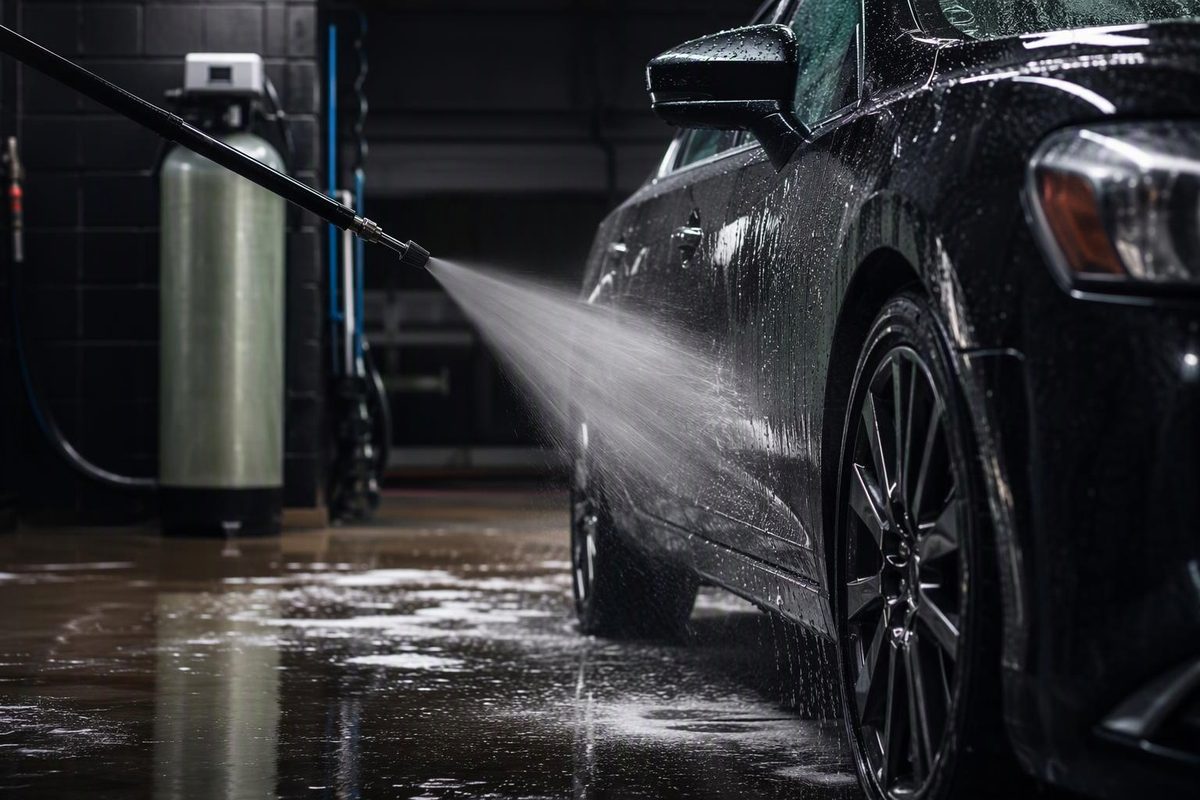
A car wash water softener can help when hardness minerals reduce cleaning efficiency or form scale in wash equipment. It is not the same as a spot-free rinse system.
A conventional sodium-cycle softener exchanges calcium and magnesium—the main hardness minerals—for sodium ions. It can reduce hardness to nearly zero, but it does not remove all dissolved material. That distinction determines whether you need a softener, a low-mineral final rinse or both.
Softened water versus spot-free water
| Treatment | What it changes | Useful car-wash role | Assume it can air-dry without spots? |
|---|---|---|---|
| Ion-exchange softener | Exchanges calcium and magnesium for sodium | Main wash, shampoo mixing and hardness-scale control | No |
| Reverse osmosis (RO) | Reduces total dissolved solids through a membrane | Low-mineral final rinse | No; residual soap or displaced tap water can still leave marks |
| Deionization (DI) | Reduces dissolved ions until its media is exhausted | Low-mineral final rinse, often where only a limited volume is needed | No |
| “Salt-free” conditioner | May change scale formation without removing calcium and magnesium | Scale control where the particular device is suitable | No |
University of Nebraska–Lincoln Extension classifies water containing 60–120 mg/L hardness as CaCO₃ as moderately hard, 120–180 mg/L as hard and more than 180 mg/L as very hard. It also explains that ion exchange removes calcium and magnesium by replacing them with sodium (UNL Extension).
Because the minerals are exchanged rather than all dissolved material being removed, softened water should not be treated as spot-free water. Commercial car washes commonly use low-TDS RO water for the final rinse because evaporation leaves dissolved solids behind. That rinse still has to displace the preceding water, and remaining soap can raise the solids left on the vehicle (Auto Laundry News).
Decide whether a softener addresses your problem
Test water from the tap that supplies the wash. White marks alone do not establish hardness, and a total-dissolved-solids meter does not replace a hardness test. Hardness testing is aimed at calcium and magnesium: drop-count titration produces a numerical result, while test strips are suitable when a general range is enough (Hach). See our guide to checking the right tap for hard water before sampling.
A softener may be easier to justify when:
- the wash-tap result is moderately hard or higher;
- mineral scale develops in nozzles, fittings or other wash equipment;
- cleaning performance remains poor after you confirm the shampoo’s dilution and method;
- you wash often enough to justify regeneration, salt and maintenance; or
- the manufacturer of a planned RO system specifies softened feed water.
Hardness can reduce the efficiency of cleaning agents and cause scale, but a softener cannot correct a weak product or poor technique. Check dilution and wash method first; our guide to car wash soap for hard water covers those lower-cost adjustments.
If the only problem is spotting as the car dries, start by washing cool panels in shade, rinsing thoroughly and drying promptly. A low-TDS final rinse addresses dissolved residue more directly than softening every gallon.
Choose treatment by the desired result
For easier washing and less hardness scale
Choose an ion-exchange softener rather than a device described only as a conditioner or descaler. The University of Minnesota notes that some non-salt conditioners inhibit scale while leaving calcium and magnesium in the water; that is conditioning, not softening in the strict sense (University of Minnesota Water Resources Center).
A portable exchange tank avoids installing a regenerating unit at the wash point, but it must be exchanged or regenerated before hardness breaks through. A plumbed, demand-initiated unit may suit a frequently used supply. Either way, compare actual capacity and flow specifications rather than relying on tank size or marketing language.
For a low-mineral final rinse
Choose RO, DI or a combination designed for the source water. A common arrangement has separate wash and final-rinse paths:
- Normal wash: source → required pretreatment → softener, if needed → hose or pressure washer
- Final rinse: treated source → RO and/or DI → dedicated final-rinse outlet
The low-TDS rinse only needs to displace the ordinary rinse water; it does not have to supply the whole wash. Dry the vehicle when practical, because soap or untreated water trapped in mirrors, trim and panel seams can run back onto the finish.
RO also creates a reject stream. EPA says a typical point-of-use RO system may discharge five or more gallons of concentrate for each gallon treated. WaterSense-labeled point-of-use models must send no more than 2.3 gallons to the drain per gallon of treated water (EPA WaterSense). Those figures apply to point-of-use systems, so check the recovery specification for the exact car-wash unit under consideration.
Size a softener from hardness, use and flow
Check four specifications:
- Hardness at the wash tap. If a supplier requires grains per gallon (gpg), divide mg/L as CaCO₃ by about 17.1.
- Water used per wash. Time how long it takes the hose to fill a known-volume container, then multiply that flow rate by the approximate time water is actually running.
- Usable capacity at the selected salt dose. Maximum advertised capacity may require much more salt than a lower setting.
- Service flow and pressure drop. The unit must deliver the inlet flow required by the hose or pressure washer without excessive restriction.
Estimate the capacity consumed with:
hardness in gpg × gallons used = grains consumed
At 10 gpg, a 50-gallon wash consumes about 500 grains of theoretical capacity. Do not plan to use every advertised grain before regeneration: iron, changing source-water hardness and the selected salt setting can affect performance.
Connection size alone does not establish usable flow. For example, Pentair’s whole-house manual lists different service-flow rates, pressure drops, grain capacities and salt doses for its tank sizes. It also calls for periodic hardness testing after installation (Pentair). Compare those same fields on your proposed unit with the pressure washer’s inlet requirements.
Operate and maintain the system
- Confirm that the unit is rated for the source-water pressure, temperature and chemistry.
- For a regenerating installation, provide the drain and any air gap required by the manufacturer and local code. Protect the equipment from freezing and weather.
- Use the regenerant and salt dose specified in the manual.
- Regenerate before hardness breaks through. Demand-initiated controls base regeneration on water use rather than a calendar alone.
- Test untreated and softened water with the same hardness method. TDS may remain substantial after softening because the system exchanges hardness ions rather than removing all dissolved ions.
- Follow local rules for brine discharge. Residential softening consumes regeneration water and releases chloride, both environmental drawbacks identified by the University of Minnesota.
- Keep a bypass or untreated branch for irrigation and other high-volume uses that do not need soft water.
If dried residue is the only complaint, prioritize rinse control and prompt drying or add a limited low-TDS final rinse. If tested hard water is also reducing cleaning efficiency and scaling equipment, a correctly sized softener is the appropriate first treatment stage.