
What 600 PSI Can Actually Do on a Car
See what 600 PSI can rinse, why flow controls cleaning speed and foam quality, which nozzle to use, and when a pump sprayer beats a cannon.
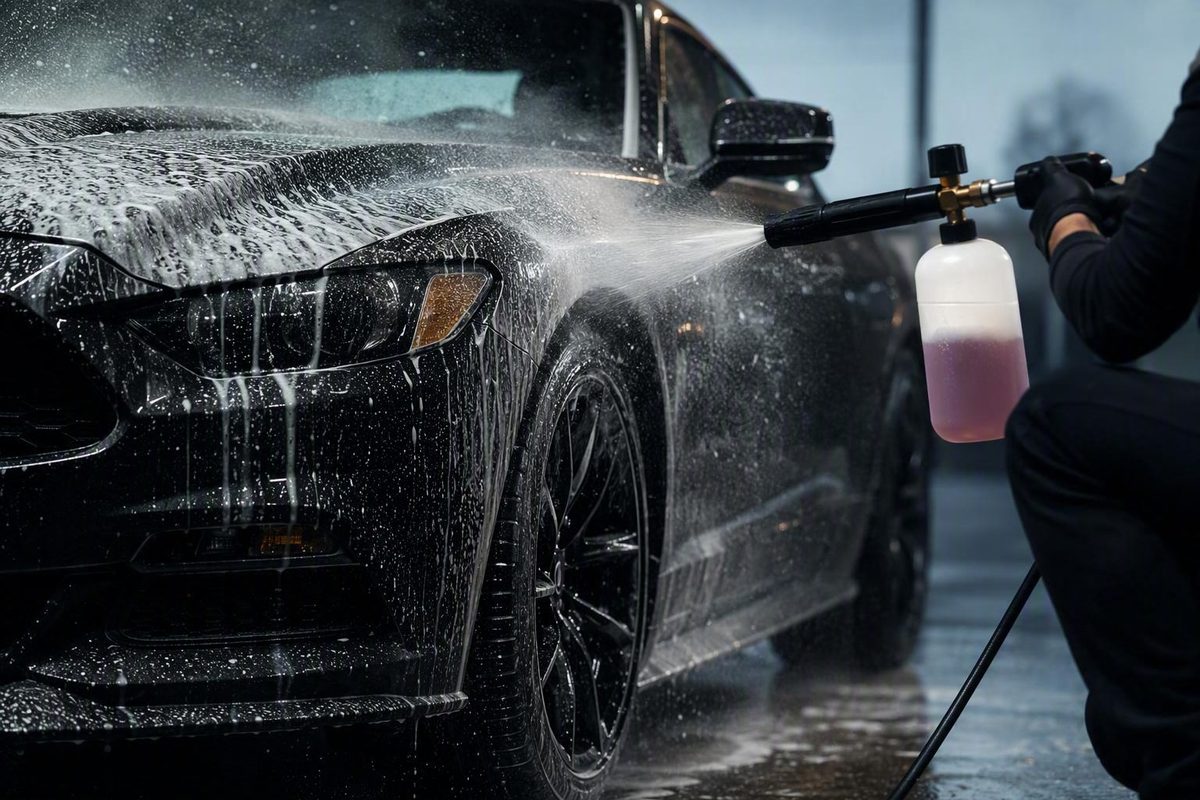
Yes, 600 PSI is enough to wash a regularly maintained car: it can pre-rinse loose dirt, remove fresh mud and bugs, and rinse away shampoo. It is less convincing for touchless removal of bonded road film, packed mud, or heavy salt. A typical 600 PSI cordless cleaner also may not have enough pressure and flow for thick foam from a conventional foam cannon, so a pump foamer or proprietary soap attachment is often the better match.
Enter your cleaner’s PSI and GPM, then choose the dirt level and water source.
Cleaning units compare pressure and flow, but they are not a safety rating or a universal dirt-removal threshold.
Good for routine rinsing; do not expect a touchless clean.
- Use shampoo and a lubricated mitt if road film remains after rinsing.
- A conventional cannon is unlikely to make thick foam at the demonstrated 600 PSI and 0.7 GPM combination.
- Expect a slower rinse than a higher-flow machine, especially on a large vehicle.
Always start farther away, keep the fan moving, and avoid 0°, 15°, turbo, or rotating jets on painted panels and vulnerable trim.
Evidence Benchmarks
| Rated or Measured Output | Cleaning Units | Reported Context | Foam Evidence |
|---|---|---|---|
| 450 PSI × 0.8 GPM | 360 | Preferred cordless option in comparative testing | — |
| 600 PSI × 0.7 GPM | 420 | Washed heavily soiled trucks with soap; contact used on one | Tested conventional cannon setup lacked sufficient output |
| 1,000 PSI × 1.0 GPM | 1,000 | Stronger portable cleaner marketed for vehicles | — |
| 1,000 PSI × 1.2–1.3 GPM | 1,200–1,300 | Vehicle-oriented model described as underpowered but appealing | — |
| 1,200 PSI × 1.8 GPM | 2,160 | Automotive kit specification | Ships as a matched foam-cannon package |
A matched 1,200 PSI and 1.8 GPM package proves compatibility for that package; it does not establish a universal foam-cannon minimum.
Sources: manufacturer specifications and the independent reviews and demonstrations cited in the accompanying article. Unknown values are shown as —.
The Practical Threshold Depends on the Task
No supplied evidence establishes a universal minimum PSI for washing every vehicle. The useful dividing line is the task, not a single pressure rating.
| Task | Is 600 PSI Enough? | What Else Is Needed? |
|---|---|---|
| Pre-rinse loose dust and grit | Usually | Broad fan and steady movement |
| Rinse shampoo | Usually | Adequate flow and complete coverage |
| Remove fresh mud and some bugs | Often | Shampoo and dwell time may help |
| Remove bonded road film | Not reliably | Lubricated contact wash |
| Clear thick salt or dried mud | Limited | Chemistry, brushing, or more capacity |
| Produce thick cannon foam | Not established | Compatible pressure, flow, and orifice |
A hands-on review of the 600 PSI RYOBI EZCLEAN reported removing everyday dust, bugs, road grime, and fresh mud. The reviewer treated it as a portable pre-rinse and maintenance-wash tool rather than a machine for packed clay, mud-caked off-road vehicles, or long-standing mould, moss, and mildew. These were practical observations, not controlled dirt-removal tests. Driven Car Guide’s review provides the full test context.
RYOBI lists vehicles among the uses for its EZCLEAN power cleaner, rated at up to 600 PSI. The words “up to” matter: actual output changes with the selected mode, nozzle, water supply, attachment, battery condition, and working distance. RYOBI’s specifications describe the available settings and water-source options.
Guidance recommending approximately 1,200–1,900 PSI describes a common operating range for conventional pressure washers, not a scientifically proven minimum. That guidance also calls for suitable detergent, distance, wand movement, and broad 25-degree or 40-degree spray patterns. Chemical Guys’ pressure-washing guidance is one example.
PSI and GPM Perform Different Jobs
PSI measures water pressure. GPM measures how many gallons of water the machine delivers per minute. Pressure helps loosen contamination; flow carries the loosened material away and determines how quickly a panel can be rinsed.
Cleaning units provide a simple way to compare both figures. Cleaning units equal PSI multiplied by GPM.
A cleaner rated at 600 PSI and 0.7 GPM produces 420 nominal cleaning units. RYOBI’s stronger portable model is rated at 1,000 PSI and 1.0 GPM, or 1,000 cleaning units. Its higher flow as well as its higher pressure should be considered; the figures do not prove that 1,000 PSI is required for a car. RYOBI’s 1,000 PSI model shows that next step in the portable category.
Independent testing reinforces the absence of a simple PSI cutoff. Car and Driver selected a cordless washer measuring no more than 450 PSI and 0.8 GPM as its preferred cordless option. It also described a vehicle-oriented model producing 1,000 PSI and 1.2–1.3 GPM as underpowered but appealing for automotive use. Car and Driver’s testing reports those measured figures.
A nominal 600 PSI cleaner can therefore be capable but slow. That trade-off is easier to accept on a compact commuter than on a large SUV or pickup. Higher flow can shorten the rinse even if the extra pressure is not needed on sound paint.
A garden hose is commonly described as supplying approximately 40–60 PSI, so 600 PSI provides substantially more rated pressure. It does not provide ten times the total washing performance because a hose may deliver more water volume.
A 600 PSI Cleaner Handles Maintenance Dirt Best
The age and type of contamination determine whether rinsing will be enough.
Loose dust, surface grit, ordinary grime, some bugs, and fresh mud are the strongest use cases. A broad fan can dislodge and carry away much of that material before it dries or bonds.
Bonded traffic film, dried bird residue, greasy deposits, thick salt, and dried mud usually need automotive shampoo, dwell time, and gentle agitation. Increasing chemical effectiveness is safer than concentrating the stream on one spot.
Packed clay, mud lodged deeply in wheel wells, baked-on biological growth, and long-standing deposits are poor matches for a light-duty cordless cleaner. It can remove loose material before brushing or a stronger wash, but a touchless result should not be expected.
A demonstration involving a cleaner rated at up to 600 PSI and 0.7 GPM showed it rinsing and washing two heavily soiled trucks. Thick salt and grime still needed soap, and a wash mitt was used on one truck. The presenter favored broad 25-degree and 40-degree nozzles. The result came from pressure, flow, detergent, nozzle selection, and contact rather than the PSI figure alone. The truck-washing demonstration shows that distinction.
Most 600 PSI Setups Should Not Be Bought for Cannon Foam
A conventional pressure-washer foam cannon uses water passing through a matched orifice to draw in and aerate detergent. Maximum PSI alone does not establish whether the cannon will work. Operating pressure, GPM, connector design, and orifice size all matter.
One demonstration of a 600 PSI cordless cleaner found that the tested pressure-and-flow combination could not operate a conventional foam cannon effectively. That result applies to the demonstrated setup rather than every product with a 600 PSI label. Bel Lavoro’s bucket-fed test provides the example.
At the other end of the comparison, an automotive kit specified at 1,200 PSI and 1.8 GPM ships with a foam cannon. That combination equals 2,160 nominal cleaning units and establishes a known compatible package, not a universal foam-cannon threshold. A different cannon may require another flow rate, fitting, or orifice.
For a 600 PSI handheld cleaner, the dependable alternatives are a pump foamer, handheld foam sprayer, bottle-mounted soap attachment, or manufacturer-approved accessory. A garden-hose foam gun also makes sense when a faucet and hose are available. These tools apply shampoo without relying on the cleaner to generate pressure-washer-style snow foam.
Foam thickness is not a measure of cleaning power by itself. The shampoo must reach the correct dilution, remain wet for its specified dwell time, and rinse away completely. Thin foam from a compatible sprayer can still support a proper wash.
Use a 40-Degree Fan on Paint
A broad 40-degree fan is the conservative choice for paint, glass, and trim. A 25-degree fan can provide a more focused general rinse when the machine supports it and the user maintains suitable distance and movement.
Do not use a 0-degree, 15-degree, turbo, or rotating jet for routine painted-panel washing. These patterns concentrate the stream into a smaller area. The Driven Car Guide reviewer specifically warned that the 15-degree setting on the tested 600 PSI cleaner could dislodge aged or brittle window rubber at close range.
No nozzle angle is automatically safe. Move farther away or bypass the area when spraying peeling clear coat, lifted paint chips, loose badges, damaged wraps, cracked decals, brittle seals, camera housings, sensors, or trim edges.
Keep the fan moving rather than holding it on one mark. A remaining stain should be treated with shampoo or appropriate agitation instead of a close, stationary jet. See Spray Nozzles Set Pressure and Coverage for how fan width changes impact and coverage.
The Safe Method Uses Pressure Before Contact
Inspect the vehicle before connecting the cleaner. Loose paint, lifting decals, damaged seals, cracked lamps, and unsecured trim should not receive direct pressure. The vehicle manual and tool instructions take precedence over general washing advice.
Start with the lowest useful setting and a broad fan. Test the pattern on an inconspicuous, sound area. Begin farther away than necessary and approach only while the pattern stays broad and controlled; there is no universally safe distance for every nozzle, finish, and machine.
Pre-rinse from the roof downward. Sweep across glass, upper panels, lower doors, bumpers, wheels, and other suitable areas without forcing water into gaps. The objective is to remove loose grit before a mitt touches the finish.
Apply automotive shampoo according to its dilution and dwell instructions. Do not allow it to dry. A compatible soap attachment is convenient, but a separate pump sprayer can perform the same application step when a cannon will not work.
Rinse from top to bottom and inspect the paint under good light. If film remains, use a clean, well-lubricated wash mitt rather than rubbing the panel with a bare finger or repeatedly blasting the same spot. Work from cleaner upper panels toward dirtier lower sections and rinse or replace the mitt as it collects contamination.
Complete a final rinse, including seams where shampoo can collect, and dry with a clean towel or controlled air. This sequence uses the 600 PSI cleaner for what it does well: removing loose contamination before contact and carrying shampoo away afterward. STIHL’s vehicle-cleaning procedure follows the same conservative progression.
Do not pressure-wash the cabin. Upholstery, switches, modules, speakers, wiring, and airbag-related parts are not normal pressure-washer targets. The engine bay also should not be treated like an exterior panel because pressurized water can reach sensitive electrical systems.
Portability Is the Main Reason to Choose 600 PSI
The strongest case for a cordless 600 PSI cleaner is access rather than raw output. RYOBI’s model can draw through a 20-foot siphon hose, connect to a 2-liter bottle adapter, or use a standard garden hose. RYOBI claims up to 25 minutes of runtime on medium pressure with a 4Ah battery.
That arrangement suits maintenance washing where a faucet or outlet is unavailable. It also introduces limits: transported water must be refilled, lower flow extends rinse time, and battery runtime has to cover both the pre-rinse and final rinse.
Reported water use varies. In the Bel Lavoro demonstration, the presenter said an SUV was washed with one bucket refill. In the truck test, one bucket did not complete the first truck, and the reviewer estimated that two would be sufficient. Neither result establishes a standard requirement because vehicle size, dirt, nozzle, flow, and trigger time differ.
A 600 PSI cleaner is a strong fit for a lightly soiled commuter, especially when compact storage or bucket feeding matters. It can also wash a large SUV or pickup, but expect slower rinsing and possible battery or water refills.
For a winter-driven vehicle, it works best when salt is removed routinely rather than allowed to accumulate. Thick deposits on lower panels, wheels, and underbody areas may require repeated detergent treatment, brushing, or a higher-flow machine.
A frequently mud-caked off-road vehicle is not the ideal primary use. The cleaner can handle field rinsing and loose material, but packed mud and loaded wheel wells favor more pressure, more flow, and suitable manual tools.
The purchase decision is therefore straightforward: choose 600 PSI for portable maintenance washing and controlled rinsing. Choose greater pressure and flow when rinse speed, large vehicles, frequent salt or mud, conventional foam-cannon use, or broader household cleaning matter more.