
Why a Clean Windshield Can Still Look Hazy—and What to Do Next
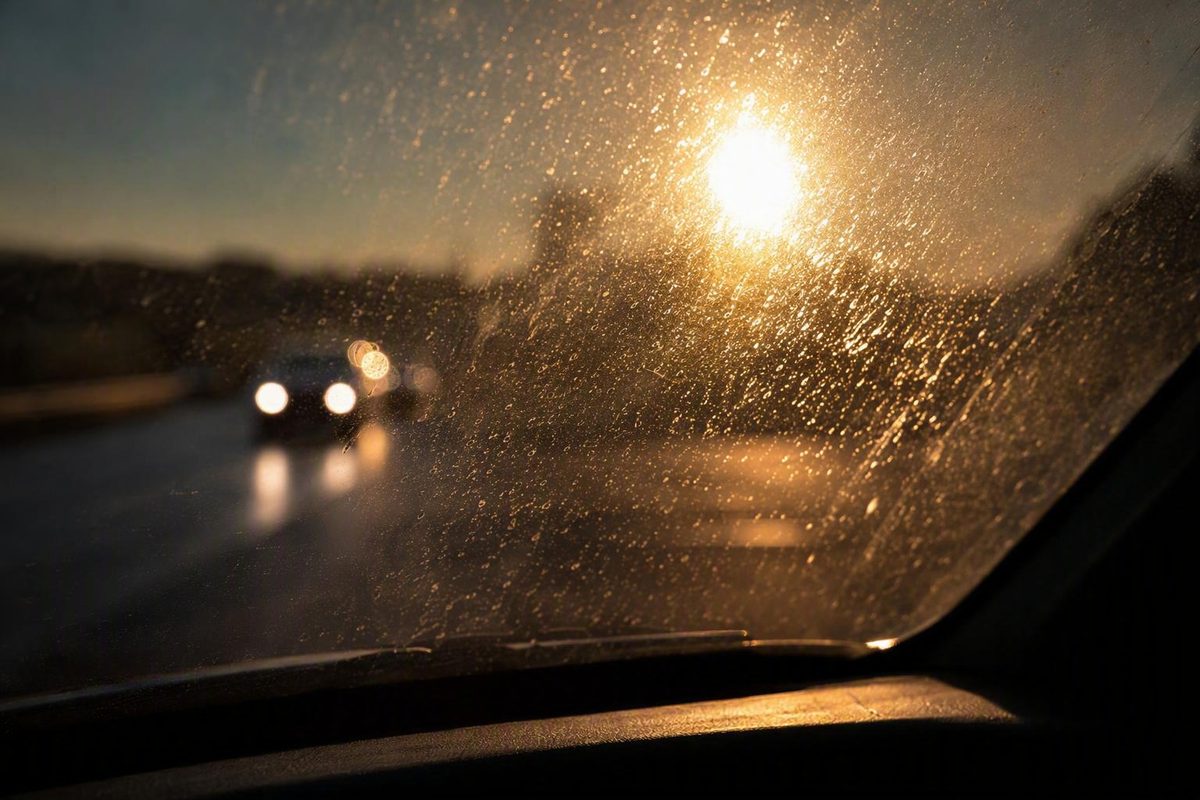
A windshield can look spotless in the shade yet turn hazy, sparkly, or glare-prone under headlights or low sun. Sometimes the cause is removable road film, mineral deposits, interior residue, or worn wipers. If the same tiny marks remain after careful cleaning, however, the glass may be physically pitted.
A pitted windshield has accumulated many small surface indentations over time. Cleaning can expose those defects, but it cannot replace the glass that has been lost. The practical question is therefore not simply, “Can I see pits?” It is, “After ruling out contamination and wiper problems, does the remaining damage interfere with a clear, undistorted view of the road?”
What a pitted windshield is—and why it can be hard to notice
Windshield pitting is cumulative surface wear made up of numerous small indentations. The most consistently identified cause is repeated contact with airborne sand, grit, gravel, small stones, and other road debris. Each impact may be unremarkable, but the accumulated marks can eventually alter the appearance of the glass and the way light passes through it. NOVUS Glass describes pitting as small craters that develop gradually rather than from one obvious incident (its overview explains the debris-related process).
That distribution distinguishes pitting from the damage most drivers call a rock chip. A chip normally has an identifiable center or impact point. A crack appears as a defined line, sometimes extending from a chip or a windshield edge. Pitting is generally spread across an area, with individual defects potentially too small to attract attention.
The combined optical effect is often easier to notice than the pits themselves. Depending on the windshield and lighting, a driver may see:
- A frosted or hazy cast on otherwise clean glass
- Tiny sparkles in sunlight
- Halos or starbursts around headlights
- Fuzzy lights or reduced contrast at night
- Glare when facing low sunlight
- Apparent distortion or visual “noise”
- Clarity that deteriorates noticeably in rain
These symptoms do not prove that pitting is present. Fixed surface defects can nevertheless scatter light, which helps explain why affected glass may appear acceptable in diffuse daylight but troublesome under headlights or low-angle sunlight.
Ordinary cleaning cannot remove true pits because they are physical indentations rather than material sitting on the glass. Cleaning still matters: until contamination has been removed from both sides, it is difficult to know how much of the haze comes from damaged glass and how much comes from dirt or residue.
Pitting should not automatically be treated as proof that a windshield is about to crack or shatter. The available pitting-specific guidance supports concern about visibility more clearly than claims about structural failure. Diagnosis should therefore focus on what is actually present—distributed pits, any separate chips or cracks, optical distortion, and the effect on the driver’s view.
How to distinguish pitting from residue, scratches, chips, and cracks
The most useful initial distinction is whether the problem changes after appropriate cleaning. Contamination may dissolve, move, diminish, or disappear. True pits remain fixed because the glass surface itself has been altered.
Use this comparison as an orientation guide, not as a safety certification:
| What you see | Typical pattern | What happens after cleaning? | Likely next step |
|---|---|---|---|
| Widespread pitting | Numerous fixed dots or tiny craters across an area; haze or sparkle may be more obvious than individual defects | Marks and light scatter remain in the same places | Assess visibility and obtain professional inspection if glare or distortion persists |
| Road film or interior residue | General cloudiness, smears, fingerprints, oily haze, or uneven streaks | Often changes substantially or disappears | Clean both sides and reassess under several lighting conditions |
| Mineral deposits | Spots, rings, or patches where water dried | May diminish with a glass-appropriate deposit-removal method | Remove cautiously before considering abrasive treatment |
| Wiper-related marks or scratches | Arcs following blade travel, linear marks, skipped areas, chatter, or recurring streaks | Loose residue may clean off; scratches remain | Clean and inspect the blades; replace worn blades and have persistent scratches assessed |
| Isolated chip | Localized impact mark, sometimes with a bull’s-eye, star, or crushed center | Remains localized | Ask promptly whether resin repair is suitable |
| Crack | Defined line that may extend from a chip or windshield edge | Remains visible and may change over time | Arrange professional assessment rather than treating it as pitting |
For localized chips and cracks, technicians consider characteristics such as shape, size, depth, and location before choosing a treatment; that illustrates why chip-and-crack rules should not be applied directly to diffuse pitting (Safelite describes this damage-by-damage assessment).
Pitting versus contamination: If the appearance changes as contamination is removed, at least part of the problem was on the glass rather than a defect in it.
Pitting versus scratches: Pitting looks more like distributed points or fine craters. Both can scatter light, and both may coexist.
Pitting versus chips: A chip presents one identifiable damaged location that may be evaluated for resin injection. Pitting consists of distributed shallow marks without one practical injection point. A windshield may have both conditions, so widespread sparkle does not make a discrete impact mark irrelevant.
Pitting versus cracks: Cracks are defined lines, not fields of tiny dots. Do not assume that a line is merely a scratch or part of the pitting. Its location, depth, and extent require separate evaluation.
Wiper chatter and streaking are particularly easy to misread. New wipers will not repair pits, but streaking from old blades is not enough to diagnose pitting.
If you cannot confidently distinguish among pitting, mineral deposits, scratches, coating damage, a chip, or a crack, stop experimenting and ask an auto-glass technician to inspect the windshield. That is especially important before using abrasive products, because polishing may remove glass without addressing the actual problem.
A conservative at-home screening process
This process is preliminary screening only. It is not a validated safety test, does not measure pit depth, and cannot certify that a windshield is safe. Its purpose is to eliminate common look-alikes and provide useful information for a professional assessment.
1. Clean the exterior glass carefully
Work on cool glass out of direct sunlight. Rinse away loose material first, then wash and dry the windshield with products and cloths suitable for automotive glass. Include the edges and the lower area around the resting wiper blades, where residue can accumulate.
Avoid grinding dry dirt into the surface. If grit is present, rinse it away rather than applying more wiping pressure.
2. Clean the interior glass
Clean the entire inside surface rather than only the area directly in front of the driver. Use good lighting to check for fingerprints, cleaner residue, and greasy smears.
Look through the windshield again before escalating to stronger products. If the haze has largely disappeared, contamination was at least partly responsible.
3. Address removable deposits without jumping to abrasive polish
If distinct water spots or mineral deposits remain, use a method identified as suitable for automotive glass and follow the relevant product and vehicle instructions. Test cautiously in an inconspicuous area if you know the windshield has an aftermarket treatment.
Do not assume that every fixed-looking spot is a pit. Deposits can be stubborn or layered. If you cannot distinguish residue, etching, coating damage, and missing glass, professional identification is preferable to repeated abrasive attempts.
4. Inspect and clean the wiper blades
When the vehicle design allows it, lift the blades, inspect the rubber, and clean the blade edges. Look for splitting, hardening, deformation, embedded debris, or uneven contact. Replace worn blades when appropriate.
Use the washers only after the glass and blades are clean. Observe whether streaking, skipped areas, or chatter remain. A blade problem can coexist with pitting, so improvement after replacement does not prove the glass is defect-free. Continued streaking also does not prove pits are responsible.
5. Inspect the dry windshield from both sides
With the vehicle parked, inspect the dry glass from inside and outside under several ordinary viewing conditions:
- Diffuse daylight, which helps reveal general cloudiness
- Low-angle natural light, without staring into intense sun
- Controlled nighttime lighting, such as surrounding street or parking-area lights
- Light arriving from different side angles
Change your viewing position slightly.
Do not turn a flashlight, sunset, or headlight check into a pass/fail test. These conditions may reveal symptoms, but no improvised home lighting setup establishes an approved safety threshold.
6. Look for persistent optical symptoms
After cleaning and checking the wipers, note whether you still see:
- Fixed sparkles or pinpoint marks
- Haze that does not shift or wipe away
- Halos or starbursts around lights
- Distortion in a particular area
- Reduced contrast through part of the glass
- Rain-related loss of clarity
- A substantial difference between looking through the affected area and an apparently clear area
Persistent glare, haze, distortion, and reduced wet-weather or nighttime clarity are reasonable grounds for professional inspection, although the available provider guidance does not establish a universal numerical cutoff (Affordable Auto Glass summarizes these visibility symptoms).
7. Prioritize the driver’s viewing area
A small defect outside the primary view and widespread light scatter directly ahead are not equivalent. Record whether the problem lies in front of the driver, whether you find yourself moving your head to see around it, and whether road markings or vehicles become harder to distinguish through that area.
If glare or distortion materially interferes with seeing the road, avoid the night, rain, or low-sun conditions in which the problem becomes pronounced until the windshield has been assessed. This is a precaution based on the documented visibility effects of pitting, not a declaration that the vehicle is universally safe or unsafe.
Why pitting develops and how to slow further wear
The best-supported explanation for windshield pitting is repeated exposure to airborne abrasive material. Sand, road grit, gravel, and small debris strike the outer glass. Over time, the accumulated impacts leave a distributed field of tiny defects.
Exposure may be greater during:
- Frequent highway driving
- Travel on or near gravel roads
- Construction-zone driving
- Driving behind trucks or other large vehicles
- Use of roads or lanes with loose aggregate
These conditions do not guarantee pitting, and avoiding them cannot guarantee prevention. The realistic goal is to reduce exposure when doing so is practical and safe.
Increase following distance. More space may reduce exposure to material thrown from tires or released by a vehicle ahead. Do not make abrupt maneuvers, but increase distance or change lanes when conditions permit.
Avoid debris-carrying vehicles unnecessarily. Trucks carrying gravel, aggregate, construction material, or unsecured debris are obvious exposure sources. The same applies to lanes where traffic is visibly displacing loose material.
Rinse before wiping or scrubbing. Flush loose grit away rather than dragging it across the windshield. This applies during routine washing and when cleaning an unusually dusty vehicle.
Keep the glass and wipers clean. Material caught on a blade edge can repeatedly travel across the windshield. Clean the glass and blade edges and replace blades that no longer wipe properly. New blades cannot restore glass already lost to pitting.
Use gentle glass-cleaning methods. More force is not necessarily more effective. Begin with adequate lubrication, clean cloths, and glass-compatible products. Escalate only after identifying a removable contaminant that needs a more specific treatment.
Use covered parking when practical. Covered parking may limit some contamination while the vehicle is stationary, but it cannot prevent driving-related debris impacts or reverse existing damage.
Greater following distance, rinsing particles away, maintaining wipers, and reducing unnecessary exposure to debris-heavy traffic are best treated as practical risk-reduction measures, not promises that pitting will stop (Glass Inc. gives similar preventive guidance).
Claims that ultraviolet light, acid rain, road salt, vehicle age, pollution, or automatic car washes are primary causes appear inconsistently in commercial articles and are not clearly established by the available evidence. Older vehicles may simply have accumulated more driving exposure. Repeated physical impact remains the more defensible central explanation.
What cleaning, resin, coatings, and polishing can—and cannot—do
Different treatments solve different problems. The key distinction is between removing material from the glass, stabilizing localized damage, altering the surface, and replacing the glass.
| Option | What it can reasonably do | What it cannot be assumed to do |
|---|---|---|
| Cleaning | Remove road film, fingerprints, cleaner residue, and some mineral deposits; reveal the glass’s actual condition | Remove physical pits or replace missing glass |
| Wiper replacement | Improve wiping when blades are worn, damaged, contaminated, or making poor contact | Repair pits, scratches, chips, or cracks |
| Chip-repair resin | Fill and stabilize certain discrete chips or cracks after assessment | Practically treat widespread micro-pitting |
| Glass coating or sealant | Alter water behavior, depending on the product | Fill existing pits or restore missing glass |
| Abrasive glass polishing | Remove a small amount of surrounding glass and potentially make some shallow defects less visible | Fill pits, guarantee original clarity, or reliably eliminate deep or extensive pitting |
| Windshield replacement | Provide a new optical surface when the correct glass is properly installed | Eliminate the need to confirm glass specifications, calibration, workmanship, and insurance details |
Cleaning is diagnostic, not a pitting repair. It can solve contamination and may produce a dramatic improvement, but it cannot remove an indentation. If cleaning completely eliminates alleged pitting, the original symptom was at least partly removable contamination.
New wipers address wiping performance. They are worth considering when blades are worn or streaking, but they do not smooth the windshield. Persistent streaks after the glass and blades have been cleaned may require further assessment.
Resin is intended for localized damage. Suitable chips or cracks offer a defined area into which resin can be introduced. AAA describes resin injection as a treatment for eligible localized windshield damage and notes that location can influence whether repair or replacement is appropriate (AAA explains the localized repair process). Distributed pitting lacks one practical injection site.
Coatings and sealants are not replacement glass. Informal detailing reports likewise describe sealants adhering to damaged glass without filling larger defects, but those reports are anecdotal rather than controlled testing (the Auto Geek discussion illustrates that limitation).
Polishing removes material; it does not add it. To reduce a pit’s apparent depth, abrasive polishing must level some of the surrounding surface. Very shallow defects may become less noticeable, while deeper or more extensive damage may require too much correction to produce a reasonable result.
Commercial advice conflicts. Some glass providers and detailers report that cautious polishing may reduce the visibility of shallow pitting. Others discourage polishing for troublesome pitting and favor replacement. Neither position supports a universal promise.
Excessive, uneven, or poorly controlled polishing may create optical distortion, which is especially concerning in the driver’s main viewing area. One pitting-focused provider specifically warns that polishing removes glass and may cause distortion if overused (Famous Auto Glass discusses that limitation).
There is therefore no responsible universal machine-polishing recipe for every windshield. Before authorizing abrasive work, tell the provider about any known coating or previous polishing and ask whether the vehicle or glass manufacturer specifies restrictions for that windshield. If the glass incorporates cameras, sensors, heating, acoustic construction, or display features, ask the qualified provider or manufacturer whether those features change the proposed procedure.
Professional polishing should be treated as a limited judgment call—not a guaranteed repair, structural restoration, or route back to original clarity.
When inspection or replacement becomes the sensible next step
The supplied evidence does not support turning informal online rules into recognized standards.
A practical decision framework starts with four questions:
- Does the problem remain after thorough cleaning and a wiper check?
- Does it materially affect visibility rather than appearance alone?
- Is the distortion or light scatter in the driver’s primary viewing area?
- Does it become substantially worse in rain, darkness, or low sunlight?
Arrange prompt professional assessment when clean glass still produces substantial headlight starbursts, low-sun glare, rain-related loss of clarity, or visible distortion. Commercial pitting guidance commonly recommends replacement when damage is widespread or continues to interfere significantly with the driver’s view, although it does not establish an objective universal threshold (Glass.NET summarizes this visibility-based approach).
A technician should inspect the glass rather than recommend replacement solely because of vehicle age or an informal estimate of the affected area. Ask where the damage is, what symptoms remain after cleaning, why polishing is or is not appropriate, and how the driver’s view is affected.
Most readily available pitting-specific guidance comes from businesses that sell auto-glass services. Their practical experience may be useful, but their commercial interest is a reason to request a documented diagnosis instead of accepting “replace it” without explanation.
A separate chip or crack requires a separate decision. Its shape, depth, size, location, and extent influence whether resin repair may be suitable. General rules for localized damage do not establish treatment criteria for diffuse pitting.
Before an appointment, document:
- Exterior and interior photographs taken after cleaning
- Images in diffuse daylight and lower-angle light
- The suspected damage’s position relative to the driver’s normal view
- Whether glare, halos, or distortion occur at night
- Whether rain makes the problem materially worse
- Whether symptoms changed after cleaning or replacing wipers
- Any isolated chips or defined cracks
- Any previous coating, polishing, repair, or windshield replacement
Photographs may not reproduce glare exactly as the driver experiences it, but they help establish locations and conditions. Written notes also make the discussion more specific than “it looks bad sometimes.”
Do not rely on a general article or home test to declare the windshield legally compliant or illegal. Roadworthiness and inspection rules vary by jurisdiction, and an individual treatment decision depends on the vehicle and the actual condition of its glass.
Planning a professional assessment or replacement
A useful consultation should produce more than a sales recommendation. Ask the shop to explain the diagnosis, options, limitations, and vehicle-specific consequences.
Use this checklist:
- What evidence shows that the problem is pitting rather than residue, mineral deposits, scratches, or coating damage?
- Are there separate chips or cracks that require their own assessment?
- Does the affected area cross the driver’s principal viewing area?
- Is the shop recommending monitoring, polishing, or replacement?
- What specific finding supports that recommendation?
- If polishing is proposed, how will optical distortion be checked?
- What result is realistic, and what defects are likely to remain?
- Does the vehicle or glass manufacturer specify any restrictions relevant to abrasive treatment?
- Is the recommendation based on documented visibility findings rather than an unsupported percentage or fingernail rule?
If replacement is being discussed, provide the vehicle’s year, make, model, and trim. Also identify equipment that may be associated with the windshield, including:
- Forward-facing cameras
- Rain or light sensors
- Heating elements
- Acoustic glass
- Head-up display
- Antennas or other embedded components
- Special tinting or shading
- Windshield-mounted brackets or sensors
Vehicles with windshield-mounted cameras or sensors may require advanced driver-assistance system calibration after replacement, and the exact procedure must be confirmed for the specific vehicle. AAA notes that these vehicles often require calibration and that capability varies among providers (its guidance explains the need to verify calibration service).
Ask the replacement provider:
- Is calibration required for this exact vehicle?
- Is it included in the quote?
- Who performs it?
- What vehicle-specific procedure will be used?
- How will successful completion be documented?
- What glass specification and brand will be installed?
- Will all relevant features remain compatible?
- What workmanship, wind-noise, and leak warranty applies?
- What happens if trim, moldings, or sensor brackets require additional work?
Price varies with the vehicle, damage, glass type, location, provider, and any calibration requirement. Broad published price ranges are not reliable personal estimates; industry guidance likewise notes that repair and replacement costs vary and that calibration may add to replacement expense (the Independent Glass Association discusses these cost variables). Compare itemized quotes covering the glass, installation, necessary consumables or moldings, taxes, mobile service, and calibration where applicable.
Insurance coverage is also case-specific. Policy terms, deductibles, claim procedures, inspection requirements, applicable law, and provider rules may affect the result. Verify the terms directly with the insurer before authorizing work, including whether any required calibration is included in or documented separately from the glass claim.
The decision path is straightforward:
- Rule out interior residue, exterior contamination, deposits, and wiper problems.
- Seek assessment if fixed pits, glare, or distortion remain.
- Compare monitoring, limited polishing, and replacement using documented findings.
- Before replacement, confirm the glass specification, calibration requirements, warranty, itemized price, and insurance terms.
Frequently asked questions
Can a pitted windshield be repaired without replacement?
Sometimes cautious professional polishing may make shallow defects less visible, but the result is uncertain. Polishing removes some surrounding glass rather than filling pits, and deeper or widespread damage is unlikely to disappear.
Cleaning and new wipers can solve overlapping problems but cannot repair physical indentations. If pitting continues to impair the driver’s view after cleaning, replacement may be the more sensible option following professional inspection.
Will cerium oxide, a ceramic coating, or a glass sealant fill windshield pits?
The supplied evidence does not demonstrate that ceramic coatings or glass sealants fill existing pits. They may change water behavior, depending on the product, but they do not restore missing glass.
Cerium oxide is an abrasive polishing material rather than a filler. Polishing may make some shallow defects less visible by leveling surrounding glass, but it cannot be assumed to eliminate deep pits and may create optical distortion if poorly controlled.
Is it safe to drive with a pitted windshield?
Pitting ranges from barely noticeable cosmetic wear to persistent light scatter or distortion that materially affects the driver’s view. No universal home test can certify a pitted windshield as safe.
If clean glass still produces substantial glare, starbursts, reduced rain clarity, or distortion—especially in the driver’s viewing area—seek prompt professional assessment and avoid the night, rain, or low-sun conditions in which visibility is impaired (NOVUS identifies persistent glare as a reason for technician evaluation).
Why can a rock chip be filled with resin when widespread pitting usually cannot?
A potentially repairable rock chip is a localized impact site. A technician can evaluate that defined point and, when appropriate, inject resin into the damaged area.
Pitting is distributed surface wear composed of numerous small indentations rather than one practical injection point. Resin criteria for individual chips and cracks therefore do not translate into a treatment for an entire pitted area.
Will replacement require camera or ADAS calibration, and might insurance cover it?
It may. Windshield-mounted cameras and sensors can require vehicle-specific calibration after replacement. Ask whether calibration is required, included, performed by a qualified party, and documented when complete.
Insurance treatment varies by policy, deductible, insurer requirements, and jurisdiction. Industry guidance presents coverage as something that must be checked against the applicable policy and local rules rather than assumed (the Independent Glass Association advises verifying applicable insurance requirements).
The final rule is visibility-first: if thorough cleaning and a wiper check remove the haze, contamination was at least partly responsible. If fixed pits, glare, or distortion remain, no ordinary cleaner or coating will restore the missing glass. Treat polishing as a limited professional judgment rather than a guaranteed cure, and arrange an auto-glass assessment when the driver’s view is materially affected—especially before driving at night, in rain, or into low sun.