
When a Portable Foamer Makes Sense for Car Detailing
It can coat a whole car, but is slower than a cannon and may require repeated pumping or refilling. The best fit turns on cleaner compatibility and parts support.
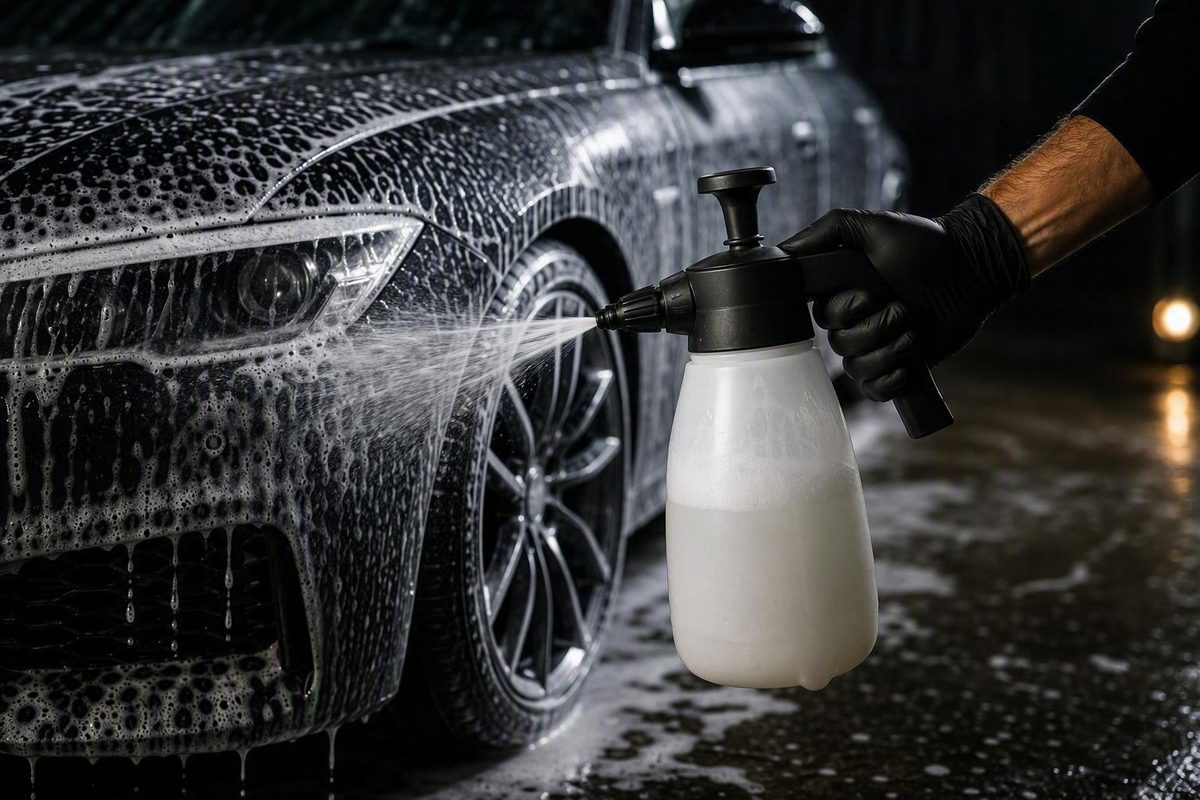
A pump foam sprayer fills the gap between a trigger bottle and a pressure-washer foam cannon. It carries its own cleaning solution, builds pressure by hand, and applies visible foam to wheels, lower panels, motorcycles, and other targeted areas without being tethered to a hose or electrical outlet.
That independence—not exceptionally thick foam—is its main advantage. A manual pump foamer can coat a complete vehicle, but application is generally slower than with a cannon and may involve repeated pumping or refilling. The useful buying question is therefore not “Which sprayer makes the thickest foam?” but “Which applicator fits the job, available equipment, cleaner, and working location?”
What a pump foam sprayer is—and what it is not
A manual pump foam sprayer, sometimes called a compression foamer, consists of a chemical reservoir, a hand-operated pump, a valve or trigger, and a foaming nozzle or insert. Pumping compresses the air above the liquid.
Foam comes from the complete system rather than the tank alone. Air, water, a foam-capable cleaner, and the correct nozzle or insert must work together. If the cleaner does not foam readily—or if the foaming insert is absent—the output is more likely to resemble a wet spray or mist.
Application normally requires no garden hose, electrical connection, or pressure washer. The wider cleaning process may still require rinse water, however. A self-contained applicator does not by itself provide a way to remove loosened contamination or chemical residue.
This distinguishes a true manual foamer from several products that may appear beside it in search results:
| Tool | Pressure source | Required equipment | Typical output | Primary automotive role |
|---|---|---|---|---|
| Manual pump foam sprayer | Hand-compressed air | Foam-capable cleaner and compatible foaming insert | Light to moderately aerated foam | Wheels, lower panels, spot treatment, and portable pre-washing |
| Ordinary compression sprayer | Hand-compressed air | Compatible liquid cleaner and spray nozzle | Liquid fan, stream, or mist | Uniform application of rinseless, waterless, or other non-foaming solutions |
| Battery-powered foamer | Electric pump or compressor | Charged battery | Aerated foam without continuous hand pumping | Repeated portable work where reduced pumping matters |
| Garden-hose foam gun | Water pressure from a hose | Garden hose | Generally loose, wet suds | Exterior soap application without a pressure washer |
| Pressure-washer foam cannon | Pressure-washer flow | Pressure washer, hose, and compatible connection | Generally denser foam with fast, broad coverage | Full-vehicle pre-washing |
Car and Driver likewise distinguishes hose-connected foam guns, pressure-washer cannons, and manually pressurized sprayers. It describes the hand-pump format as portable but potentially tedious over a complete car because pressure falls during use; it also characterizes foam-gun suds as looser than cannon foam. Car and Driver explains the equipment differences.
Do not assume that every product labeled “pump sprayer” is a foamer. Retail categories may mix ordinary compression sprayers, manual foamers, battery models, hose-connected wash guns, foam cannons, and replacement parts. Check the product description, included spray head, connection requirements, and manufacturer documentation instead of relying on the category title.
Foam is also an application format, not proof of cleaning power. A pump foamer is best understood as a pre-wash or targeted chemical applicator—not a complete wash process in a bottle.
Where a portable foamer works best
The strongest use cases are relatively small or clearly defined areas:
- Wheels and tires
- Lower doors, rocker panels, and bumpers
- Wheel arches and crevices
- Door jambs
- Engine bays, when the cleaner and procedure are suitable
- Motorcycles and bicycles
- Lawn equipment and compact machinery
- Localized bug residue, grime, or spot treatment
These jobs capitalize on portability and controlled placement. You can carry a small foamer to the affected area, apply cleaner only where needed, and avoid setting up a pressure washer for a short task.
A pump foamer can be practical in apartment parking areas, at campsites, or during mobile detailing when pressure-washer access is unavailable. That does not make the wider process infrastructure-free: determine how the cleaner must be removed and check any property, facility, or local requirements that may apply to vehicle washing and runoff.
Complete-car use is possible, but effort is the limiting factor. As stored air is consumed, output weakens and the tank must be repressurized. A compact reservoir may also need refilling. Commercial detailing comparisons generally characterize manual-foamer output as lighter and slower to apply than pressure-washer foam, although those comparisons do not provide standardized measurements. One seller comparison presents full-body speed as the cannon’s advantage and portability as the pump sprayer’s advantage. Jimbo’s Detailing outlines that task-based distinction.
A task-based decision is more useful than declaring one tool universally better:
- Choose a pump foamer when portability, targeted cling, compact storage, or independence from a pressure washer matters most.
- Choose a regular pressure sprayer when rapid, even liquid coverage matters more than visible foam.
- Choose a foam cannon when you already have a suitable pressure washer and prioritize fast, broad application.
- Consider a powered foamer when repeated hand pumping is the main problem, after checking documented battery support, charging requirements, and service terms.
Some detailers keep both a manual foamer and a cannon. The foamer handles wheels or heavily contaminated lower panels; the cannon covers the body. That is a workflow option, not a universal professional standard. Someone who treats only wheels may never need a cannon, while a person regularly washing large vehicles may find a hand-pump unit frustrating as the primary applicator.
Avoid purchase decisions based on promised coverage per fill, a fixed number of pump strokes, or a guaranteed whole-car application time. The available evidence contains no controlled, comparable measurements for those outcomes.
Pump foamer vs regular sprayer, foam gun, and foam cannon
Each category solves a different pressure-and-coverage problem. The following comparison reflects normal design priorities rather than guaranteed performance from every model.
| Type | Pressure source | Equipment needed | Portability | Expected foam character | Application speed | Manual effort | Likely refill burden | Best fit |
|---|---|---|---|---|---|---|---|---|
| Pump foamer | Hand pumping | None for application | High | Usually lighter than cannon foam | Slow to moderate | Repeated pumping | Low on small jobs; potentially high on a full vehicle | Wheels, lower panels, spot cleaning, and remote work |
| Regular pressure sprayer | Hand pumping | None for application | High | Primarily liquid spray | Moderate | Some pumping | Capacity- and task-dependent | Rinseless pre-soak, waterless solution, and even chemical coverage |
| Foam gun | Garden-hose pressure | Hose and water connection | Moderate | Loose, wet suds | Moderate | Low while spraying | Bottle-dependent | Exterior washing where a hose is available |
| Foam cannon | Pressure-washer flow | Pressure washer, supply hose, and connections | Low to moderate | Generally dense, broad foam | Fast | Little pumping but more setup | Usually fewer interruptions during broad coverage | Whole-vehicle pre-washing |
| Battery-powered foamer | Electric pump or compressor | Charged battery | High | Model- and setup-dependent | Not established across models | Reduced hand pumping | Capacity-dependent | Repeated portable work |
Pump foamer or regular pressure sprayer?
The important difference is the desired output. A foamer aerates a compatible solution to create visible foam and cling. A regular pressure sprayer prioritizes a liquid fan or mist, which can distribute solution quickly and evenly.
For a rinseless or waterless pre-soak, foam may not be the objective. Several participants in an automotive-detailing forum preferred ordinary pressure sprayers for those uses because they considered the liquid pattern faster and more even, while reserving foamers for wheels, tires, and crevices. Those reports are anecdotal rather than controlled comparisons. The Auto Geek discussion records the differing user experiences.
Pump foamer or foam gun?
A foam gun connects to a garden hose and uses the water supply to mix and carry soap. It eliminates hand pressurization but also eliminates the pump foamer’s independence from a hose. Its suds are generally wetter and looser than those from a pressure-washer cannon.
Choose the gun when a hose is readily available and convenient exterior application matters more than dense foam. Choose the pump foamer when you need a self-contained applicator or want to treat a small area without uncoiling a hose.
Pump foamer or foam cannon?
A cannon is the natural option for someone who already owns a suitable pressure washer and wants to cover a complete vehicle quickly. Pressure-washer flow mixes and projects the solution over a broad area, generally creating denser foam than a manual foamer.
The trade-off is setup. A cannon depends on the washer, water supply, hoses, fittings, storage space, and suitable operating conditions. A manual foamer is slower and requires pumping, but it can be carried to the task and stored compactly.
For related information about pressure-washer tips, hose nozzles, and cannon setup, see Car Cleaning Zone’s guide to spray nozzles for car cleaning.
What about a powered foamer?
Battery-powered foamers occupy a middle ground.
The available evidence does not establish whether the premium is worthwhile. Comparable measurements for runtime, battery longevity, application speed, labor savings, and repair costs are missing. Treat powered operation as an ergonomic feature to investigate—not automatic proof of better foam or value.
How to choose the right pump foam sprayer
There is no universal best capacity or design. Start with the work the sprayer must perform, then eliminate products that lack adequate documentation.
1. Match the tank to the task
A compact unit suits wheels, jambs, and spot treatment. It is easier to carry, maneuver, and store but may need refilling during a larger job.
Separate total container volume from usable liquid capacity. A compression sprayer needs air space above the solution. Do not assume that the advertised tank size is also the permitted fill volume; look for a marked fill line or manufacturer-stated usable capacity.
2. Verify pressure and operating instructions
Before buying, locate the manual or manufacturer documentation and confirm that it identifies:
- Maximum permitted pressure
- Safe fill line or usable capacity
- Pressure-relief provisions
- Permitted operating orientation
- Correct pumping procedure
- Depressurization method
- Transport and storage instructions
Do not infer these details from a marketplace title. The available sources do not verify model-specific pressure ratings, orientations, or valve designs across the products discussed here.
3. Check the entire chemical path
“Chemical resistant” is too broad to establish suitability for a particular cleaner.
Seek written compatibility information for the product category you plan to use. Do not assume a generic claim covers acidic wheel cleaners, strongly alkaline products, solvents, or degreasers. Sprayer compatibility also does not prove that the cleaner is suitable for paint, wheels, trim, coatings, or engine-bay materials.
4. Examine nozzle and insert choices
Useful questions include:
- Can the output be changed from wetter to drier foam?
- Is the foam insert removable under the documented service procedure?
- Are replacement inserts available?
- Can the spray pattern be adjusted?
- Can the unit be converted to liquid spray?
- Are service instructions and replacement nozzles available?
More settings are not automatically better. A simple, supported nozzle may be more valuable than proprietary inserts that cannot be replaced.
5. Consider filled ergonomics
A sprayer that feels light when empty may be awkward once filled. Consider loaded weight, balance, handle clearance, pump-handle size, trigger reach, carrying method, and stability when the tank is set down.
Controls should remain practical while wearing any protective equipment specified by the cleaner label. For frequent use, pumping posture and trigger comfort may matter more than cosmetic features.
6. Prioritize serviceability
Before purchase, check whether the supplier offers:
- Seals and O-rings
- Foam inserts and nozzles
- Pump or lid assemblies
- Hoses and pickup tubes
- Triggers, valves, and spray heads
- Complete service kits
Parts availability may make a higher-priced unit less wasteful if one component can be replaced instead of discarding the tank. It does not prove that the product will last longer.
7. Investigate support and ownership costs
Read the warranty instead of assuming that a familiar brand provides broad coverage. Check exclusions involving chemicals, wear components, batteries, and commercial use. For powered models, investigate the replacement battery, charger, support period, and whether the battery is user-replaceable.
The supplied evidence does not establish model-specific seal materials, warranties, battery runtime, chemical compatibility, or long-term durability. Those details require current documentation for the exact model and sales region.
Budget, premium, and powered options: what price does—and does not—tell you
Prices, discounts, ratings, inventory, shipping, and return terms vary by date, seller, location, and product variant. The retailer snapshots supplied for this guide did not preserve a verifiable capture date, so their exact displayed prices should not be treated as publishable current-price evidence. Recheck all listings before purchase.
The undated Walmart snapshot illustrates the lower-priced marketplace, but it also shows the classification problem: manual foamers appeared alongside general sprayers, battery products, wash guns, and other equipment. The Walmart category demonstrates how mixed these listings can be.
The undated specialty-retailer snapshot illustrates higher-priced manual and powered tiers. It also includes nozzle kits, service kits, lids, compressors, and spray heads, meaning not every displayed amount represents a complete operational sprayer. The Rag Company collection shows both complete units and related parts.
These listings are not apples-to-apples performance comparisons. Products differ in format, capacity, power system, and included components, while complete technical specifications are not available for every listing. A higher price might reflect a larger tank, powered operation, brand support, or replacement-part access. It does not prove denser foam, better chemical compatibility, longer service life, or greater comfort.
Retailer ratings are also weak evidence for comparative performance. The captured review summaries included products with review counts ranging from single digits to the low hundreds, and those reviews may reflect different cleaners, tasks, and expectations. A star average cannot establish whether a sprayer is compatible with your wheel cleaner, comfortable when full, or repairable years later.
A more useful comparison considers total ownership cost:
- Initial purchase: Include any required nozzle, battery, charger, or adapter.
- Routine service: Check the cost and availability of seals, inserts, and nozzles.
- Repairability: Determine whether the trigger, valve, lid, hose, or pump can be replaced.
- Battery support: For powered models, investigate replacement availability and cost.
- Downtime: If the sprayer supports paid work, consider how quickly parts can be obtained.
- Replacement risk: A low-cost sealed unit may be economical for occasional use but less attractive if one failed component makes it unusable.
- Documentation: Clear operating and compatibility information can be more valuable than an unexplained accessory bundle.
Before comparing prices, confirm that each listing is for a complete sprayer. Nozzle kits, replacement lids, compressor modules, spray heads, and service packs can resemble full products in search results.
The sensible result is a shortlist rather than a universal ranking. Retain the products that meet your capacity, documented compatibility, ergonomic, and serviceability requirements. Then compare newly verified prices, warranty terms, and parts support.
How to mix and use a pump foamer without relying on a universal recipe
There is no evidence-supported soap ratio that applies to every cleaner and pump foamer. Commercial articles often publish dilutions for the seller’s own formula, while sprayer designs, water conditions, and intended surfaces vary. Do not transfer a pressure-washer snow-foam recipe directly to a hand-pump foamer.
Start with two documents: the cleaner label and the sprayer manual. Confirm that the cleaner is intended for the surface, that the sprayer’s wetted components are documented as compatible, and that the dilution and fill volume comply with both sets of instructions.
Calculate concentrate from the permitted liquid fill volume—not the tank’s advertised total volume. If the manual specifies a usable fill below the nominal container size, use that permitted liquid volume in the calculation and retain the required air space.
Participants in an automotive-detailing forum reported that thin, foam-capable liquids behaved more predictably than non-foaming or highly viscous products. That is useful troubleshooting context, but it remains anecdotal rather than standardized viscosity testing.
A bounded operating sequence is:
- Inspect the sprayer components identified in the manual.
- Prepare the cleaner as directed for the intended surface and application method.
- Add solution without exceeding the documented fill line.
- Close the tank according to the manual.
- Pressurize it using the specified procedure.
- Test the output away from the vehicle.
- Adjust only settings identified as user-adjustable.
- Apply an even layer to a manageable section.
- Follow the cleaner’s stated working time.
- Prevent the solution from drying, then rinse or continue the wash as directed.
Foaming is commonly a pre-wash or targeted application step. It does not automatically remove all contamination, eliminate rinsing, or replace an appropriate contact wash.
Sources disagree about pre-rinsing. Some workflows rinse loose dirt first; some snow-foam sellers advise applying their products to a dry vehicle because surface water may dilute the mixture. Pro-Kleen, for example, recommends no pre-rinse for its own pressure-washer snow foam while acknowledging that foam changes with dilution, water conditions, temperature, and equipment. Its advice concerns a lance and pressure washer, not a hand-pump foamer. Pro-Kleen’s instructions illustrate why equipment-specific guidance should not be generalized.
Treat neither pre-rinsing approach as universal. Follow the cleaner directions and account for contamination, panel temperature, the available rinse method, and working conditions.
If foam appears thin, do not automatically add more concentrate. A wetter foam that applies consistently may be more useful than a thick mixture that sputters or obstructs the nozzle.
Troubleshooting watery foam, weak output, and rapid pressure loss
Begin with the exact sprayer manual. Do not modify calibrated openings, override pressure-control components, or exceed documented operating limits.
| Symptom | Plausible causes | Checks permitted by the manual | When to stop or seek support |
|---|---|---|---|
| Watery or non-foaming output | Missing insert; non-foaming cleaner; incorrect dilution; excessive viscosity; dirty nozzle | Confirm the cleaner, dilution, insert, and documented cleaning procedure | Contact the supplier if the correct setup still gives abnormal output |
| Weak or uneven spray | Insufficient pressure; inadequate air space; obstructed passage; worn nozzle; incorrect orientation | Verify fill level, pressure procedure, accessible passages, and permitted orientation | Seek service if output remains irregular |
| Rapid pressure loss | Normal air consumption or leakage around the lid, valve, hose, trigger, or seals | Follow the documented shutdown procedure before inspecting accessible components | Stop using the unit if it cannot retain pressure or a pressure component appears damaged |
| Constant pumping | Small air volume; broad job; high foam-air demand; possible leak | Confirm headspace and test on a smaller section | Consult support if pumping frequency changes suddenly |
| Sputtering or clogging | Dried chemical, debris, viscous solution, or obstructed insert | Use only the approved flushing and cleaning procedure | Do not force tools through calibrated openings |
| Fluid around lid or seals | Displaced or damaged seal, cracked component, or improper closure | Stop operation and follow the documented pressure-release procedure | Replace only specified parts or seek service |
| Foam changes between washes | Different water, temperature, formula, dilution, or nozzle condition | Recheck the documented setup and clean the fluid path | Ask the cleaner or sprayer manufacturer if the change persists |
Foam production consumes stored compressed air, so some pressure decline is expected. A compact tank or broad job may therefore require repeated pressurization even when the unit is functioning normally. A sudden change, audible leakage, or inability to hold pressure warrants stopping and consulting the manual or supplier.
Findings about pressure-washer foam should not be treated as measured pump-foamer performance because the equipment mixes and delivers solution differently.
Changing an insert or dilution will not solve every fault. Persistent problems involving the tank, lid, valve, or pressure-control components belong with the manufacturer or an approved service source.
Cleaning, storage, and chemical-safety fundamentals
The sprayer manual, cleaner label, and vehicle or surface-care instructions take priority over general guidance.
Use the ventilation and personal protective equipment specified by the chemical label. Do not assume that converting liquid into foam eliminates droplets, mist, or inhalation exposure. Follow the label’s restrictions for nearby people, animals, wind, and disposal.
Observe the cleaner’s surface-temperature instructions and do not allow it to dry. Commercial sprayer guidance also identifies dried residue and debris as potential causes of component clogging. Meitai discusses drying, residue, and nozzle maintenance.
Before opening or servicing a tank, use the exact pressure-release method specified for that model. If the documented method cannot be followed or a pressure-control component appears damaged, stop using the sprayer and contact its manufacturer.
A post-use checklist should be derived from the manual and cleaner label. Confirm how to:
- Release pressure
- Handle unused solution
- Rinse the reservoir
- Flush the permitted fluid path and nozzle
- Remove and clean the insert, if user removal is allowed
- Dry the components
- Reassemble or store the unit
- Keep the sprayer and chemical away from unauthorized users or incompatible materials
Chemical residue left in a nozzle or internal passage can dry and contribute to clogging. Before reuse, inspect the components identified by the manufacturer, including accessible seals, hoses, valves, the tank, lid, and pressure-control parts.
Use only replacement parts and maintenance products specified for the exact sprayer. The available evidence does not support a universal lubricant, substitute O-ring, or maintenance interval for every foamer.
Finally, distinguish sprayer compatibility from surface compatibility. A tank may tolerate a cleaner that is inappropriate for matte or satin paint, coatings, older paint, plastic trim, rubber, a particular wheel finish, or sensitive engine-bay materials. Use the cleaner and procedure approved for the actual surface and test inconspicuously when the product instructions recommend it.
A pump foamer is a pressurized chemical applicator. General editorial guidance can organize the decision process, but it cannot replace instructions for a specific sprayer, cleaner, or vehicle surface.
Frequently asked questions
Can I use a pump foam sprayer without a hose or pressure washer?
Yes. A manual pump foam sprayer creates application pressure by hand, so it normally requires neither a hose nor a pressure washer to dispense solution.
You may still need an appropriate rinse method if the cleaner must be rinsed away. Check the product directions and any rules that apply at the intended washing location.
Can a pump foam sprayer cover an entire car?
Yes, but capability does not guarantee convenience. Expect slower coverage, declining pressure, repeated pumping, and possibly refilling, depending on the sprayer, solution, and vehicle.
A pump foamer makes the most sense for whole-car use when pressure-washer access is unavailable and you accept the additional labor. If rapid full-body coverage is the priority and you already own suitable equipment, evaluate a foam cannon instead.
Is a regular pressure sprayer better for rinseless or waterless wash solution?
It can be a better task-specific option when quick, uniform liquid coverage matters more than foam. Some detailers report preferring regular pressure sprayers for rinseless or waterless pre-soaking, but that preference is based on anecdotal user experience rather than comparative testing.
Follow the cleaner’s application instructions. If the formula is designed to foam or visible cling is useful on a targeted area, a compatible foamer may still be appropriate.
Why is my pump sprayer making watery foam?
Check whether the correct foam insert is installed, whether the cleaner is capable of foaming, and whether the dilution follows the label. Also confirm the documented fill level and pressure procedure and inspect the nozzle using the manufacturer-approved method.
Do not automatically add concentrate. If the documented setup and cleaning procedure do not restore normal output, contact the manufacturer or replace the specified service component.
Are premium pump foam sprayers better than inexpensive models?
Not necessarily. A higher price may correspond to a larger format, powered operation, clearer documentation, replacement-part access, or broader service support. The available retailer listings do not prove superior foam, ergonomics, durability, or chemical compatibility.
Compare usable capacity, documented chemical compatibility, operating instructions, filled ergonomics, warranty terms, and replacement-part availability. Treat price and retailer ratings as screening information rather than proof of performance.
Choosing the right applicator
Choose a manual pump foamer when portability, targeted cling, and independence from a pressure washer matter more than application speed. Choose a regular pressure sprayer when even liquid coverage is the priority, or a foam cannon when rapid whole-vehicle application justifies pressure-washer setup.
A powered foamer is worth considering only after checking its documented battery support, charging requirements, and service costs. Before buying any type, verify usable capacity, chemical compatibility, operating instructions, filled ergonomics, and replacement-part support. Foam appearance, price, and retailer ratings can help form a shortlist, but none proves cleaning performance or long-term value.