
Choose the Right Nozzle for the Liquid, Target, and Sprayer
Verify the exact pattern, output, pressure range, material, connection, accessories and operating limits against current manufacturer documentation.
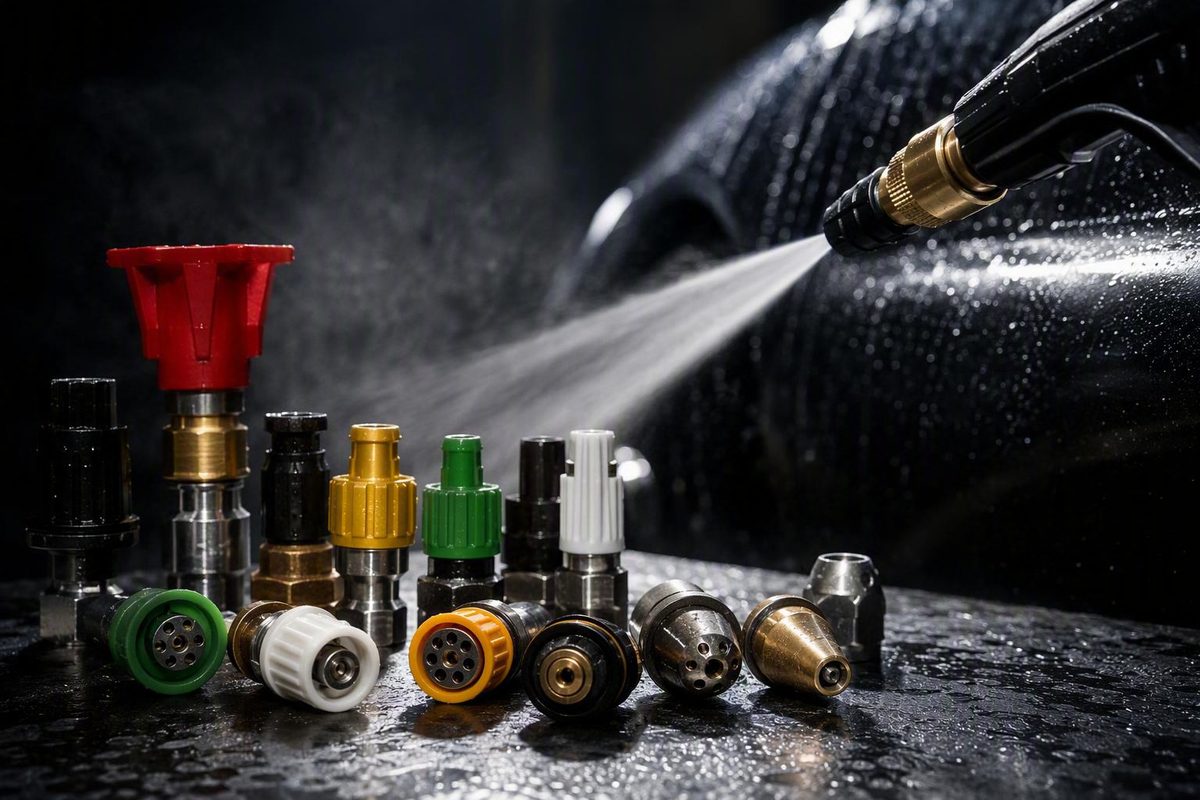
A sprayer nozzle is more than an interchangeable outlet. It meters liquid, forms a spray pattern, and must work with the pump, pressure, flow, fittings, controls, seals, and liquid in the rest of the system. A nozzle intended for a field boom may be unsuitable for a backpack sprayer, garden hose, or pressure washer.
There is no universal best nozzle. First identify the equipment and task. Then compare pattern, required output, operating pressure, orifice, material, connection, and accessories. Before use, verify the exact product against current manufacturer documentation and, for regulated agricultural applications, the applicable product label. The agricultural evidence available here consists mainly of specialist-retailer catalogs, so this guide provides a qualified selection framework rather than a complete calibration or chemical-application procedure.
Start Here: Which Kind of Sprayer Nozzle Do You Need?
“Sprayer nozzle” covers several fundamentally different product markets. Use this selector before comparing angles, colors, sizes, or materials.
| Your equipment or task | Nozzle category to investigate | Typical intent |
|---|---|---|
| Tractor, ATV, UTV, or mounted boom | Agricultural boom tip | Broadcast application, banding, fertilizer, herbicide, or fungicide placement |
| Handheld, compression, or backpack sprayer | Portable-sprayer nozzle | Paths, beds, spot treatment, shrubs, trees, or longer-range application |
| Pasture sprayer without a conventional long boom | Boomless nozzle or assembly | Broad-swath treatment around rough terrain or obstacles |
| Process equipment, tank cleaner, misting system, sewer jet, deicing rig, or wash system | Industrial or specialty nozzle | Cleaning, cooling, coating, misting, jetting, rinsing, or liquid distribution |
| Ordinary water hose | Garden-hose nozzle | Adjustable rinsing, broad fan flow, crevice flushing, or low-force washing |
| Powered pressure washer | Pressure-washer tip | Surface cleaning, detergent application, foam-cannon operation, or rinsing |
These categories can differ in operating pressure, connection, flow, liquid compatibility, pattern geometry, and safety requirements. One broad specialist catalog, for example, includes agricultural, garden-hose, high-pressure, misting, sewer-jetting, tank-cleaning, and industrial nozzles. Its catalog-wide limits therefore do not apply to every listed product. Dultmeier’s catalog illustrates the range of distinct nozzle categories.
Common buying intents include:
- Broadcast or band application: distributing liquid across a field or defined strip.
- Handheld area treatment: covering paths, beds, turf, or other small areas.
- Localized spot work: directing liquid toward individual weeds or limited targets.
- Shrub or canopy spraying: reaching into or around three-dimensional plant structures.
- Pasture spraying around obstacles: creating a broad swath where a long boom is impractical.
- Detergent application: introducing cleaner through a compatible low-pressure tip, injector, or foam accessory.
- Vehicle rinsing: removing loose contamination and cleaner while limiting unnecessary force on vulnerable surfaces.
Do not transfer specifications between markets. An agricultural tip’s pressure range or angle does not establish how an automotive pressure-washer tip will behave. Likewise, a maximum pressure displayed for an industrial catalog does not mean every item in that catalog can withstand it.
Spray Patterns Explained: What Each Design Is Built to Do
Pattern names describe a nozzle’s general spray form or product design. They do not guarantee performance in every installation. Two products sold as flat-fan tips may have different flows, operating ranges, materials, droplet descriptions, and connection systems.
Flat-fan
A flat-fan nozzle forms a sheet-like spray that widens away from the outlet. Agricultural catalogs commonly list flat-fan tips for broadcast and area coverage, including multi-nozzle booms where the installed patterns are intended to work together.
A nominal fan angle does not establish finished coverage by itself. The exact nozzle model, pressure, mounting arrangement, spacing, alignment, movement, and target geometry all matter. Because the evidence here does not provide a validated overlap or spray-height procedure, use the relevant manufacturer’s chart rather than applying a universal setup rule.
Wide-angle flat
A wide-angle flat nozzle forms a broader nominal fan than a narrower model under its stated operating conditions. That may support a different installation arrangement, but “wider” does not automatically mean more uniform or more suitable.
Confirm the model’s intended application, pressure range, flow, and installation instructions.
Twin or dual flat-fan
A twin or dual-fan product forms two fans instead of one. Some cataloged agricultural models use different forward and backward angles, but that geometry is model-specific rather than a universal feature of every dual-fan nozzle.
The product name alone cannot establish whether two-direction spraying will improve deposition. The target, orientation, operating conditions, formulation, and permitted application method still control suitability.
Hollow-cone
Portable-sprayer listings commonly associate hollow-cone products with bushes and spot treatment. Agricultural catalogs also list hollow-cone tips and components for specialized applications.
These are seller or product-line application mappings, not independent proof that every hollow-cone nozzle suits every shrub, crop, or formulation. Check flow, angle, operating pressure, fit, and the instructions governing the intended liquid.
Full-cone
Full-cone nozzles appear in general, cleaning, and specialty catalogs. The name distinguishes the pattern from a hollow-cone design, but it does not reveal the model’s exact distribution, flow, angle, material, or operating range.
Use the model specification rather than choosing from the pattern name alone.
Solid-stream or jet
A solid-stream or jet nozzle directs liquid through a narrow path. Portable-sprayer sellers commonly associate jet products with longer-range or spot spraying.
A solid stream should not be treated as a safe general-purpose rinse pattern, especially when used with powered equipment.
Adjustable
An adjustable nozzle changes its pattern, commonly between a directed stream and a broader spray. It can provide flexibility for portable sprayers and garden hoses, but each setting may change reach, concentration, and distribution.
For measured applications, repeatability also matters. An adjustable nozzle selected for convenience may be less appropriate when the process requires a documented output and pattern.
Air-induction
Agricultural catalogs market air-induction tips for larger-droplet applications and drift management. That description does not mean the nozzle eliminates off-target movement.
Use only the operating conditions and droplet information stated for the exact model. The supplied retailer evidence does not support a universal pressure, height, or application rule for all air-induction products.
Pre-orifice
Pre-orifice tips are another agricultural product family marketed for flow or droplet management. Some listings associate selected models with larger droplets and reduced drift potential.
As with air-induction products, “reduced drift” is conditional rather than absolute. The agricultural nozzle catalog shows flat-fan, twin-fan, hollow-cone, air-induction, and pre-orifice products as separate model ranges, each requiring model-level verification.
Boomless
A boomless nozzle or assembly is intended to produce a relatively broad swath without a conventional long boom carrying many tips. Retailers position these products for pastures, rough ground, obstructions, and other installations where a long boom is difficult to use.
Products differ by connection, material, pressure, flow, and nominal angle. Ag Spray’s boomless category shows that the market includes distinct tips, assemblies, swivel products, and replacement parts.
An advertised swath or angle does not establish uniformity, edge control, or drift performance relative to a conventional boom. Those questions require model-specific technical data and validation under the intended operating conditions.
Practical pattern guide
| Pattern family | Commonly reported application | What to verify before choosing |
|---|---|---|
| Conventional flat-fan | Boom broadcast or general area coverage | Required flow, angle, pressure range, spacing, height, alignment, droplet description |
| Wide-angle flat | Broad fan coverage | Installation geometry, target boundaries, pressure, flow, edge exposure |
| Twin or dual flat-fan | Two-direction spraying | Fan orientation, target geometry, pressure, flow, permitted application method |
| Hollow-cone | Bushes, canopy work, or localized portable spraying | Flow, angle, reach, sprayer fit, off-target exposure |
| Full-cone | General distribution, rinsing, or specialty processes | Distribution specification, flow, pressure, material, connection |
| Solid-stream or jet | Longer reach or narrowly directed liquid | Concentration, target tolerance, overshoot, operator control |
| Adjustable | Variable portable or hose work | Available settings, repeatability, seals, flow, liquid compatibility |
| Air-induction | Larger-droplet applications and drift management | Model chart, operating range, droplet information, application restrictions |
| Pre-orifice | Flow or droplet management | Model chart, pressure range, filtration requirements, permitted use |
| Boomless | Broad swath without a long boom | Swath data, output, mounting, pump capacity, terrain, wind exposure, edges |
These mappings are starting points. Pattern, pressure, height, spacing, alignment, target geometry, and movement operate as a system.
The Selection Variables: Flow, Pressure, Orifice, Angle, and Droplets
Nozzle specifications are connected:
- PSI expresses pressure in pounds per square inch.
- GPM expresses volumetric flow in gallons per minute.
- Orifice means the nozzle opening through which liquid exits.
- Spray angle describes the nominal spread under stated conditions.
- Droplet behavior describes the range and movement of droplets produced.
Specifications are conditional. A flow or angle stated for one model at one pressure should not be assumed at another pressure or transferred to another model.
In a pressure-washer system, the orifice restricts flow and influences the resulting operating pressure. The nozzle must therefore be matched to the pump’s flow and operating limits rather than selected by angle or color alone.
Agricultural nozzle selection sequence
The supplied evidence does not support publishing a universal agricultural sizing equation, calibration tolerance, overlap requirement, or worked chemical-application example. Those depend on authoritative technical documentation not included here. A defensible buying sequence is:
- Define the target and task. Identify whether the proposed application is broadcast, banded, directed, canopy-oriented, or another method.
- Obtain the controlling instructions. Use the applicable product label and current equipment documentation. Retailer guidance is not a substitute for either.
- Record the actual setup. Document travel speed, nozzle spacing, nozzle count, pump capacity, controller, and intended operating conditions.
- Determine required per-nozzle output through an authoritative method. Use the nozzle or equipment manufacturer’s current calculator, chart, or sizing process.
- Select a candidate pattern and model. Consider the target, stated droplet category, mounting arrangement, and operating restrictions.
- Read the exact pressure-flow chart. Choose a model and size capable of delivering the required output within its documented range.
- Verify the assembled system. Check actual output, pressure stability, alignment, and pattern before applying the intended liquid.
No component should be operated beyond its documented limits.
Because the evidence pack lacks regulator, extension-service, chemical-label, and primary manufacturer documentation, this sequence should not be treated as a complete pesticide or fertilizer application procedure.
Pressure-washer orifice selection
For a pressure washer, start with the pump’s rated flow and intended operating pressure. Then consult current pump and nozzle documentation for the candidate orifice.
One retailer guide warns that an opening that is too small can restrict flow and potentially damage the pump, while one that is too large can reduce cleaning pressure. The same guide reports conflicting recommendations for a Ryobi example: one calculator produces a 1.7 result that the retailer rounds to 2.0, while another chart suggests 3.0. That disagreement is a reason to reject any universal rule that an intermediate result must always be rounded in one direction. The retailer’s pressure-washer orifice guide describes both the sizing conflict and the reported consequences of a mismatch.
A calculated or suggested size is only a candidate. Confirm:
- The exact nozzle model and chart
- Pump-rated flow and pressure
- The intended operating point
- Gun, lance, hose, regulator, and accessory limits
- Connection and quick-connect requirements
- Pattern behavior at the operating point
- Any equipment-manual restrictions
Match the Nozzle to the Job
This matrix narrows the product family without pretending that a pattern name selects the final nozzle.
| Task | Likely pattern family | Essential specifications to verify | Compatibility checks | Major cautions |
|---|---|---|---|---|
| Agricultural broadcast | Flat-fan, air-induction, or pre-orifice | Per-nozzle flow, pressure range, angle, stated droplet category, mounting requirements | Body, cap, controller, strainer, spacing, PWM status | Uneven output, off-target movement, unsupported operating method |
| Band application | Flat-fan or banding-specific tip | Band width, flow, pressure, mounting height, orientation | Holder, cap, alignment, row geometry | Treating band specifications as broadcast specifications |
| Fertilizer or herbicide | Product- and method-specific tip | Required output, pressure, pattern or stream arrangement, material | Formulation compatibility, seals, pump, strainer | Corrosion, abrasion, crop exposure, off-target movement |
| Handheld area treatment | Flat spray or adjustable pattern | Flow, angle, working distance, pressure | Sprayer model, wand, cap, gasket, filter | Inconsistent hand speed or distance |
| Localized spot work | Hollow-cone, adjustable, or directed jet | Output, pattern width, reach, pressure | Wand fit, seals, cap, liquid compatibility | Overspray or excessive local concentration |
| Bushes or trees | Hollow-cone, full-cone, adjustable, or reach-oriented tip | Reach, flow, pattern, stated operating range | Pump capacity, hose, wand, fittings | Off-target movement, runoff, incomplete coverage |
| Long-range spraying | Solid-stream or jet | Reach, flow, operating pressure | Wand, pump, fittings, seals | Narrow coverage, overshoot, concentrated impact |
| Boomless pasture work | Boomless nozzle or assembly | Documented swath, flow, pressure, mounting | Connection, regulator, pump, vehicle layout | Wind exposure, uncertain edges or uniformity |
| Industrial or process work | Fan, cone, mist, stream, tank-cleaning, or specialty | Process flow, pressure, temperature, pattern, material | Threads, tubing, valves, system approvals | Category name alone is insufficient |
| Vehicle detergent application | Compatible low-pressure detergent tip or foam system | Injector requirements, orifice, cleaner compatibility, flow | Washer, injector, accessory, quick-connect | Wrong orifice, incompatible cleaner, cleaner drying |
| Vehicle rinsing | Verified wide pressure-washer pattern or hose fan | Washer output, orifice, angle, surface condition | Pump, gun, lance, nozzle, vehicle guidance | Finish damage, lifted edges, seals, badges, trim |
Portable-sprayer sellers commonly map flat sprays to paths or general area treatment, hollow-cone products to bushes or spot work, and jet nozzles to longer reach. Some assemblies also require separate caps, elbows, filters, or gaskets. The Solo portable-nozzle catalog provides these seller-attributed application mappings and component examples.
For regulated agricultural products, the matrix cannot establish legal or label compliance. Verify the permitted application method and operating requirements against the current product label and equipment documentation before use. If the sources conflict, stop rather than selecting the more convenient instruction.
Industrial categories should be treated only as taxonomy here. “Cleaning nozzle” could refer to a hose attachment, pressure-washer fan, tank-rinse head, or specialized jet. Selecting one requires process-specific information about liquid, flow, pressure, temperature, fittings, and target.
Compatibility Checklist: Make Sure the Tip Fits the Whole System
A nozzle assembly can include more than the visible tip. Depending on the equipment, it may use a body, cap, holder, adapter, filter, strainer, gasket, elbow, regulator, check valve, or other seal. Buying by pattern alone can leave the system incomplete or incompatible.
Before ordering, record and verify:
- [ ] Sprayer or pressure-washer make and model
- [ ] Pump-rated flow and pressure
- [ ] Permitted operating range
- [ ] Required nozzle flow at the intended operating point
- [ ] Nozzle-body make, series, and part number
- [ ] Cap, bayonet, FastCap, or quarter-turn system
- [ ] Thread type and gender
- [ ] Connection or outlet size
- [ ] Wand, lance, boom, or tubing interface
- [ ] Gaskets, O-rings, and required seals
- [ ] Filter or strainer requirement
- [ ] Check-valve or anti-drip arrangement
- [ ] Liquid and wetted-material compatibility
- [ ] Temperature limit, when relevant
- [ ] PWM compatibility, when relevant
- [ ] Required adapters and replacement-part availability
Specialist catalogs filter products by attributes including manufacturer, thread, outlets, tubing, boom type, check valve, angle, and compatibility. They also list tips, bodies, strainers, caps, and gaskets separately, reinforcing that the nozzle should be treated as part of a system. Sprayer Depot’s catalog provides model-level examples of these filters and component categories.
Fit exclusions can be highly specific. For example, the Solo retailer says selected Speed Tip and elbow/nozzle assemblies do not fit models 400-1G, 405-B, 405-N, or one-hand sprayers. That restriction applies only to the identified assemblies and models; it should not be generalized to unrelated products.
PWM compatibility is likewise model-specific. A retailer identifies one listed model as PWM compatible, but that does not support a universal PWM sizing or operating procedure. Use the controller, sprayer, and nozzle manufacturers’ current instructions for the exact system.
Verify every part number before ordering. Retail pages can omit qualifications, display accessories separately, or show changing configurations and availability.
Materials, Wear, Chemicals, and Drift
The represented catalogs include brass, stainless steel, ceramic, polyacetal, UHMWPE, polypropylene, composites, and assemblies combining metal and polymer parts. The evidence does not independently compare their service life under abrasive or corrosive conditions, so it does not support a universal durability ranking.
Choose material by asking:
- Is the wetted material approved for the intended liquid?
- Could the liquid expose it to corrosion, swelling, softening, or chemical attack?
- Does the liquid contain abrasive material?
- What does the equipment or nozzle manufacturer specify?
- Are the seals, body, cap, filter, hose, and pump also compatible?
- Are replacement tips and seals available?
- What are the inspection, replacement, and downtime costs?
A ceramic or stainless component may appeal for demanding service, while a polymer product may offer different cost or compatibility characteristics. Material name alone does not establish service life.
Wear, clogging, and supporting components
Gaskets seal joints, while some product lines include check valves and regulators as separate system components. The correct configuration depends on the nozzle, liquid, pump, and manufacturer’s instructions.
Do not select a filter mesh merely because it appears beside a nozzle in a catalog. The evidence supplied here does not establish a universal mesh requirement.
Before use:
- Inspect tips for visible damage, deposits, or deformation.
- Check seals and connections.
- Look for leakage around bodies, threads, caps, and quick-connects.
- Clean or flush components only by an approved method.
- Observe the pattern for collapse, asymmetry, streaking, or pulsing.
- Measure output when the application procedure requires it.
- Compare positions on a multi-nozzle system.
The available sources do not establish a universal wear threshold or calibration tolerance. Use the applicable manufacturer’s replacement criteria and operating procedure.
Drift is a system outcome
Agricultural catalogs market air-induction, pre-orifice, and selected larger-droplet designs as drift-management options. They do not establish that those products eliminate off-target movement.
“No-drift” may also be a product name rather than a literal performance guarantee. Treat claims such as “no drift,” “guaranteed coverage,” or “universally safe” as promotional language unless they are bounded by applicable technical data and instructions.
Car-Washing Nozzles: A Separate, Risk-Based Decision
Automotive guidance must remain separate from agricultural nozzle selection. No angle, color, pressure, or distance is guaranteed safe for every vehicle.
Common pressure-washer color code
Many consumer pressure-washer systems use the following mapping:
| Common color | Nominal pattern | Commonly reported role |
|---|---|---|
| Red | 0° | Concentrated stream; automotive sources advise against use on vehicles |
| Yellow | 15° | Narrow cleaning fan; commonly treated as too concentrated for paint |
| Green | 25° | Medium fan; automotive sources disagree about use on painted panels |
| White | 40° | Wide pattern commonly recommended for general vehicle rinsing |
| Black | 65° | Low-pressure detergent application |
Verify the manufacturer’s code because proprietary systems may use different colors, angles, or connections. Active Products publishes this mapping, recommends white for general rinsing and black for detergent, and advises against red and yellow tips on vehicles. Those are manufacturer recommendations rather than a universal safety standard. See the Active Products nozzle guide for its color and angle recommendations.
A white 40-degree tip is a common starting recommendation for general rinsing, and a black 65-degree low-pressure tip is commonly assigned to detergent application. The numbers describe nominal patterns, not guaranteed surface force or safety. Orifice, pump output, distance, movement, and finish condition remain relevant.
Why the 25-degree tip is disputed
Some car-care guidance accepts a 25-degree tip for cautious vehicle use. Capital One’s automotive article takes a narrower position, recommending a white 40-degree nozzle for general washing and limiting the green 25-degree nozzle to wheels, tires, and the undercarriage. It also warns that concentrated pressure can damage paint, seals, badges, and trim. Capital One’s vehicle-washing guide illustrates this more restrictive recommendation.
The disagreement cannot be resolved by angle alone. Tips with the same nominal angle can use different orifices and operate on machines with different flow and pressure.
A cautious approach is to:
- Follow the equipment and vehicle manufacturers’ instructions.
- Avoid red 0-degree and yellow 15-degree jets on vehicles, consistent with the cited automotive guidance.
- Treat a 25-degree tip as disputed rather than categorically safe or unsafe.
- Prefer a manufacturer-verified wide pattern for general painted surfaces.
- Keep the lance moving rather than dwelling on one spot.
- Begin conservatively and test an inconspicuous area.
- Stop if the pattern is unstable or the spray affects the finish or attached components.
There is no universal safe PSI or distance
The available automotive sources disagree on preferred pressure, starting distance, and the role of a 25-degree tip. Their recommendations concern different machines, nozzles, and assumptions, so they do not establish a universal safety limit.
Risk depends on the combined setup:
- Washer operating pressure
- Pump flow
- Nozzle orifice
- Spray angle and pattern quality
- Distance from the surface
- Time over one location
- Lance movement and approach
- Paint and clear-coat condition
- Condition of seals, badges, trim, and edges
Follow the washer, gun, lance, nozzle, detergent accessory, and vehicle instructions. If their limits conflict, do not improvise a compromise.
Paint chips, peeling clear coat, oxidation, repainting, body repairs, wraps, paint-protection film, loose badges, trim edges, seals, cameras, and sensors require vehicle- or product-specific guidance. A wide pattern cannot guarantee protection where an edge is already lifting or a finish has deteriorated.
Pressure washer or garden-hose nozzle?
Neither method is universally better for vehicle rinsing.
A pressure washer can provide focused cleaning and support compatible detergent accessories.
In one detailing-forum discussion, participants reported mixed preferences: some used pressure washers with 25- or 40-degree tips, while others preferred a hose for setup convenience, flow, or clearing foam from crevices. These are user anecdotes rather than comparative tests. The Adams forum discussion reflects the setup-dependent preferences.
Do not assume a garden hose is safe for an already damaged edge, seal, or film. Reduce force and obtain manufacturer-specific guidance where the surface is compromised.
A cautious vehicle-washing sequence
- Inspect the vehicle. Look for chips, lifting film, repainting, oxidation, loose trim, damaged seals, and other vulnerable areas.
- Verify the equipment. Match the pressure-washer orifice to the pump and confirm that the hose or pressure-washer nozzle is intact.
- Use a compatible detergent system. Apply automotive cleaner through the system specified by the cleaner and equipment manufacturers.
- Follow the cleaner’s dwell and rinsing instructions. Do not allow the product to dry when its instructions prohibit that.
- Rinse top-down. Use a verified wide pattern, conservative setup, and continuous movement.
- Reduce exposure around vulnerable areas. Do not direct concentrated spray into lifting edges, damaged seals, loose badges, cameras, or sensors.
- Inspect as you work. Stop if the spray lifts an edge, dislodges a component, or changes the finish.
How to Buy and Validate a Sprayer Nozzle
A disciplined buying process is more reliable than selecting by color, marketing label, or nominal angle.
1. Identify the nozzle category and task
Determine whether you need an agricultural boom tip, portable-sprayer nozzle, boomless assembly, industrial nozzle, garden-hose attachment, or pressure-washer tip. Define the task precisely: broadcast, band, spot, canopy, long-range, detergent, or rinse.
2. Document the equipment
Record the equipment model, pump flow, rated pressure, regulator or controller, existing nozzle body and cap, connection size, mounting arrangement, and relevant accessories. Do not rely on memory or visual similarity.
3. Determine the required output and pattern
For measured agricultural work, use the applicable label, equipment documentation, and a current manufacturer sizing method to establish the required parameters. This article does not provide a complete calibration formula.
For a pressure washer, match the candidate orifice to the pump’s flow and intended operating pressure using current pump and nozzle documentation. Where calculators or charts disagree, ask the manufacturer rather than adopting a universal rounding rule.
4. Verify liquid and material compatibility
Check every wetted component, not just the tip. The liquid may contact the body, cap, gasket, filter, check valve, hose, pump, regulator, injector, and accessory.
5. Confirm connections and accessories
Verify threads, quick-connects, quarter-turn systems, caps, seals, strainers, check valves, and adapters. Confirm whether the product is a complete assembly or only one component.
6. Consult the current chart and instructions
Use the exact model’s current pressure-flow chart, installation guide, and operating limits. For regulated agricultural products, verify the planned method against the applicable label rather than relying on a retailer’s category description.
7. Test the assembled system
Before directing spray at the target:
- Check for leaks.
- Inspect seals and connections.
- Confirm that required filters or strainers are installed and clean.
- Look for blockage or visible pattern distortion.
- Verify stable operation.
- Check aiming and alignment.
- On multi-nozzle systems, compare output and alignment across positions.
Do not invent a pass-fail tolerance where the manufacturer or controlling procedure provides a specific one.
Treat promotional terms carefully. “Professional-grade,” “ideal,” “no-drift,” “safe,” and “best” do not replace operating data, material specifications, connection details, or instructions. Prices, ratings, stock, and retailer result counts can also change, so they are poor foundations for an evergreen recommendation.
Frequently Asked Questions
What is the best sprayer nozzle?
There is no single best sprayer nozzle. The right choice depends on the equipment, target, liquid, required output, pressure, pattern, material, connection, and operating conditions.
A boom application may call for a flat-fan, air-induction, or pre-orifice model selected from a current chart. Portable spot work may require a hollow-cone or adjustable nozzle that fits the exact wand. Vehicle rinsing generally calls for a manufacturer-verified wide pattern rather than a concentrated jet.
How do I choose the correct sprayer-nozzle size?
For agricultural equipment, establish the application requirements, actual setup, speed, spacing, and required per-nozzle output using the applicable label and an authoritative manufacturer or equipment-sizing method. Then select a specific model and operating point from its current chart.
For a pressure washer, use the pump’s rated flow and intended pressure to identify a candidate orifice, then verify it with the pump and nozzle manufacturers. Do not assume every intermediate result should be rounded up or down.
Does a no-drift nozzle completely prevent drift?
No. “No-drift” may be a product name, but the available retailer evidence does not establish that off-target movement is eliminated.
Air-induction, pre-orifice, larger-droplet, or lower-pressure approaches may be marketed for drift management, but their use remains conditional on the exact model, operating setup, weather, target, formulation, and applicable instructions.
What pressure-washer nozzle is commonly recommended for washing a car?
Automotive sources commonly recommend a white 40-degree tip for general rinsing and a black 65-degree low-pressure tip for detergent application. Verify the equipment manufacturer’s color code and the correct orifice because angle and color alone do not establish pressure or safety.
The cited guidance advises against concentrated red 0-degree and yellow 15-degree tips on vehicles. Recommendations for green 25-degree tips differ, so use them only as permitted by the relevant equipment and vehicle instructions.
Is a garden-hose nozzle or pressure-washer tip better for rinsing a car?
It depends on the equipment, water supply, vehicle, and task. A pressure washer can provide focused cleaning and work with compatible detergent accessories. A hose nozzle may offer simpler setup and useful flow for flushing seams or crevices.
The available comparison is anecdotal and does not prove either method universally safer or more effective. With either system, inspect the vehicle, verify the nozzle, use conservative technique, and follow the relevant manufacturer instructions.
Use a two-stage decision. First choose the correct nozzle family for the equipment and task. Then verify the exact pattern, output, pressure range, material, connection, accessories, and operating limits against current manufacturer documentation and any applicable product label. For vehicles, reject universal safety promises: use a verified wide pattern, conservative setup, continuous movement, and an inconspicuous test area. If the label, chart, equipment manual, and retailer listing conflict, stop and ask the manufacturer or a qualified application specialist.