
A Foam Cleaner Is Only Safe When It Matches the Surface
Choose car foam cleaner for paint, fabric, carpet or glass without confusing foam format with surface compatibility or cleaning strength.
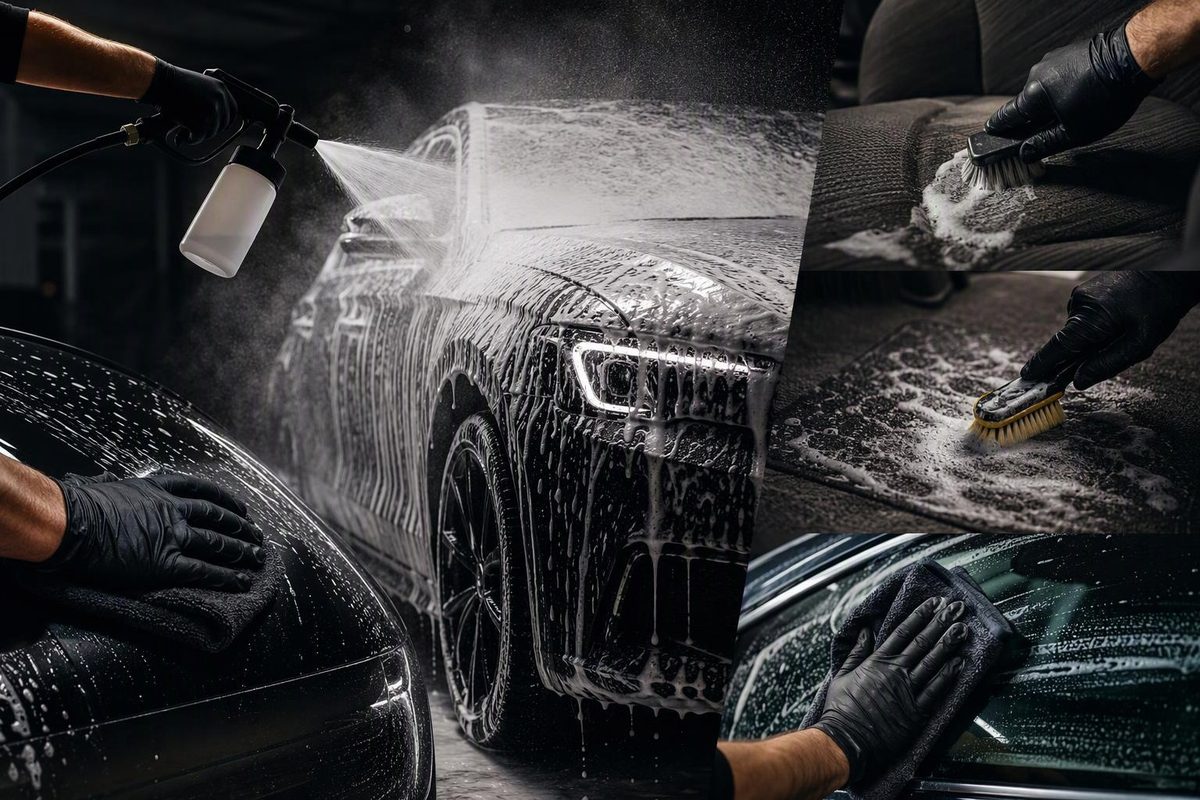
“Foam cleaner” can mean an exterior snow foam, a foaming car shampoo, a fabric-upholstery aerosol or a foaming glass cleaner. These products are not interchangeable. Foam describes how the cleaner is delivered; the label must still approve the exact vehicle surface.
Before buying or spraying, identify all three:
- Surface: paint, carpet, cloth upholstery, glass, vinyl or another material.
- Contamination: loose road film, food, grease, mud, fingerprints or an unknown stain.
- Removal method: rinse with water, wipe with a towel or allow to dry and vacuum.
If the product does not name your surface and explain how to remove its residue, choose another cleaner.
Match the foam cleaner to the job
| Job | Product wording to look for | Typical removal step | Main stop point |
|---|---|---|---|
| Painted exterior | Automotive snow foam, pre-wash or car shampoo | Thorough water rinse | Do not let it dry |
| Carpet or removable fabric mat | Automotive carpet cleaner | Blot or wipe; vacuum if directed | Stop if color transfers or the backing becomes saturated |
| Cloth seat | Upholstery cleaner approved for that fabric | Wipe, dry and/or vacuum as specified | Do not assume approval for leather, suede or Alcantara-like materials |
| Automotive glass | Glass cleaner approved for the glass and any applied film | Wipe dry with a clean, low-lint towel | Avoid overspray onto displays and materials not named on the label |
| Headliner | Only a cleaner and method allowed by the vehicle or material maker | Controlled, minimal-moisture wiping | Do not treat it like carpet or soak it |
Product instructions show why the category name is insufficient. Koch-Chemie’s Gentle Snow Foam is listed for exterior pre-washing and manual washing, with a different dilution for each method. Turtle Wax’s foaming upholstery product instead directs the user to work it into fabric, wipe the seat, let it dry and vacuum away the powder. A professional-use 3M foaming glass cleaner has another process: apply from 20–30 cm away, allow 30 seconds and wipe dry (Koch-Chemie, Turtle Wax, 3M technical data sheet).
How to use exterior foam cleaner
First determine whether the product is a pre-wash, a contact-wash shampoo or approved for both. Snow foam can loosen contamination before a contact wash, but a layer of suds does not make a gritty car safe to scrub immediately.
- Park out of direct sun and let hot panels cool.
- Read the dilution for your applicator. Do not copy a ratio from another shampoo.
- Pre-rinse if the label directs it. Autoglym, for example, tells users to hose away excess dirt before applying its Foaming Car Wash.
- Apply the cleaner by the stated method. A bucket shampoo, pump-sprayer solution and foam-cannon mixture may require different dilutions.
- Stay within the stated contact time and rinse before any section dries.
- If the label permits or requires a mitt wash, use a clean mitt and a lubricated wash solution rather than rubbing a drying foam layer.
- Rinse thoroughly and dry before water spots form.
As one product-specific example—not a universal dilution—Koch-Chemie specifies about 20 ml of Gentle Snow Foam per 1 liter of water in a foam sprayer and 50 ml per 10 liters for hand washing. Autoglym specifies two capfuls of its Foaming Car Wash in 10 liters of bucket water and says to work on cool paint without letting the shampoo dry (Koch-Chemie, Autoglym).
A pump unit can apply foam without a pressure washer, but cleaner compatibility, seals and usable capacity matter; see how to choose a pump foam sprayer.
How to use foam cleaner on carpet or cloth seats
Start with the driest effective process:
- Vacuum loose debris thoroughly.
- Check that the label names the material. Treat leather, perforated leather, suede-like fabric and damaged upholstery as separate cases.
- Patch-test an inconspicuous area. Let it dry fully before judging color or texture.
- For a spot, remove solids and blot liquid first. Follow the stain-specific sequence in how to remove stains from car seats.
- Apply only the amount directed. Aerosol foam can still wet the material beneath it.
- Agitate gently with a material-appropriate brush or towel if permitted.
- Remove residue exactly as directed—blotting, wiping, rinsing and dry vacuuming are not equivalent.
- Leave doors open in a secure, ventilated place until the material is completely dry.
For an even result, a product may direct treatment of the entire seating panel rather than only the visible spot. Turtle Wax, for example, says to spray its upholstery cleaner over the entire seat cover, work it into the fabric, wipe until dry to the touch, then vacuum after complete drying (Turtle Wax). Follow that process only for the product and materials its current label approves.
What foam cannot tell you
Dense, lingering foam does not by itself establish cleaning power, gentleness, lubrication or residue-free rinsing. Likewise, “pH neutral” describes a particular formula; it is not permission to use that formula on every surface. Concentration, contact time, agitation and complete removal all affect the process.
Stop and reassess if you see color transfer, whitening, sticky residue, swelling, loose trim, persistent odor or a water ring. More cleaner and harder scrubbing can enlarge the affected area. For an unknown material or aftermarket finish, confirm the care instructions with the vehicle, upholstery or film manufacturer before proceeding.