
How to Use a Citrus-Based Cleaner Without Guessing
Match a citrus-based car cleaner to the surface and grime, then follow its own dilution, dwell time, agitation and rinse directions.
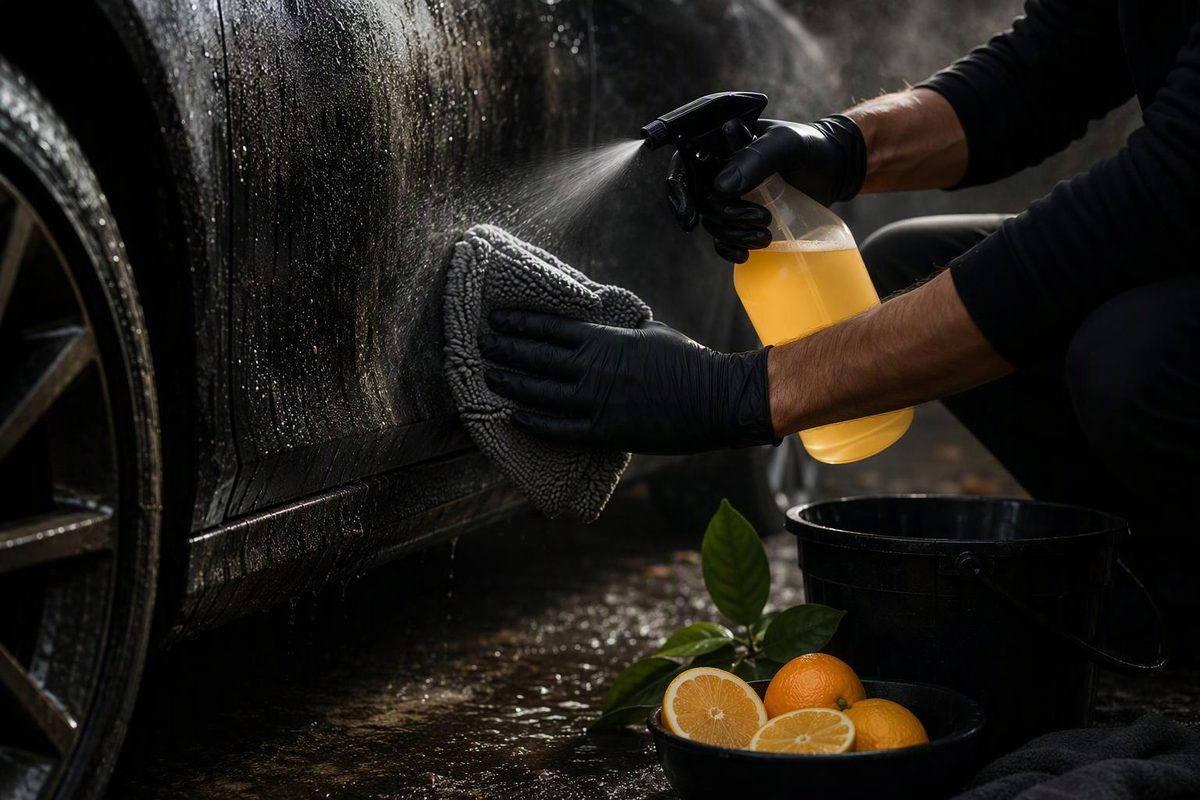
A citrus-based cleaner may be sold as an exterior pre-wash, a concentrated all-purpose cleaner or a specialized remover. Those products are not interchangeable, and “citrus” does not establish a safe dilution or compatible surface.
The useful rule is: choose an automotive cleaner whose current label names both the surface and the job. Do not substitute a household citrus degreaser because it smells similar.
Check what kind of cleaner it is
Before applying anything, classify the product from its label:
- Ready-to-use exterior pre-wash: Applied before contact washing to loosen contamination such as bug residue and road film.
- Concentrated all-purpose cleaner (APC): Mixed at a product-specific ratio for an approved task.
- Adhesive, sap or tar remover: Used as a targeted treatment rather than as a general cleaner.
The finished formula matters more than the citrus name. For example, the April 2022 safety data sheet for Meguiar’s D107 Citrus Power Cleaner Plus gives the concentrate a pH of 12–13, lists sodium metasilicate at 1–5%, and classifies it as causing severe skin burns and eye damage (Meguiar’s D107 SDS). A citrus name or pleasant odor is not a safety rating.
Match the product to the contamination
Use the label—not a generic dilution chart—to make the first decision:
| Job | What to look for |
|---|---|
| Bug residue or traffic film | Exterior pre-wash approved for the vehicle’s paint or film |
| Greasy door jambs | Automotive APC or degreaser approved for the materials present |
| Carpet or floor-mat grime | Cleaner specifically permitted on that textile |
| Tire grime | Product whose directions expressly include tires |
| Wheel contamination | Cleaner approved for the exact wheel finish |
| Tar, sap or adhesive | Dedicated spot remover approved for the affected surface |
A product’s directions apply only to that product. Auto Finesse, for example, describes Citrus Power as pre-diluted and ready to use. For lower body panels, its instructions say to spray the lower half of the vehicle, allow five to ten minutes, and rinse before the wash stage (Auto Finesse instructions). That dwell time is not a universal rule for citrus cleaners.
Likewise, citrus branding does not make a cleaner suitable for every wheel. Identify the finish first; the black-rim cleaner guide explains why wheel color alone is not enough.
Use a controlled process
- Read the bottle and current safety data sheet. Confirm that the directions cover the exact surface. Clear-coated paint, matte paint, wraps, plastic, metal, fabric and leather are not equivalent.
- Work on a cool surface out of direct sun. Do not apply the cleaner where it may dry before the stated dwell time ends.
- Patch-test an inconspicuous spot. Stop if color, gloss or texture changes, or if interior dye transfers to the towel.
- Dilute exactly as directed. If the label says 10:1 water-to-product, that means 10 parts water plus one part concentrate. Check the stated order rather than assuming it.
- Apply only where needed. Around interior switches, screens, seams and perforations, applying an approved cleaner to a towel or brush can offer more control than spraying the surface directly.
- Use only the specified contact time. Longer dwell is not automatically better. Never let the product dry unless its directions explicitly permit that.
- Agitate only when allowed. Use a clean, surface-appropriate towel or soft brush. Do not scrub gritty paint.
- Remove all residue as directed. Rinse an exterior pre-wash thoroughly before contact washing. If the label calls for a normal shampoo wash afterward, complete that step.
- Inspect before repeating. If the remaining mark is tar, mineral scale, bonded contamination or finish damage, increasing APC strength is unlikely to be the right next step.
A pre-wash can remove some contamination before a mitt touches the paint, but it does not automatically replace a lubricated contact wash. If no hose is available and the vehicle is only lightly dirty, use a purpose-made waterless wash method rather than wiping the paint with APC.
Know when not to proceed
Do not infer compatibility from terms such as natural, biodegradable or all-purpose. Unless the cleaner’s own directions expressly allow it, keep it off:
- infotainment and instrument screens;
- unfinished, aniline or damaged leather;
- suede-like upholstery;
- matte paint or matte wraps;
- hot panels, exhaust parts and brake components;
- bare aluminum, anodized metal and unidentified wheel finishes;
- recently refinished paint, newly installed paint-protection film or a coating still within its cure period.
After body work, follow the repairer’s restrictions before using a pre-wash or degreaser. Approval for a gentle hand wash does not necessarily permit stronger chemicals; see cleaning a car after body repair.
Protect yourself
Wear the protection specified by the product. The cited D107 SDS, for example, calls for protective gloves, protective clothing and eye or face protection, and says to avoid breathing mist or spray and to use the product outdoors or with adequate ventilation. It also directs users to keep the cleaner in its original container and away from incompatible materials (Meguiar’s D107 SDS). Do not mix a detailing cleaner with bleach, acids or another cleaner unless the manufacturer explicitly provides that procedure.
Choose a citrus-based cleaner only when its documentation covers the contamination and surface in front of you. Start with the least aggressive approved dilution, observe the stated dwell time and remove the residue completely.