
How to Identify the Warning—and Know When to Stop Driving
A complete circle usually points to the brakes. An open horseshoe usually points to tire pressure. A triangle needs vehicle-specific identification.
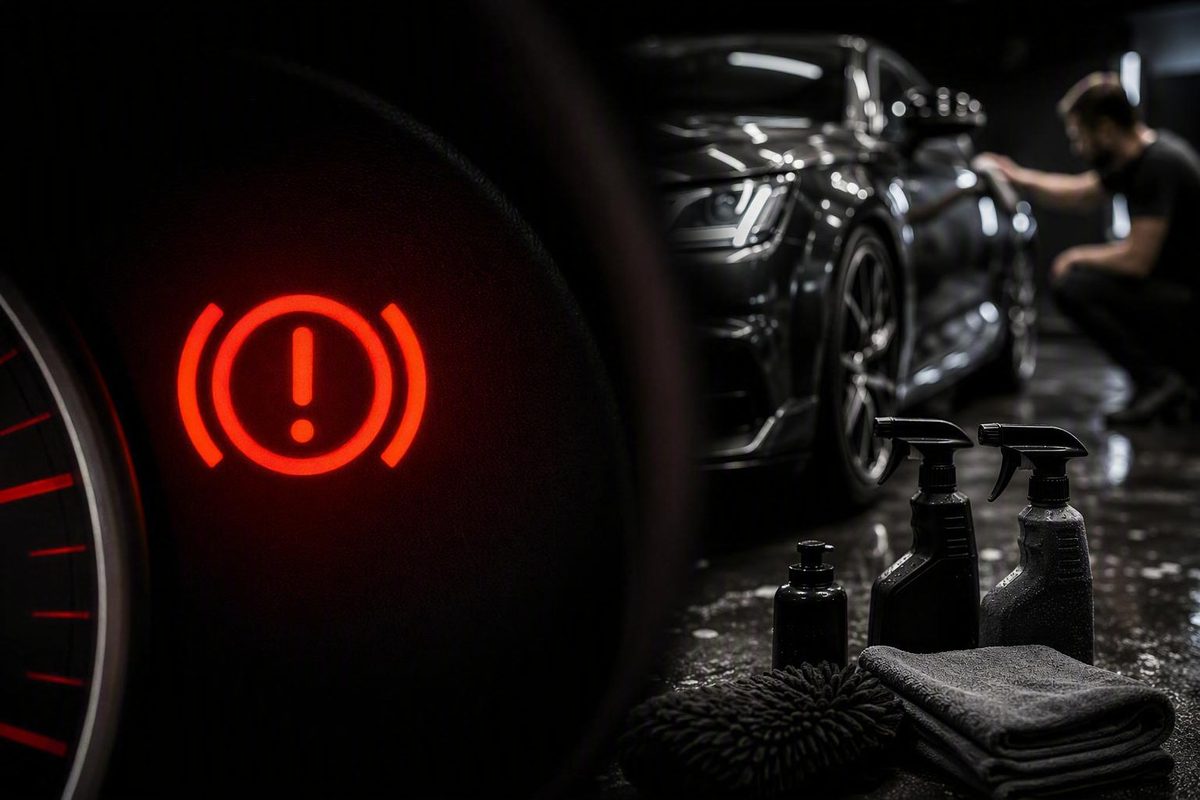
The short answer: a complete circle usually means a brake warning
A plain exclamation mark enclosed by a complete circle, often with curved brackets on either side—(!)—usually identifies the brake-system warning light. Depending on the vehicle, it may also serve as a parking-brake reminder. Symbols and colors can vary by make, model, model year, and market, so confirm the exact meaning in the owner’s manual.
Safety first: If a red circular brake warning remains illuminated, reduce speed smoothly and stop in a safe place. Do not continue driving if braking performance has changed or the pedal feels soft, unusually hard, unresponsive, or otherwise abnormal. A persistent red brake warning should be treated as potentially dangerous until the cause has been assessed. RAC advises stopping safely and obtaining professional help for a red brake warning.
Only after the vehicle is safely stopped and secured should you check whether the parking brake is fully released. If the light switches off, it may have been acting as a parking-brake reminder. If it remains on, do not assume the reminder is simply faulty: low brake fluid, reduced brake pressure, worn brake components, or another braking-system fault may be responsible.
The icon identifies the system that needs attention, not the failed part. It cannot reveal the precise cause or confirm that the vehicle is safe to drive.
A warning can appear before the driver notices an obvious change, and the condition may worsen. If the warning remains illuminated, follow the vehicle-specific instructions in the owner’s manual and arrange professional assessment.
The outline around the exclamation mark is crucial:
- A complete circle, often with side brackets, usually points to the brakes.
- An open horseshoe, U-shape, or tire outline usually points to tire pressure.
- A triangle or symbol with additional geometry may relate to a master warning, traction control, or stability control and must be identified separately.
Identify the outline before interpreting the exclamation mark
The exclamation mark is a general attention signal. The surrounding outline is what usually identifies the relevant system.
If it is safe to do so, photograph the symbol while the vehicle is stationary. Record its color, whether it is steady or flashing, and any message or accompanying warning light.
| Outline | Likely system | Typical concern | First response |
|---|---|---|---|
| Exclamation mark inside a complete circle, often with curved side brackets | Braking system or parking brake | Parking brake engaged, low brake fluid, reduced brake pressure, worn components, or another brake fault | Stop safely, secure the vehicle, and verify that the parking brake is fully released. If a red warning remains on, seek professional help. CAA-Quebec identifies the circular symbol as a brake warning and recommends a cautious response. |
| Exclamation mark inside a U-shaped, horseshoe-shaped, tread-like, or flat-tire outline | Tire-pressure monitoring system, or TPMS | One or more tires may be underinflated | Stop safely, look for obvious tire damage, and measure the pressures with a gauge. Cars.com identifies the U-shaped symbol as the low-tire-pressure warning. |
| Exclamation mark inside a triangle | Master or general warning on many vehicles | Another condition requires attention | Read the accompanying display message and check the owner’s manual. |
| Triangle, arrows, rings, or a skidding-car image | Possibly traction or stability control | The system may be active or may have a fault | Identify the complete icon and obtain vehicle-specific guidance. |
| “ABS” or a separate ABS symbol | Anti-lock braking system | An ABS-related fault | Treat it as a separate warning; the situation is more concerning if the circular brake warning is also on. |
Complete circle: usually the braking system
The conventional brake icon places an exclamation mark inside a complete circle. Curved lines resembling parentheses often appear outside that circle.
The same indicator may illuminate while the parking brake is engaged. That is why checking the parking brake is a useful first step—but the check should be made only after the vehicle is safely stopped and secured.
If the light remains on after the parking brake is fully released, it should not be dismissed. The cause could involve brake-fluid level, pressure, brake components, or another system fault. The dashboard symbol cannot distinguish among those possibilities.
Horseshoe or flat-tire outline: usually tire pressure
The TPMS symbol does not normally form a complete circle. It resembles a tire cross-section: rounded at the bottom, open at the top, and sometimes marked to suggest tread. It may look like a horseshoe, a wide “U,” or a flat tire.
This warning means that at least one monitored tire may be underinflated. A tire can look normal and still have insufficient pressure, so appearance alone is not a reliable check.
Triangle or added geometry: identify it separately
Do not interpret every exclamation mark as a brake warning.
A vehicle-specific explanation for a triangle-and-exclamation icon does not establish the meaning of a plain exclamation mark inside a complete circle. Likewise, a fault considered possible on one vehicle should not be generalized to every warning symbol.
For reliable identification, record:
- The exact outline surrounding the exclamation mark
- Whether the outline is open or closed
- Any curved brackets, arrows, triangle, tread, or skidding-car shape
- The warning color
- Whether the light is steady or flashing
- The vehicle’s make, model, and model year
- Whether the warning remains after startup
- Whether the parking brake is engaged
- Any accompanying dashboard message
- Any ABS, traction-control, or stability-control warnings
- Whether pedal feel or braking performance has changed
These details are far more useful than searching for “exclamation mark dashboard light” without describing the surrounding shape.
What to do when the circular brake warning appears
Treat the situation as a safety decision first and a diagnosis second. Your immediate task is to reach a safe stopping place without making abrupt demands on a braking system that may have a fault. General brake-warning guidance recommends stopping safely and arranging repair rather than continuing normally when the full-circle warning remains on. MotorTrend distinguishes the circular brake warning from the tire-pressure symbol and recommends prompt professional attention.
1. Stay calm and reduce speed smoothly
Ease off the accelerator and increase the space between your vehicle and surrounding traffic. Avoid abrupt steering, sudden lane changes, hard acceleration, or unnecessary heavy braking.
Choose a safe stopping place away from moving traffic where possible. Use hazard lights when conditions warrant and local rules permit.
Do not attempt to diagnose the warning while the vehicle is moving. Wait until it is safely parked and secured.
2. Pay attention to braking response
As you slow down, notice whether the pedal and vehicle respond normally. Warning signs include:
- A soft or spongy pedal
- A pedal that travels farther than usual
- An unusually hard or unresponsive pedal
- Delayed or weak braking
- Pulling, vibration, grinding, or other unexpected behavior
- An urgent dashboard message or warning buzzer
- Unexplained fluid beneath the vehicle
Fluid beneath a vehicle does not by itself prove there is a brake-fluid leak. Its source requires diagnosis.
If the pedal or braking performance is abnormal, do not continue driving. Arrange roadside assistance or recovery. Do not repeatedly test the brakes at road speed.
3. Check the parking brake after stopping
Once the vehicle is safely stopped and secured, verify that the parking brake is fully released. Follow the vehicle’s instructions, especially if it has an electronic parking brake.
Where the manual permits:
- Keep the vehicle secure and your foot on the service brake.
- Engage the parking brake.
- Release it completely.
- Observe whether the warning turns off, remains illuminated, or returns.
A light that turns off may have been associated with the parking brake. A light that stays on requires further attention. Do not repeatedly operate the parking brake in an attempt to force the warning to clear.
4. Assess the complete warning pattern
Consider four questions:
- Is the circular warning red?
- Does it remain on after the parking brake is released?
- Has the pedal or braking response changed?
- Is the ABS warning also illuminated?
A persistent red warning, abnormal braking, a suspected leak, or simultaneous brake and ABS warnings favors professional assistance or recovery rather than continued driving.
Do not use normal pedal feel as the sole reason to continue. The warning may relate to a condition that cannot be evaluated from the driver’s seat.
5. Arrange professional assistance when safety is uncertain
Do not continue driving when:
- Braking performance has changed
- The pedal feels abnormal
- The red circular warning remains illuminated
- A brake-fluid leak is suspected
- The brake and ABS warnings remain on together
- An urgent message or buzzer is present
- You cannot identify the warning confidently
- You cannot confirm that the vehicle is safe to move
Contact roadside assistance, a qualified repair facility, or an appropriate recovery service. Do not crawl under the vehicle or inspect brake components beside moving traffic. If the stopping location itself is unsafe, prioritize personal safety and follow the roadside-emergency guidance applicable in your area.
Possible causes of a persistent brake warning
A warning light identifies a system that needs attention. It does not diagnose the failed component. The following are possible causes, not conclusions.
Parking brake engaged or not fully released
The simplest explanation is that the parking brake remains engaged. A partially released parking brake may keep the warning illuminated.
If the warning disappears after the parking brake is fully released, consult the manual to confirm that this behavior matches the vehicle’s design. If the light stays on or returns unexpectedly, do not dismiss it as a reminder.
Low brake-fluid level
Some vehicles use the circular warning to indicate low brake fluid. The reason for a low level must still be identified.
Adding fluid is not necessarily a complete repair. It may change the indicated level without addressing why the level fell. The correct fluid specification and checking procedure are also vehicle-specific.
If leakage is suspected or braking feels different, do not drive onward.
Reduced hydraulic pressure
The warning may indicate reduced brake pressure or another hydraulic problem. This possibility is particularly concerning when the pedal or braking response has changed.
A driver cannot determine from the dashboard alone whether the cause is hydraulic, mechanical, or electrical. Professional inspection may be required.
Worn brake pads or other brake components
Worn brake pads or other brake components are possible triggers on some vehicles, but this is not universal. A vehicle may use a separate wear indicator, display a written message, or provide no electronic pad-wear warning.
Do not assume worn pads are the cause merely because the circular light is on. Equally, the absence of a separate wear warning does not establish that the brakes are in good condition.
Broader brake-system malfunction
A general dashboard guide similarly lists an engaged parking brake and braking-system problems as possibilities rather than presenting one universal diagnosis. Exclusive Motorcars describes the icon as a brake warning that can have more than one cause.
Professional assessment may include inspection and vehicle-specific diagnostic testing. The useful distinction is:
- The icon identifies the likely system.
- Inspection identifies the actual problem.
How color and timing affect the response
Color and timing provide useful context, but neither should be considered in isolation.
Red generally means stop as soon as safely possible
Dashboard colors often follow a traffic-light convention. Red can indicate a serious, potentially dangerous condition requiring the driver to stop when it is safe to do so. A persistent red brake warning should therefore be treated cautiously and assessed professionally. RAC classifies red warnings as potentially dangerous and advises stopping safely.
A red warning does not prove that the brakes have already failed. It means the potential risk is too serious to dismiss without identifying the cause.
Yellow or amber generally means prompt attention
Vehicles may use different colors or symbols for parking-brake, hydraulic, electronic-braking, component-wear, and ABS warnings. A written dashboard message may also change the required response.
Manufacturer instructions take priority over general color conventions. Abnormal braking, a red warning, a buzzer, or a stop instruction should be treated as the more urgent indication.
Brief startup illumination may be a self-check
Dashboard warning lights commonly illuminate briefly during startup and then switch off. The important distinction is whether the light extinguishes as expected or remains on.
Do not assume every brief appearance is harmless. Vehicle behavior varies. If the sequence is unfamiliar, lasts longer than expected, recurs, or has recently changed, consult the owner’s manual.
Persistence and braking behavior matter most
Use this practical order of concern:
- Changed braking performance or abnormal pedal response
- A persistent red circular warning
- Brake and ABS warnings illuminated together
- An urgent message, buzzer, or suspected leak
- A warning that remains after the parking brake is released
- The warning color
- Whether it appeared only during startup
Color helps indicate urgency, but it does not override a physical change in braking. An amber light accompanied by a soft or unresponsive pedal still requires an urgent response.
What it means when the brake and ABS lights are on together
The circular brake warning and ABS warning are generally separate indicators. An ABS light should not automatically be named as the cause of every circular brake warning, and the circular light should not automatically be interpreted as an ABS fault.
When both warnings remain illuminated, the situation is more concerning. Guidance for the bracketed circular brake symbol states that simultaneous brake and ABS lights can indicate a braking-system malfunction and that the brakes may not work properly. Warranty Direct advises stopping when the brake and ABS warnings appear together.
The practical response is to:
- Reduce speed smoothly.
- Avoid abrupt braking or steering.
- Stop in a safe location.
- Do not continue solely because the pedal currently feels normal.
- Arrange professional assessment or vehicle recovery.
The warning lights do not identify the failed component. Do not guess that a wheel-speed sensor or another particular part is responsible.
A triangle, skidding-car symbol, or symbol with arrows must be distinguished from the plain circular brake warning.
If the red brake warning and ABS warning both remain on, avoid continued driving and call for assistance.
If the outline is horseshoe-shaped, check the tires instead
An exclamation mark inside a U-shaped, horseshoe-shaped, tread-like, or flat-tire outline normally indicates the tire-pressure monitoring system. It means at least one tire may be underinflated.
The basic distinction is:
- Complete circle: usually brakes
- Open horseshoe or tire shape: usually tire pressure
Stop safely and inspect the tires
Move to a safe location before examining the tires. Look for an obviously flat tire or visible damage. If a tire appears unsafe, do not continue driving on it; follow the vehicle’s roadside instructions or call for assistance.
A visual check is only the first step. A tire can appear normal while still being underinflated.
Measure pressure with a gauge
Measure the applicable tires with a reliable gauge and use the vehicle manufacturer’s recommended pressures. Proper inflation affects braking, handling, stability, tire life, and fuel economy. Cars.com explains why the TPMS warning and correct tire inflation matter.
Do not rely on appearance or pressing the tire’s sidewall. If one tire repeatedly loses pressure, further investigation is needed.
Cold weather can trigger the warning
The warning commonly appears after temperatures fall because tire pressure changes with conditions. Do not ignore the light as merely weather-related. Measure the pressures and adjust them according to the vehicle instructions.
Check all applicable tires rather than assuming the one that looks lowest is the only concern.
Reset behavior varies
On many vehicles, the TPMS light switches off after the tires are correctly inflated and the vehicle is driven under suitable conditions.
There is no universal reset method. Follow the owner’s manual rather than disconnecting the battery, pressing an unrelated control, or driving an assumed distance.
If the pressure is correct but the light stays on, flashes, or returns, professional investigation may be needed.
Confirm the exact warning for your vehicle
General guides can identify the likely system, but they cannot replace the vehicle’s owner’s manual or a mechanical diagnosis. Look in the manual’s instrument-panel, warning-light, braking, tire-pressure, or emergency section.
Match the complete icon, not the exclamation mark alone. Compare:
- The outer shape
- Open versus closed outlines
- Side brackets or parentheses
- The warning color
- Steady versus flashing illumination
- Accompanying text
- Related warning lights
When searching a digital manual or speaking to a professional, provide:
- Make, model, and model year
- Market, if relevant
- Warning color
- Exact surrounding shape
- Whether the light remains on
- Parking-brake status
- Pedal feel and braking response
- Any accompanying ABS, traction-control, or stability-control warnings
- Any dashboard message or buzzer
A useful description would be:
“The vehicle is a [year, make, and model]. A steady red exclamation mark inside a complete circle with curved side brackets remains on after the parking brake is released. The ABS light is also on, and the pedal feels different.”
Seek professional assessment when the warning persists, recurs, accompanies abnormal braking, appears with a suspected leak or ABS warning, or cannot be identified confidently.
The decision rule is straightforward: a complete circle usually suggests the brakes; a horseshoe or tire outline usually suggests tire pressure; a triangle or added geometry requires separate, vehicle-specific identification.
Frequently asked questions
Can I drive with a red circle-and-exclamation brake warning on?
Do not plan to continue driving with a persistent red circular brake warning. Reduce speed smoothly, stop as soon as safely possible, and arrange professional assistance—especially if the pedal feels different, braking has changed, leakage is suspected, or another brake-related warning is illuminated. Allen Tire’s dashboard guidance recommends stopping safely and arranging recovery for the full-circle brake warning.
Check the parking brake only after the vehicle is safely stopped and secured. Normal pedal feel does not by itself confirm that the vehicle is safe.
Why is the brake warning still on after I released the parking brake?
Possible causes include low brake fluid, reduced hydraulic pressure, worn brake components on vehicles that monitor them, or another braking-system malfunction. The icon cannot distinguish among these conditions. CAA-Quebec lists multiple possible triggers for the circular brake warning.
If the warning remains red, stop safely and arrange an inspection rather than guessing from the symbol.
Does a circle with an exclamation mark mean low tire pressure?
A complete circle with an exclamation mark usually indicates the brake system. The low-tire-pressure warning normally places the exclamation mark inside an open U-shaped, horseshoe-shaped, tread-like, or flat-tire outline. MotorTrend distinguishes the full-circle brake warning from the open tire-pressure symbol.
If the symbol is tire-shaped, stop safely, inspect the tires, and measure their pressure with a gauge.
What should I do if the brake and ABS lights come on together?
Slow down smoothly, avoid abrupt maneuvers, and stop in a safe place. When the brake and ABS warnings remain on together, the braking system may have malfunctioned and the brakes may not work properly. Arrange professional assessment or recovery. Warranty Direct specifically warns against continuing when both indicators are illuminated.
Do not assume a particular sensor is responsible. The vehicle may require fault-code retrieval, inspection, and model-specific diagnosis.
Will adding brake fluid turn off the warning light?
It may affect the warning if low fluid is the trigger, but adding fluid is not necessarily a repair. A low level may be associated with leakage, brake wear, or another condition that must be identified. Acura of Tempe lists low brake fluid as one possible cause of the circular brake-system alert.
Do not add fluid without following the manufacturer’s instructions and using the specified fluid. If the warning remains red, leakage is suspected, or braking feels abnormal, do not drive onward.
Inspect the outline first: a complete circle with an exclamation mark usually points to the brake system, while a horseshoe-shaped outline usually points to tire pressure. After stopping safely, verify that the parking brake is fully released. If a red circular warning remains on—especially with abnormal braking, suspected leakage, or an ABS warning—arrange professional assistance and confirm the vehicle-specific instructions in the owner’s manual.