
Read Water Beading as a Surface Clue, Not a Protection Test
Learn what water beading says about car paint, why it changes, how to check a clean panel, and when to wash, decontaminate or renew protection.
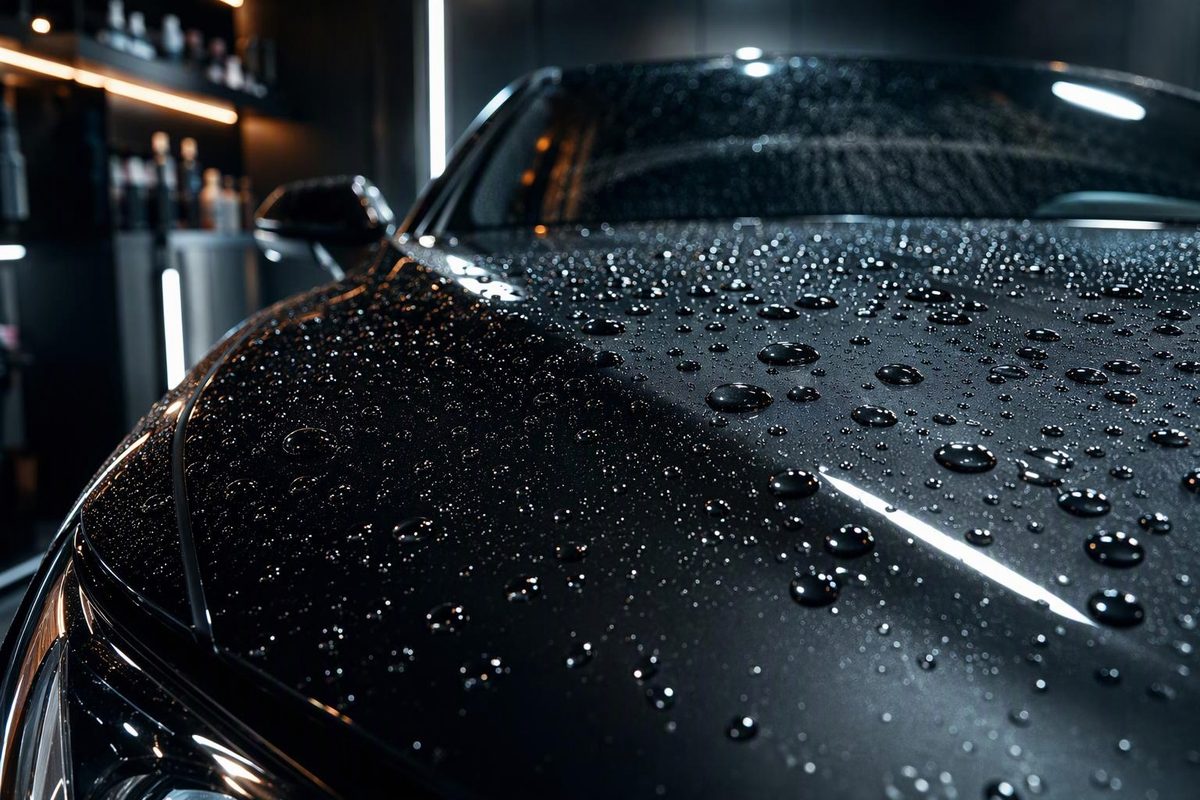
Water beading means the surface currently resists wetting: water pulls into separate, rounded drops instead of spreading into a continuous film. It is evidence of hydrophobic behavior, but it does not prove that wax, sealant or ceramic coating remains intact.
In surface science, a water contact angle above 90 degrees is classed as hydrophobic; a higher angle indicates lower wettability. A car panel is not a controlled laboratory sample, however. Surface roughness and chemical differences—including dirt and product residue—can change the observed angle (Biolin Scientific).
What the water can—and cannot—tell you
During the final rinse, look for three broad behaviors:
- Beading: water separates into rounded drops.
- Sheeting: water forms a broad film but retreats and leaves relatively little behind.
- Persistent wetting: a film clings across much of the panel.
Beading is not automatically better than sheeting. Watch how readily the water leaves, not just how tall the drops look. Surface-science guidance explains that a high initial contact angle does not fully describe water repellency: a rounded drop can still adhere strongly, while wetting and dewetting behavior provide additional information (KRÜSS Scientific).
Do not use beads alone to declare paint protected or unprotected. A drying aid or detail spray can make the exposed surface bead, while road film can temporarily hide an underlying coating’s normal behavior. Hydrophilic paint-protection products also exist. Dr. Beasley’s therefore describes beading as a poor stand-alone test of remaining protection (Dr. Beasley’s).
Check a clean panel
Rain on a dirty car is a poor coating diagnostic. Check water behavior after a normal maintenance wash:
- Work on cool paint out of direct sun. Dilute and use the shampoo as its label directs.
- Pre-rinse loose grit, then wash gently. Keep wheel tools and towels away from paint.
- Rinse thoroughly. Shampoo or wash-product residue can affect the result.
- Compare several panels. Check the roof and hood as well as doors and lower sections. One weak area suggests a localized difference in contamination, product coverage or wear; it does not establish the cause.
- Dry the vehicle completely. Do not leave test water to evaporate.
For comparisons over time, use the same washing process and water source where practical. If mineral deposits keep returning, test the tap that actually supplies the wash rather than assuming the shampoo or coating is at fault.
If beading has weakened, clean before adding protection
Use a least-aggressive sequence and stop when the expected water behavior returns.
1. Perform a careful maintenance wash
A complete wash may remove traffic film, oils or wash-product residue. Opti-Coat’s coating-care guidance says road film, minerals, oils and other contamination can change both beading and sheeting; reduced water behavior alone does not necessarily mean a ceramic coating has failed (Opti-Coat).
2. Identify any remaining contamination
After washing and drying, inspect the paint rather than immediately reaching for clay or polish:
- Visible rings or pale deposits: suspect mineral contamination. Use a water-spot product only if its directions approve the paint, coating or film involved. A different shampoo may improve the wash process, but it is not automatically a cure for existing deposits; see what helps when washing with hard water.
- Orange-brown pinpoints: they may be ferrous contamination. Use an iron remover only when its label approves the affected finish, and follow its dwell and rinse directions.
- Dark, sticky dots: they may be tar. Choose a compatible tar remover and treat only the affected area.
- Unidentified roughness: ask the coating maker or installer what decontamination process is permitted before proceeding.
Do not clay or polish merely because a panel stopped beading. Clay media can mar paint, while polishing is abrasive and may alter or remove wax, sealant or coating. On a coated vehicle, follow the coating maker’s maintenance instructions and warranty terms first.
3. Rinse, dry and check again
If washing or suitable chemical decontamination restores the previous behavior, contamination was masking the surface. If a clean panel remains noticeably different from comparable panels, the protection may be worn, uneven or damaged—but beading alone cannot identify which.
4. Renew protection only when justified
For wax or a consumer sealant, prepare the surface and reapply according to the product’s compatibility, application and cure instructions. For a professionally installed ceramic coating, contact the installer before polishing or adding an unrelated topper, particularly when the warranty requires inspections or specified maintenance products.
Beading does not prevent water spots
Rounded drops concentrate water into discrete areas; they do not make it disappear. If mineral-containing water dries on the vehicle, deposits can remain. Opti-Coat advises against allowing tap, sprinkler or wash water to air-dry because the resulting spots may etch a coating or the paint beneath it.
After washing, remove water with a clean microfiber drying towel or a vehicle-safe blower. There is no need to chase every rain bead, but sprinkler and wash water should not be left baking on hot panels. Strong beading is a surface characteristic—not permission to skip drying, washing or contamination control.