
A Practical Guide to Cleaning, Protecting, and Caring for Your Car
Match service to vehicle condition, follow safer DIY workflows, and compare written scope, price, duration and policies before hiring.
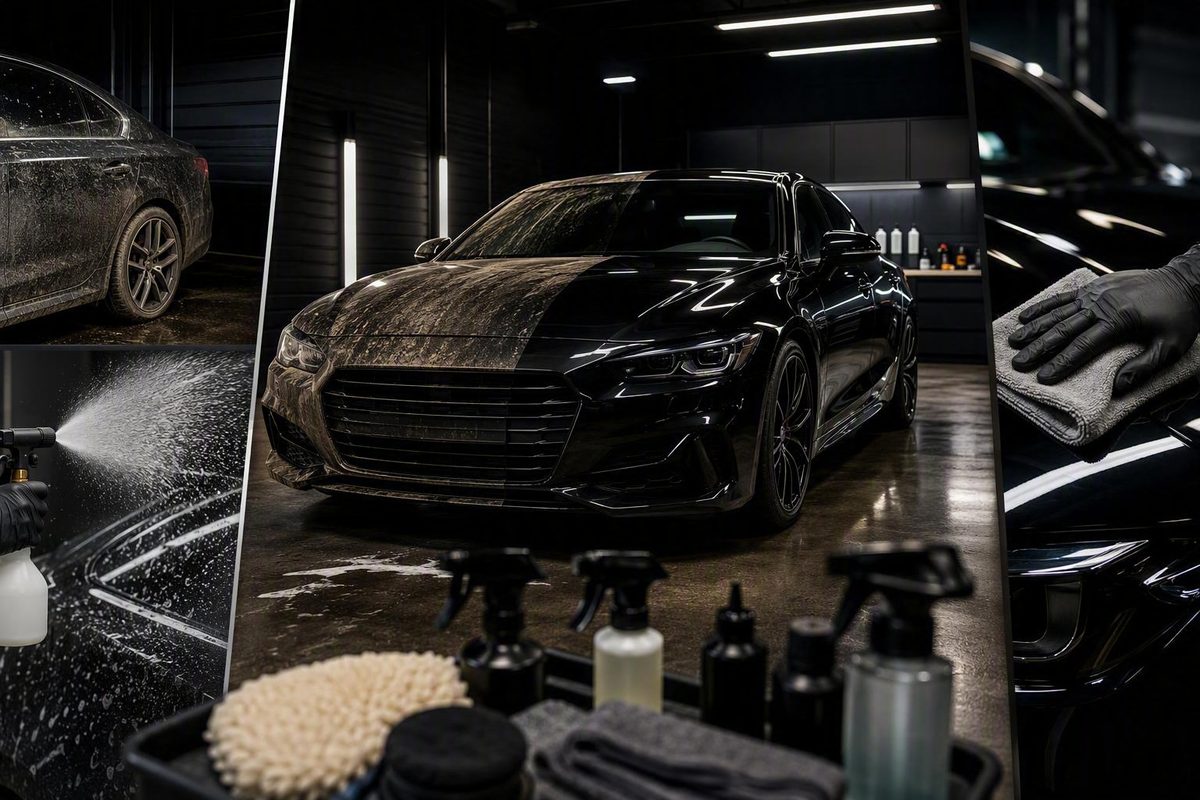
It can describe anything from a careful maintenance wash and light interior cleanup to deep upholstery cleaning, paint decontamination, machine correction, ceramic coating, or paint protection film. That breadth explains why two packages called a “full detail” can have very different prices, time requirements, and results.
The most useful approach is condition-first. Identify what is dirty, contaminated, damaged, or unprotected before buying products or comparing packages. Then choose the least aggressive process capable of producing the result you want.
What car detailing is—and how it differs from a car wash
A routine car wash primarily removes loose and surface-level dirt from the exterior. Detailing is generally more extensive. It may clean interior and exterior surfaces more thoroughly, address residue or bonded contamination, refine the finish, and add optional protection. It does not follow one universal checklist.
Exterior detailing can involve paint, wheels, tires, glass, trim, emblems, crevices, and door jambs. Interior detailing can cover seats, carpets, mats, dashboards, consoles, vents, glass, storage areas, and other cabin surfaces. A package may focus on one side of the vehicle or combine both.
Common service categories include:
- Routine wash: Rinsing, washing, drying, and possibly basic wheel or glass cleaning.
- Maintenance or express detail: A more deliberate wash and light cabin cleanup for a regularly maintained vehicle.
- Deep detail: More intensive treatment of accumulated soil, carpets, upholstery, trim, crevices, wheels, or exterior contamination.
- Decontamination: Removal of material that remains attached after ordinary washing.
- Correction: Abrasive refinement intended to reduce selected paint defects.
- Protection: Application or installation of wax, sealant, coating, or film.
The word “detail” does not automatically mean restoration. Nor does “full detail” guarantee extraction, stain treatment, clay treatment, polishing, or protection. AutoZone’s overview separates exterior and interior work and presents polishing as an optional step rather than a universal part of every package (see its detailing guide).
Several higher-level services should be distinguished from cleaning:
- Polishing refines a painted surface with an abrasive product.
- Paint correction uses controlled abrasion to reduce selected visible defects.
- Ceramic coating is an applied protective product that normally has its own preparation and installation process.
- Paint protection film, or PPF, is a physical film installed over selected painted areas.
- Body repair addresses dents, rust, failed paint, collision damage, and other structural or finish problems.
Detailing can improve cleanliness, gloss, texture, and overall cosmetic condition, but it cannot guarantee removal of every stain, odor, scratch, water mark, or paint defect. An odor may originate beneath an accessible surface. A scratch may be too deep to reduce responsibly through polishing. Loose trim, deteriorated leather, failing headliners, rust, and peeling clear coat require assessment rather than increasingly aggressive cleaning.
A practical service ladder is:
- Maintenance cleaning
- Express detailing
- Deep interior or exterior detailing
- Paint and surface decontamination
- Paint enhancement or correction
- Applied or film-based protection
You do not necessarily need to climb the entire ladder. A well-maintained car may need only the first two levels. A neglected interior may need deep cleaning without paint correction.
The car-detailing service ladder: from maintenance wash to PPF
Package names are marketing labels, not specifications. Compare the written tasks, exclusions, and intended result rather than assuming one provider’s full detail matches another’s.
Maintenance and express detailing
A maintenance detail is intended for a vehicle that already receives regular care. Its purpose is to remove ordinary road film, dust, light cabin debris, fingerprints, and minor soil before they become more difficult to address.
Common tasks include:
- Pre-rinsing or light pre-cleaning
- Hand washing
- Basic wheel and tire cleaning
- Controlled drying
- Exterior and interior glass cleaning
- Light vacuuming
- Wiping accessible dashboard, console, and trim surfaces
- Optional wax, sealant, or maintenance product
An express service may omit carpet shampooing, stain treatment, pet-hair removal, deep crevice work, decontamination, and polishing. Check those points explicitly before booking.
Exterior detailing
A more complete exterior detail normally begins with inspection, pre-cleaning, washing, wheel and tire care, rinsing, and drying. Depending on the package and the paint’s condition, it may then include tar or iron treatment, clay treatment, trim care, glass cleaning, light polishing, and wax or sealant.
Exterior detailing should not be equated with paint correction. Washing removes ordinary dirt. Decontamination targets material left after washing. Polishing abrades a limited portion of the paint system to reduce selected defects. These are different operations with different time, product, and skill requirements.
Interior detailing
A basic interior detail commonly includes removing loose debris, vacuuming, cleaning accessible hard surfaces, treating seats and carpets according to their materials, cleaning glass, and inspecting the finished cabin.
A deep interior service may add focused stain treatment, more extensive pet-hair removal, carpet or fabric extraction, difficult crevice work, or odor-source investigation. Those tasks are not automatic. Ask whether the package includes the headliner, cargo area, seat rails, spare-wheel compartment, child-seat area, and spaces beneath removable components.
Decontamination
If clean paint still feels rough or shows attached residue, a targeted decontamination process may be appropriate:
- An iron-removal product targets compatible ferrous contamination.
- A tar remover targets tar-like residue.
- Lubricated detailing clay or a clay alternative physically removes remaining bonded contamination.
- Other deposits may require product-specific treatment or professional assessment.
Use the product label to determine compatibility, dilution, dwell time, surface-temperature limits, rinsing, and required follow-up. Clay must remain adequately lubricated and should be considered only after washing. Do not combine products or improvise a chemical sequence when the manufacturers’ instructions do not support it.
Paint enhancement and correction
A light paint enhancement seeks a general improvement in gloss and clarity. Paint correction is more defect-focused.
That makes correction an inspection and judgment task. The technician must consider the paint’s condition, the nature of the defects, previous repairs, and the customer’s expectations. Not every scratch can—or should—be pursued.
A written quote should state:
- Whether the goal is general enhancement or targeted correction
- How many polishing stages are included
- Which panels are included
- Whether an inspection may change the recommendation
- Which defects are expected to remain
- Whether coating preparation is included or priced separately
Wax, sealant, ceramic coating, and PPF
These categories are not interchangeable:
- Wax is a separately marketed applied protectant often selected for appearance and straightforward application.
- Paint sealant is another type of applied protectant. Product terminology can overlap, so use the named product’s preparation, compatibility, and maintenance instructions rather than relying on the category alone.
- Ceramic coating is an applied coating that generally involves dedicated preparation, installation, curing, and maintenance instructions.
- PPF is a physical film installed on agreed panels or sections of a vehicle.
Durability, curing, maintenance, and warranty claims should be documented for the named product rather than inferred from the category. Preparation may be a separate line item.
Allentown-area providers illustrate the breadth of the market. Local menus advertise combinations of interior and exterior detailing, paint correction, ceramic coatings, PPF, tinting, maintenance programs, and add-ons. TopLine Auto Spa, for example, markets detailing alongside correction, coating, film, and tint services, showing why “car care” can extend well beyond washing (review its advertised service categories). That does not make every listed service necessary for every vehicle.
| Service level | Typical tasks | Appropriate vehicle condition | Optional add-ons | Questions to ask |
|---|---|---|---|---|
| Maintenance wash | Rinse, hand wash, wheels, drying, glass | Regularly maintained; light soil | Spray protection, tire treatment, light vacuum | Are door jambs, wheels, and interior included? |
| Express detail | Maintenance wash plus light interior cleaning | Mild exterior and cabin soil | Wax, sealant, spot treatment | What makes this different from a wash? |
| Interior detail | Decluttering, vacuuming, material-specific cleaning, glass | Dust, crumbs, ordinary use | Pet hair, stain treatment, extraction, odor work | Are the cargo area, headliner, and deep stains included? |
| Exterior detail | Wash, wheel care, drying, glass, trim | General road film or dull appearance | Decontamination, wax, sealant | Is bonded contamination assessed separately? |
| Deep or full detail | More intensive interior and exterior work | Accumulated soil across both areas | Extraction, pet hair, odor work, protection | Can I see a line-by-line written scope? |
| Decontamination | Targeted chemical treatment and/or lubricated clay | Paint remains rough or contaminated after washing | Polishing, protection | What contamination was identified, and what follows treatment? |
| Paint enhancement or correction | Abrasive refinement and inspection | Visible swirls, haze, or selected correctable defects | Coating preparation, panel-specific work | What result is realistic, and what defects will remain? |
| Ceramic coating | Preparation plus applied coating | Owner wants a coating-specific protection system | Correction, wheels, glass, maintenance visits | Which product, preparation, curing, warranty, and maintenance are included? |
| PPF | Preparation and installation of physical film | Owner wants film on agreed panels | Correction, coating, expanded coverage | Which panels, edges, film, warranty, and aftercare are included? |
How much car detailing costs—and what changes the quote
The available evidence does not establish a definitive national average or a definitive Allentown market average. Advertised starting prices are not final quotes, and similarly named packages may include substantially different work.
As an Allentown planning snapshot, Panda Hub displays an entry package starting at $79.91, states that many services in the area fall around $100 to $400, and shows selected booking examples above $400. Its examples also display estimated durations of approximately two to 3.5 hours. These figures come from the company’s promotional page, have no clear pricing effective date, and do not provide a complete inclusion list for every example (view the displayed Allentown pricing).
Treat those figures as conversation starters, not benchmarks or guarantees. A low starting price may describe an express package for a small, regularly maintained sedan. It does not establish the price of a deep interior detail on a three-row SUV with embedded pet hair, staining, or persistent odor. It also does not establish the price of correction, coating, or film installation.
Variables that can change the quote
A detailer may price work according to:
- Vehicle size, body style, and seating configuration
- Current condition rather than age alone
- Amount and type of exterior soil
- Pet hair, sand, mud, food debris, or heavy dust
- Number, type, and age of stains
- Smoke, pet, food, moisture, or other odor sources
- Interior-only, exterior-only, or combined service
- Carpet or upholstery extraction
- Access beneath or around seats
- Any proposed seat removal
- Bonded exterior contamination
- Tar, iron deposits, sap, overspray, or adhesive residue
- Paint enhancement or multi-stage correction
- Wax, sealant, coating, or film
- Vehicle location and travel distance
- Water or electrical access
- Weather-related rescheduling
- Optional areas such as cargo compartments or heavily soiled door jambs
Some conditions are difficult to price from a short description. Clear photographs help, but an in-person inspection may reveal additional work. The important issue is not whether a quote can ever change; it is whether the provider explains the possible triggers and obtains approval before proceeding.
How long should you plan for?
Time estimates vary with package and condition. Detail King estimates approximately 1.5 to three hours for many sedan interior details, depending on equipment, stains, odor work, and vehicle condition, while noting that difficult restoration can take considerably longer (see its interior workflow and timing).
A broader AutoZone comparison estimates approximately three to eight hours for professional detailing and notes that specialty or extra-large vehicles may take longer (review its professional-versus-DIY comparison). These are planning ranges, not service guarantees.
Restorative cleaning, extensive contamination, oversized vehicles, correction, coating preparation, film installation, curing, and unexpected material problems can extend the appointment. A short estimate is not automatically suspicious if the service is limited and the vehicle is already clean. Conversely, a longer booking does not prove that the work is more thorough.
A quote-request template
Use a message like this before booking:
I have a [year, make, model, body style] and want help with [interior, exterior, or both]. The main conditions are [pet hair, stains, odor, heavy soil, rough paint, swirls, sap, or other concerns]. Please provide:
- The written scope and exclusions
- The estimated total price
- Applicable taxes, fees, or deposits
- Vehicle-size or condition surcharges
- Travel charges, if any
- Add-ons that may be recommended
- Conditions that would cause the quote to change
- The expected appointment duration
- Drying, curing, or vehicle-hold requirements
- What happens if additional work is discovered
- The realistic result and defects likely to remain
Attach current photographs taken in ordinary daylight. Include the driver’s seat, rear seating, carpets, cargo area, wheels, and representative paint panels. If odor is the main concern, describe when it occurs and any known spills or moisture events; photographs cannot communicate odor.
Mobile versus in-shop detailing
Neither mobile nor shop detailing is inherently better. Suitability depends on the requested service, workspace, weather, equipment, operator, and vehicle condition.
Mobile detailing
Mobile service can be convenient when a technician can work at your home or workplace while you do something else. It may suit maintenance washes, ordinary interior cleaning, and other tasks that fit the operator’s equipment and the available environment.
Do not assume that “mobile” means fully self-contained. Ask whether the operator supplies water and electrical power. Mr. Detailing says its mobile unit carries spotless water and self-contained power and also advertises pickup and drop-off, but availability and terms should be verified for the specific appointment (see its advertised service options).
Mobile work introduces practical variables:
- Is the parked vehicle accessible for the entire appointment?
- Is there safe working space on every side?
- Will sprinklers, landscapers, traffic, or workplace rules interfere?
- What are the runoff and drainage expectations?
- Can the service proceed in wind, cold, heat, or direct sun?
- Does the provider need a faucet or outlet?
- Is the address inside the service radius?
- Are travel charges included?
- What happens if rain is forecast?
- Who will provide and retrieve the keys?
Travel and weather policies vary. Panda Hub advertises no travel fee on its Allentown page. Magic Car Detailing states that travel beyond 30 miles from its Bethlehem headquarters incurs a $1-per-mile surcharge and says mobile appointments may be rescheduled when rain is forecast (check its published mobile terms). Confirm the applicable policy in writing because availability and terms can change.
In-shop detailing
It may also provide fixed equipment and space to retain a vehicle for longer work. Those characteristics can make a shop more practical for paint correction, coating preparation and curing, PPF installation, and other work that benefits from a controlled environment.
Shop service may be less convenient if the vehicle must stay for a day or longer. Ask:
- When must the vehicle be dropped off?
- Will it remain indoors?
- Is overnight storage required?
- Who may move the vehicle?
- Is pickup or drop-off available?
- When is payment due?
- What happens if completion is delayed?
- Are there aftercare restrictions following collection?
| Factor | Mobile detailing | In-shop detailing |
|---|---|---|
| Location | Home, workplace, or another approved site | Provider’s fixed facility |
| Convenience | Less customer travel; vehicle must remain accessible | Requires handoff and collection unless transport is offered |
| Weather risk | More exposed to rain, wind, heat, and cold | Usually more controlled |
| Utilities | Provider may be self-contained or require customer access | Fixed utilities are more likely, but equipment should still be verified |
| Advanced work | Possible where the process and conditions allow | Often more practical for controlled-environment work |
| Travel charges | May be included, zoned, or mileage-based | Usually not applicable to the service itself |
| Vehicle handoff | Keys and parking access must be coordinated | Formal drop-off and collection |
| Appointment length | Often structured around same-location completion | May accommodate extended or overnight work |
Mobile-booking checklist
Confirm these points in writing:
- Service radius and exact appointment address
- Travel fee or mileage surcharge
- Water and electrical requirements
- Space needed around the vehicle
- Runoff or drainage expectations
- Rain, wind, heat, and cold policy
- Deposit, cancellation, and rescheduling terms
- Arrival window and expected completion time
- Access to keys and the parked vehicle
- Whether the vehicle may be moved
- Services excluded from mobile appointments
- Contact information for appointment-day changes
DIY or professional detailing: a condition-based decision
Routine DIY detailing is practical for many owners. Washing, dedicated wheel cleaning, vacuuming, light surface cleaning, glass care, and straightforward wax or sealant application can be manageable when product labels and vehicle instructions are followed.
DIY gives you control over tools, product selection, pace, and maintenance frequency. Reusable equipment can support repeated work. The tradeoffs are startup cost, storage, setup and cleanup time, physical effort, and the need to learn which products and methods suit each surface.
Professional service shifts much of that work to someone else and may provide access to specialized equipment or experience. It does not guarantee a better outcome. Results still depend on the technician, package, inspection, process, vehicle condition, and agreed scope.
Suitable beginner DIY tasks
Consider handling these yourself when the surfaces are sound and the contamination is ordinary:
- Rinsing and washing a cool exterior
- Cleaning wheels with dedicated tools
- Drying with clean microfiber towels
- Vacuuming seats, mats, and carpets
- Wiping compatible hard surfaces
- Cleaning automotive glass
- Treating a small, familiar spot with a compatible product
- Applying a straightforward wax or sealant according to its directions
- Performing regular inspections and light maintenance
Stop if the finish reacts unexpectedly, color transfers to the towel, a material becomes sticky or discolored, trim feels loose, or a stain spreads. Recheck the product label and vehicle guidance before continuing.
Conditions that justify professional assessment
Ask for an assessment when you encounter:
- Severe or unidentified stains
- Persistent smoke, pet, food, or moisture odors
- Loose or aging headliners
- Unfamiliar, delicate, or deteriorating leather
- Extensive sap, overspray, adhesive, tar, or other contamination
- Widespread paint defects
- Suspected repainting or previous body repair
- Paint correction
- Ceramic-coating installation
- PPF installation
- Restoration work
- Any condition for which you cannot identify a compatible product or safe stopping point
Machine polishing is an advanced task. The available general guidance does not establish universal paint-thickness limits, machine settings, or pad-and-compound combinations. One beginner guide specifically cautions inexperienced users against machine polishing because incorrect use can damage paint (read the retailer’s beginner discussion).
This guide does not provide operating instructions for ozone generators, seat removal, aggressive extraction, or engine-bay cleaning. The available evidence does not address the equipment-, material-, exposure-, electrical-, and vehicle-specific questions well enough to support a universal procedure.
A practical decision tree
-
Is the problem ordinary dirt or light surface residue? If yes, routine DIY cleaning may be reasonable.
-
Is the material intact and clearly identifiable? If no, pause and seek material-specific guidance or professional assessment.
-
Do you have compatible products and dedicated tools? If no, obtain the correct basics or hire the work out rather than improvising with an unknown cleaner.
-
Can you work in a suitable space with enough time? If no, mobile or shop service may be more practical.
-
Does the desired result require abrasion, disassembly, substantial moisture, curing, or specialist installation? If yes, obtain an assessment before proceeding.
-
Are you willing to accept technique-related risk and stop when the result becomes uncertain? If no, professional service is the more appropriate choice.
A hybrid strategy is also practical: perform frequent washing, vacuuming, glass care, and light surface maintenance at home, then request professional help for correction, coatings, severe contamination, persistent odor, or delicate materials.
A beginner-safe exterior detailing workflow
No sequence can guarantee scratch-free paint. The goal is to reduce avoidable contact, keep dirty tools away from sensitive surfaces, use compatible products, and stop before uncertainty becomes damage.
1. Inspect and prepare
Work on cool surfaces where practical. Read every product label before opening the container, check relevant vehicle-manufacturer instructions, and identify peeling paint, failing trim, damaged wheel finishes, exposed repairs, loose emblems, or cracked seals.
Test unfamiliar products in an inconspicuous area. Arrange your tools before wetting the vehicle so you are not searching for a clean towel while soap dries on the paint.
A simple color system can reduce mix-ups:
- Blue: Paint
- Red: Wheels and tires
- Green: Glass
- Yellow: Interior
- Black or gray: Door jambs and dirty utility work
Color alone is not enough. Store heavily contaminated wheel and utility tools separately.
2. Decide when to clean the wheels
Published workflows do not use one universal sequence. Heavily contaminated wheels are often handled first because their residue can splash onto nearby paint. Other workflows wash the body before addressing the wheels and lower areas.
Either sequence can be organized sensibly. The controlling principle is to prevent wheel residue, brushes, mitts, and towels from reaching completed paint. If wheels are cleaned first, rinse nearby bodywork before starting the contact wash. If they are cleaned later, avoid spraying residue over panels that have already been finished.
Use dedicated wheel buckets, brushes, mitts, and towels. Auto Finesse’s beginner sequence likewise separates wheel tools from paint equipment as part of its contamination-control process (see the illustrated sequence).
3. Rinse and pre-clean
Rinse away loose dirt. If the vehicle has heavier road film, bug residue, or lower-panel grime, apply an appropriate pre-cleaning stage according to its label and rinse as directed.
The purpose is to remove or loosen contamination before the mitt touches the paint. Do not assume that stronger pressure, more chemical, a longer dwell time, or closer spraying is automatically more effective or appropriate.
Readers comparing fan patterns, foam cannons, garden-hose options, and cleaning pressure can consult Car Cleaning Zone’s feature on spray nozzles for car cleaning. Equipment selection still needs to account for the particular vehicle, finish condition, tool instructions, and vehicle-manufacturer guidance.
4. Perform the contact wash
Prepare one bucket with the specified wash solution and a second with rinse water for the mitt. The rinse bucket provides a place to release dirt before collecting fresh wash solution. This is a contamination-control technique, not a guarantee against paint marring.
Wash in small sections, generally moving from cleaner upper areas toward dirtier lower panels. Maintain lubrication, use restrained pressure, and rinse the mitt frequently. Replace visibly dirty solution rather than attempting to finish with heavily contaminated water.
Avoid repeatedly rubbing a stubborn spot. If ordinary washing does not remove it, identify the contamination and use a compatible targeted process later.
5. Complete the final rinse and controlled drying
Rinse away remaining soap and residue. Dry with clean microfiber towels and light pressure. Change towels when they become dirty, saturated, or dropped.
During drying, look for:
- Soap residue
- Streaks
- Missed dirt
- Water trapped around trim or mirrors
- Rough areas suggesting bonded contamination
- Marks that require investigation
- Loose components that should not receive more contact
Do not repeatedly drag a towel across rough contamination. Finish cleaning first or leave the area for assessment.
6. Consider decontamination only when needed
After washing, evaluate whether contamination remains. A compatible chemical treatment may be appropriate for an identified deposit; lubricated clay may address bonded material left after washing.
Follow the product’s dilution, dwell time, temperature, rinsing, and compatibility instructions. Do not let the product dry unless its instructions explicitly permit it. If the required sequence or surface reaction is uncertain, stop and consult the manufacturer’s directions or a qualified detailer.
Decontamination is not required during every wash. It should address an observed condition rather than function as an automatic ritual.
7. Treat polishing as optional and advanced
Polishing is not another cleaning step. It uses abrasion to alter the painted surface and should follow inspection and, where appropriate, decontamination.
A mild product applied by hand may be less complex than machine correction, but it still requires a test area and realistic expectations. Do not assume that every swirl or scratch can be removed. If the paint condition, previous repair history, or safe approach is uncertain, seek an assessment rather than escalating the process.
8. Add optional protection and finish the details
Apply wax or sealant only to compatible, properly prepared surfaces. Follow the named product’s directions for amount, application, removal, and curing. Excess product can create unnecessary residue and more removal work.
Finish with compatible care for glass, exterior trim, and tires. Keep each product off surfaces for which it was not designed. Inspect the vehicle from more than one lighting angle for streaks, residue, missed dirt, and transfer onto adjacent materials.
A material-aware interior detailing workflow
Interior detailing requires identification before application. A product appropriate for a hard plastic panel may not suit a screen, leather surface, headliner, tinted window, or fabric insert.
1. Empty and inspect the cabin
Remove personal belongings, trash, and floor mats. Check under seats and inside storage areas for coins, pens, broken glass, sharp objects, food, and anything else that could damage a tool or injure the person cleaning.
Inspect for:
- Loose trim
- Failing or sagging headliner material
- Cracked, worn, or dyed seating
- Pet hair
- Damp carpet
- Visible staining
- Odor sources
- Damaged switches or screens
- Child-seat residue
- Unknown sticky material
- Dye transfer or previous cleaner residue
Photograph pre-existing damage if the vehicle belongs to someone else or is being handed to a provider.
2. Work top to bottom and front to back
A consistent route prevents repeated work. Begin with upper and forward areas, then move downward and rearward. The exact starting seat matters less than maintaining a logical sequence that keeps dust and overspray away from completed surfaces.
Loosen dry debris before introducing moisture. Vacuum seats, seams, carpets, mats, pockets, and accessible crevices. Address pet hair before carpet or upholstery extraction because professional workflow guidance places pet-hair removal before wet extraction and cautions against oversaturating interior materials (review Detail King’s interior procedure).
3. Identify each material
Do not classify the whole cabin as “leather and plastic.” Common surfaces include:
- Cloth upholstery
- Vinyl
- Coated leather
- Aniline or other less-protected leather
- Hard and soft-touch plastics
- Gloss trim
- Painted or metallic trim
- Touchscreens and instrument displays
- Tinted or coated glass
- Perforated seating
- Carpet and fabric mats
- Rubber or all-weather mats
Material identification affects the cleaner, towel, brush, moisture level, and finishing product. Malco’s guide distinguishes vinyl, coated leather, and aniline leather, recommends automotive-specific compatible cleaners, and warns against applying slick dressing to steering or pedal surfaces (review its material-focused guidance).
Vinyl does not require leather conditioner. Perforated seating should not receive products likely to clog its holes. Screens may require a different method from the surrounding trim. Follow the label, test first, apply conservatively, and inspect the towel for unexpected color transfer.
4. Clean hard surfaces with restraint
Apply a compatible product as directed. When overspray could reach screens, glass, stitching, or controls, apply the product to a towel or applicator if the label permits rather than spraying broadly.
Use soft tools around vents, switches, seams, and textured trim. Avoid flooding openings. Remove residue rather than leaving a heavily dressed surface.
Keep slick products away from the steering wheel, shifter, pedals, and any control surface that must remain secure in the hand or underfoot.
5. Treat seats, carpets, and mats according to material
Use the least moisture and agitation required. Do not prescribe one cleaner, brush, or conditioner for every seat.
For fabrics, focus on controlled application and removal. For leather, determine the finish type before selecting a cleaner or conditioner. For vinyl, use a compatible approach. For perforated seating, prevent excess product from accumulating in the holes.
Headliners deserve particular caution. If the material is already sagging, loose, or broadly stained, pause rather than repeatedly wetting or scrubbing it. Avoid oversaturating carpets and upholstery, and allow damp materials to dry before closing the cabin or replacing the mats. Home Depot’s detailing guidance likewise advises material-specific seat care, avoiding clogging products on perforated seating, and drying mats fully before replacement (see its material-care guidance).
6. Clean glass last
Use a cleaner compatible with automotive glass and any tint or coating. Work with clean glass towels rather than interior-purpose towels carrying dressing or cleaner residue.
Inspect from several angles. Smears may become visible only against direct light. Also check the lower windshield, mirror edges, instrument-cluster cover, and glass near seals.
7. Perform a final cabin inspection
Before replacing belongings and mats, check for:
- Damp carpets, seats, seams, or headliner areas
- Cleaner or dressing residue
- Transferred dye
- Glass streaks
- Remaining debris
- Unresolved odor sources
- Product trapped in perforations
- Slick steering, shifting, or pedal surfaces
- Loose trim or newly visible material damage
A pleasant fragrance does not prove that an odor source has been removed. If the odor returns after the cabin dries, investigate the source rather than simply adding more scent.
Maintenance, common mistakes, and how to choose a detailer
Maintenance should respond to use and condition rather than a rigid calendar. Mileage, weather exposure, outdoor parking, passengers, pets, spills, road treatment, and the existing protective product all affect when a vehicle needs attention.
Published schedules vary. AutoZone suggests a complete detail roughly once or twice per year, or more often when required, while other beginner guidance recommends more frequent maintenance depending on use and condition (compare the general maintenance guidance). These are general reference points, not universal requirements.
Condition-based checks are more useful:
- Is visible soil accumulating?
- Does clean paint still feel rough?
- Has the water behavior of an existing protectant noticeably changed?
- Are touchpoints becoming greasy or dirty?
- Is residue returning to glass or trim?
- Are carpets or fabrics still damp?
- Has an odor returned?
- Did a spill occur that should be addressed promptly?
- Are wheel or lower-body deposits becoming difficult to remove?
Common detailing mistakes
Avoid these recurring problems:
- Using one towel across wheels, paint, glass, and interior surfaces
- Returning wheel brushes or mitts to paint duty
- Applying too much cleaner, dressing, wax, or sealant
- Using pressure or agitation as a substitute for the correct product
- Working out of order and re-soiling completed areas
- Failing to rinse or replace contaminated tools
- Cleaning hot surfaces without checking product limitations
- Skipping material and tint compatibility checks
- Allowing products to dry contrary to their instructions
- Repeatedly scrubbing a stain or defect without reassessing it
- Closing the vehicle while carpets, seats, or mats remain damp
- Applying slick dressing to controls
- Assuming a “full detail” includes correction or protection
- Treating a promotional photograph as proof of a typical result
Provider-verification checklist
Before booking, ask for:
- A written list of inclusions
- Explicit exclusions
- The expected appointment duration
- The final estimated price
- Taxes, deposits, and other fees
- Vehicle-size and condition surcharges
- Travel charges
- Mobile weather and rescheduling policies
- Water, power, access, and runoff requirements
- Proof of current insurance appropriate to the work
- Relevant training for correction, coatings, film, or delicate materials
- Product names where durability or warranty matters
- Written warranty terms
- The remedy available under any satisfaction guarantee
- Deposit and cancellation terms
- Consistent business address, phone, and email information
- Recent independent reviews, including critical reviews
- Realistic limitations and likely remaining defects
Ratings and testimonials can suggest questions to investigate, but they do not prove typical performance or identify the right provider for your vehicle. Look beyond the average score. Check whether recent reviews describe the service you intend to buy, how the business responds to problems, and whether its contact and policy information is consistent.
The quote should distinguish cleaning, correction, and protection. Ask whether the following cost extra:
- Iron or tar treatment
- Clay decontamination
- Paint polishing or correction
- Carpet or upholstery extraction
- Pet-hair removal
- Stain treatment
- Odor-source treatment
- Coating preparation
- Coating maintenance visits
- PPF preparation
- Cargo-area cleaning
- Seat removal or other disassembly
Local variation reinforces the need for comparison. Allentown and Lehigh Valley businesses advertise different combinations of mobile and shop service, maintenance plans, pickup and drop-off, ceramic coating, correction, PPF, tinting, and fleet work. Several do not publish complete prices or detailed package inclusions.
Car Cleaning Zone is an editorial site covering car-cleaning sprayers, products, and technique. It says Marco Reyes detailed professionally for a decade and states that its content is not sponsored and manufacturers do not pay for placement. Both statements are the site’s own claims rather than independently verified findings (read its stated editorial approach).
Frequently asked questions
How long does car detailing take?
A maintenance or express detail may take a few hours, while deep cleaning, extensive contamination, correction, coating preparation, curing, and film work can take much longer. Oversized vehicles and difficult restoration can also extend the appointment.
Use published ranges only as planning references. Ask for an estimate based on your vehicle, its condition, and the exact package. Confirm whether the stated duration includes drying, curing, final inspection, or vehicle-hold time.
How often should a car receive a full detail?
There is no universal interval. A vehicle parked outside, driven frequently, used by children, or carrying pets may need attention sooner than a lightly used, garage-kept vehicle.
Inspect the condition instead of relying only on the calendar. Visible soil, recurring odor, rough paint, changed water behavior, spills, residue, and dirty high-contact surfaces are more practical signals.
Does car detailing remove scratches?
Cleaning alone does not remove scratches. Polishing or paint correction can reduce some defects by abrading a limited amount of the paint system, but the result depends on the defect, paint condition, previous repairs, and the correction approach selected after inspection.
A written estimate should explain which marks may improve, which are expected to remain, and whether body or paint repair is more appropriate. Do not treat complete scratch removal as an automatic outcome of detailing.
What should I ask before booking mobile car detailing?
Confirm the service radius, travel charge, weather policy, cancellation terms, deposit, arrival window, and expected duration. Ask whether the operator supplies water and power, how much working space is needed, what the runoff expectations are, and whether the requested service can be performed at the location.
Provide the vehicle type and honest condition details. Disclose pet hair, staining, odor, heavy soil, difficult access, and known damage so the provider can estimate the scope more accurately.
Is ceramic coating included in a full detail?
Only if the written package explicitly says so. “Full detail” is not standardized, and ceramic coating commonly has its own inspection, decontamination, preparation, application, curing, maintenance, and warranty terms.
Ask for the coating product, included panels, preparation steps, curing instructions, warranty conditions, maintenance requirements, total price, and whether polishing costs extra. Do not infer coating inclusion from words such as “premium,” “protection,” or “complete.”
Start with the vehicle rather than the package name. Decide whether it needs maintenance cleaning, a deeper interior or exterior detail, decontamination, correction, or protection. For DIY work, use dedicated tools, compatible products, restrained technique, and clear stop conditions. When hiring a provider, compare the written scope, total estimated price, duration, travel and weather policies, qualifications, preparation requirements, and warranty terms—not promotional labels or ratings alone.