
When Isopropyl Alcohol Is Safe for a Car—and When It Is Not
A 1:1 mixture of 70% alcohol and water produces approximately 35% isopropyl alcohol, not a 10%, 15%, or 20% working solution.
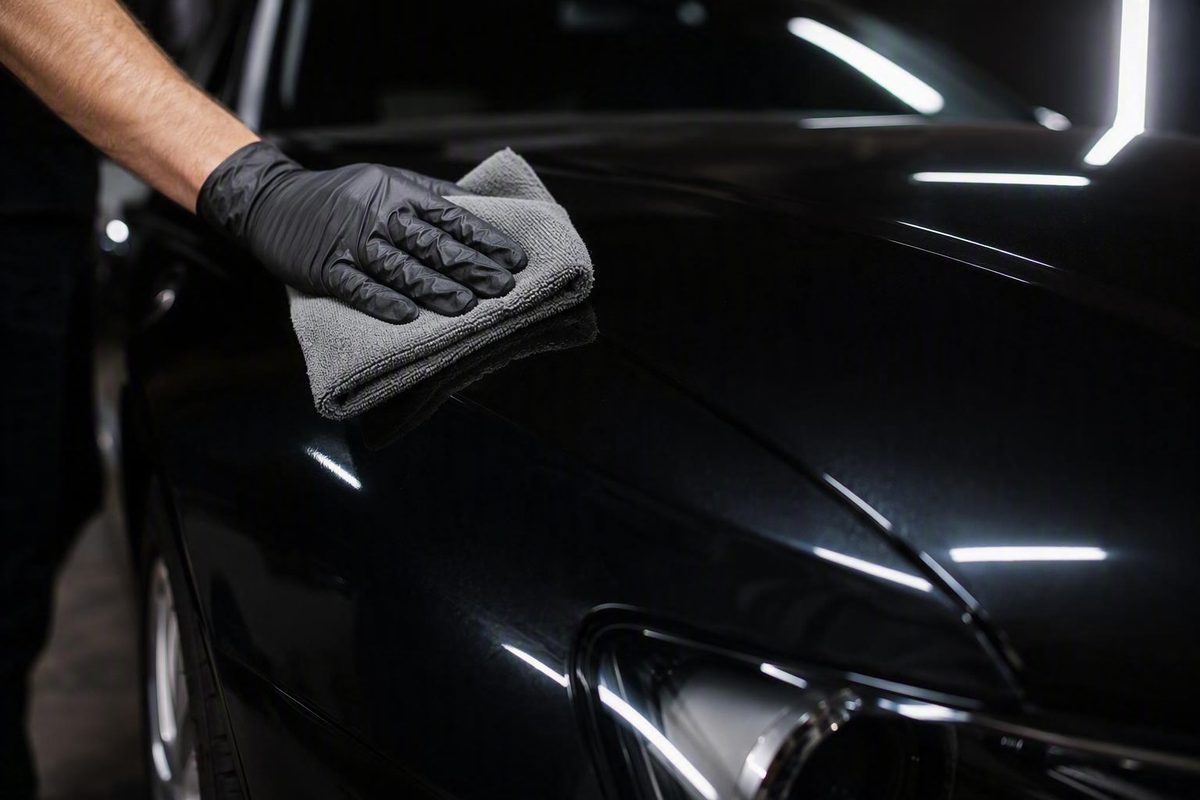
The short answer: rubbing alcohol can damage paint, but the risk depends on how and where it is used
Occasional, brief use of properly diluted isopropyl alcohol is generally considered low risk on intact, fully cured, clear-coated automotive paint. That is not a guarantee for every vehicle or application. Paint type, repair history, alcohol concentration, quantity, contact time, panel temperature, protective layers, and wiping technique can all affect the result.
The lowest-risk situation is a small contaminant on known, healthy factory paint, treated once with a conservative dilution and a clean microfiber towel. Risk increases when the alcohol is strong, the panel is hot, the finish is fresh or compromised, a large area is saturated, or the same spot is repeatedly scrubbed. Kelley Blue Book similarly limits its guidance to alcohol that is adequately diluted, used sparingly, and applied occasionally to healthy paint (Kelley Blue Book’s rubbing-alcohol guidance).
It helps to distinguish four outcomes that are often grouped together as “paint damage”:
- Contaminant removal. Alcohol may lift polishing oils, grease, wax, adhesive, light sap, or other localized residue.
- Protection removal. The treated area may lose wax or sealant even if the clear coat beneath it remains unchanged.
- Mechanical marring. Grit, a contaminated towel, or forceful rubbing can leave fine scratches independently of the solvent.
- Chemical alteration. A vulnerable finish may become sticky, stained, hazy, softened, discolored, or otherwise changed.
Removing wax is therefore not automatically the same as damaging clear coat. If alcohol strips them, however, the treated spot may have less protection until the product is restored.
A practical decision rule is:
- Reasonable with precautions: a one-time spot treatment on known, fully cured, intact, gloss clear-coated paint.
- Avoid or obtain product-specific guidance: fresh paint, visible touch-up paint, uncertain body-shop repairs, single-stage paint, matte or satin finishes, peeling or oxidized clear coat, vinyl wraps, ceramic coatings, or paint protection film.
If you do not know the vehicle’s paint or repair history, start with the least aggressive paint-compatible cleaner rather than assuming the surface will behave like cured factory clear coat.
Why concentration, heat, exposure, and rubbing change the risk
Isopropyl alcohol is a solvent, not a substitute for automotive shampoo. It can lift substances that normal washing may leave behind, including oils, grease, wax, polishing residue, light sap, and some adhesive residue. That solvent action is useful only when the exposure is controlled.
Four variables determine how aggressive an application is:
- Concentration: A stronger solution delivers more alcohol to the surface.
- Quantity: Saturating a panel creates more exposure than lightly dampening a towel for one small spot.
- Contact: Longer contact and repeated applications give the solvent more opportunity to affect vulnerable material.
- Area: Treating a badge-sized patch is easier to control than wiping an entire hood or vehicle.
These factors interact. A weak mixture used repeatedly over a large, hot panel may be less predictable than one brief spot treatment on a cool surface. Because automotive finishes and protection products vary, the available evidence does not establish one concentration, contact time, or frequency that is safe for every car.
Heat reduces the working margin. On a hot panel, liquid may evaporate before it can be spread and removed evenly, potentially leaving marks or encouraging additional applications. Kelley Blue Book advises avoiding product application when the vehicle surface reaches 90°F or higher, citing reduced working time and the possibility of products drying or staining on the finish.
Chemical exposure is only part of the risk. Mechanical abrasion can mark the surface even when the alcohol itself does not alter the clear coat. Common causes include:
- wiping paint before loose dirt has been removed;
- using microfiber that contains grit;
- pressing hard on dried adhesive or sap;
- continuing to wipe with a contaminated section of towel;
- repeatedly rubbing one small area.
If residue does not release, apply another small amount of the selected cleaner and use light pressure rather than scrubbing harder. Change to a clean face of the towel as contamination transfers.
The supporting evidence has important limits. Most available recommendations come from automotive publishers, car-wash or detailing businesses, and owner forums—not controlled comparisons across factory clear coats, refinishing systems, touch-up products, coatings, wraps, and films. Restorers also disagree about household alcohol versus purpose-made panel-preparation products (AACA forum discussion of isopropyl alcohol for paint preparation). Such accounts can reveal practical concerns, but they cannot establish universal thresholds.
Which automotive surfaces are most—and least—suitable
“Car paint” is not one uniform material. The following matrix is a conservative screening tool, not a compatibility guarantee. CarParts.com likewise conditions its guidance on dilution, limited quantity, gentle application, testing, and avoidance of freshly painted areas (CarParts.com’s paint-surface precautions).
| Surface | Relative suitability for diluted alcohol | Conservative approach |
|---|---|---|
| Intact, fully cured factory clear coat | Lowest-risk scenario | Use only for a localized need; dilute, test, wipe gently, and remove promptly |
| Repainted panel | Uncertain | Ask the repair shop or follow paint-system instructions |
| Fresh paint | High risk | Avoid unless the paint or repair provider specifically permits solvent use |
| Touch-up paint | High risk | Avoid; small air-dried repairs may be particularly vulnerable |
| Single-stage paint | Uncertain to high risk | Obtain paint-specific guidance; stop if color transfers |
| Peeling, cracked, oxidized, or damaged finish | High risk | Do not use solvent casually; seek professional assessment |
| Ceramic coating | Product-dependent | Follow the coating manufacturer’s maintenance instructions |
| Paint protection film | Product-dependent | Check film and topcoat guidance; test only if permitted |
| Vinyl wrap | Product-dependent | Use a cleaner approved by the wrap manufacturer |
| Matte or satin paint | High consequence if altered | Use only finish-approved products; do not assume polishing can correct a mark |
| Unknown paint or repair history | Uncertain | Prefer a dedicated compatible cleaner or professional advice |
Intact factory clear coat provides the most favorable conditions for an occasional diluted spot treatment.
Fresh paint and touch-up paint warrant substantially more caution. In one uncontrolled detailing-forum report, rubbing alcohol began removing touch-up paint applied about two weeks earlier. Another participant reported that a 50:50 alcohol-and-water mixture stained a six-month-old repaint, although polishing later removed the visible stain (Autopia discussion of touch-up paint and repaint reactions). These anecdotes do not identify all relevant variables, including paint chemistry, pressure, and exposure time. They show why repair age alone cannot prove solvent resistance.
Repainted panels should remain in the uncertain category even when they look identical to surrounding factory paint. The materials, curing process, repair quality, and maintenance requirements may differ. Ask the body shop what was applied and which surface cleaners are allowed.
Single-stage and compromised finishes also require restraint. Available evidence does not establish safe alcohol use on oxidation, peeling clear coat, exposed paint edges, cracking, or unusually soft surfaces. Color transfer to the towel is a reason to stop immediately.
For ceramic coatings, wraps, and paint protection film, compatibility with the underlying paint does not establish compatibility with the upper layer. As a conservative precaution under that uncertainty, follow the applicable manufacturer’s instructions rather than relying on a generic “paint safe” claim.
Warning signs include recent bodywork, visible touch-up blobs, sanding marks, overspray, mismatched gloss, unusual texture, cracking, peeling clear coat, or uncertainty about prior collision repairs. These clues do not identify the paint system conclusively, but they are reasons not to proceed casually.
A conservative dilution guide for 70% and 91% isopropyl alcohol
For routine spot treatment on a suitable finish, begin with a 10% to 20% final isopropyl-alcohol concentration. This is practical guidance from automotive sources, not a universally validated standard. Published recommendations differ: Kelley Blue Book suggests approximately 20%, BLISS Car Wash recommends 10% to 15%, and CarParts.com gives a 10% to 20% range. The disagreement supports starting near the lower end when a weaker mixture can do the job (BLISS Car Wash’s dilution guidance).
Use this formula:
Volume of starting alcohol = (desired final concentration ÷ starting concentration) × desired final solution volume
For example, to prepare 100 mL of a 15% solution from 70% alcohol:
(15 ÷ 70) × 100 mL = 21.4 mL of 70% alcohol
Measure the starting alcohol, then add water until the total solution volume reaches 100 mL. The water figures below are useful practical approximations; adding water to the final volume is the more consistent mixing method.
Using 70% rubbing alcohol
| Desired final concentration | Measure 70% alcohol | Approximate water quantity | Make up to |
|---|---|---|---|
| 10% | 14.3 mL | 85.7 mL | 100 mL total |
| 15% | 21.4 mL | 78.6 mL | 100 mL total |
| 20% | 28.6 mL | 71.4 mL | 100 mL total |
Using 91% rubbing alcohol
| Desired final concentration | Measure 91% alcohol | Water | Make up to |
|---|---|---|---|
| 10% | Approximately 11.0 mL | Add water to final volume | 100 mL total |
| 15% | Approximately 16.5 mL | Add water to final volume | 100 mL total |
| 20% | Approximately 22.0 mL | Add water to final volume | 100 mL total |
One part of 70% alcohol mixed with three equal parts water produces four total parts:
70% ÷ 4 = 17.5% final isopropyl alcohol
That mixture is sometimes described in practical guidance as “about 20%,” although its calculated concentration is 17.5%.
EuroLuxe Detailing recommends direct 70% isopropyl alcohol for limited light-sap or sticky-residue removal. That commercial recommendation is more aggressive than the broader 10% to 20% guidance and does not establish safety across all paint systems (EuroLuxe Detailing’s residue-removal guidance). It should not be the default for an owner who does not know the finish’s history.
Check the bottle before mixing. “70% rubbing alcohol” is the starting concentration, not the concentration after dilution. A 1:1 mixture of 70% alcohol and water produces approximately 35% isopropyl alcohol—not a 10%, 15%, or 20% working solution.
Before handling or storing the product, follow all ventilation, ignition-source, protective-equipment, and storage precautions printed on its label. Do not transfer the mixture into an unlabeled container.
How to use diluted rubbing alcohol on a small paint spot
A controlled process matters as much as concentration. Prepare the surface, towels, and solution before touching the contaminant.
-
Remove loose dirt first. Wash the affected area with an automotive wash product, rinse it, and dry it. At minimum, remove grit thoroughly. Alcohol does not provide the lubrication of car shampoo, so dirt left on the panel can be dragged across the finish.
-
Move into shade and cool the panel. Do not work on sun-heated paint. If the surface is warm, let it cool naturally. Avoid application at or above the cited 90°F surface-temperature precaution.
-
Inspect the finish. Do not proceed if the spot includes fresh paint, visible touch-up paint, peeling clear coat, cracking, exposed edges, unusual softness, or signs of an uncertain repair.
-
Choose a conservative dilution. Start near the lower end of the 10% to 20% practical range unless product-specific instructions call for another method.
-
Test an inconspicuous area. Apply a very small amount where a change would not be obvious. Remove it, let the area dry fully, and inspect it under good lighting. A successful test reduces uncertainty but does not guarantee that longer or repeated exposure will be harmless.
-
Dampen the towel rather than saturating the panel. Put a small amount on a clean, soft microfiber towel. It should be damp, not dripping. Avoid broadly spraying the panel or allowing liquid to run into seams or onto adjacent materials.
-
Treat only the residue. Use light, controlled passes over a small area. Keep contact brief, but do not rely on a supposedly universal safe dwell time; none is established across all automotive finishes.
-
Remove the solution promptly. BLISS Car Wash advises applying diluted alcohol to microfiber rather than directly to paint, followed by prompt rinsing and drying (BLISS Car Wash’s application procedure). Other practical instructions describe wiping the area clean. Rinsing with water is a conservative removal step, not a scientifically proven requirement for every diluted application.
-
Dry with a separate towel. Do not use the towel face carrying dissolved adhesive, sap, grease, or grit.
-
Inspect after drying. Compare color, gloss, and texture with the surrounding panel from several angles.
If residue remains, repeat a small, gentle application rather than increasing pressure. Turn to a clean section of microfiber each time. Commercial detailing guidance likewise recommends reapplying a suitable solvent instead of rubbing harder.
Stop immediately if:
- paint color transfers to the towel;
- the finish becomes sticky or unusually soft;
- haze, staining, dullness, or discoloration appears;
- the surface texture changes;
- the towel begins to drag unexpectedly;
- paint, film, or wrap starts lifting.
Once the area is clean, dry, and visibly normal, consider restoring wax or sealant according to that product’s instructions. Do not apply protection over remaining contamination or a visibly altered finish.
When alcohol is useful—and when another cleaner is the better first choice
Rubbing alcohol should be matched to a specific contaminant rather than treated as an all-purpose automotive cleaner.
| Contaminant or task | Best first approach | Possible role for diluted alcohol |
|---|---|---|
| Dust, mud, or road film | Automotive prewash and shampoo | Generally unnecessary |
| Polishing oils | Manufacturer-specified panel preparation | Controlled wipe when permitted |
| Wax or oily residue | Product-compatible surface cleanser | May remove localized residue or protection |
| Sticker adhesive | Paint-compatible automotive adhesive remover | Possible spot-treatment alternative after testing |
| Light tree sap | Dedicated automotive sap remover | Conservative spot treatment may help |
| Grease or oil | Remove excess, then use a suitable automotive cleaner | May lift a remaining oily film |
| Bug residue | Wash and use a paint-compatible bug remover | Possible escalation for a small remnant |
| Coating preparation | Coating maker’s specified panel preparation | Use only if the instructions permit it |
| Whole-car maintenance | Normal wash process | Not recommended |
Ordinary dirt and road film: Use automotive shampoo, adequate water, and a clean wash medium. Alcohol lacks the cleaning balance and lubrication expected from a wash solution. Applying it across large panels also creates unnecessary exposure.
Polishing oils and surface preparation: Diluted isopropyl alcohol is commonly used to remove polishing oils so the paint can be inspected or prepared for a protection product. Instructions from the wax, sealant, coating, paint, or refinishing-system manufacturer should take priority. A purpose-made panel wipe may be more appropriate when the system specifies one.
Adhesive and sticker residue: Remove the sticker or emblem by a suitable method without gouging the paint. Diluted alcohol may help with a small amount of remaining tacky film. A paint-compatible automotive adhesive remover is another option when its manufacturer expressly permits use on the surface involved.
Tree sap: A dedicated automotive sap remover or conservative diluted treatment is the better starting point. Although stronger alcohol appears in limited commercial guidance, that advice conflicts with more conservative concentration recommendations. Hardened material may need repeated gentle softening or professional removal rather than force.
Grease and oil: Lift loose contamination first so it is not spread across the panel. A limited diluted-alcohol wipe may remove the final oily film from a small spot.
Bug residue: Soak and wash it first. A paint-compatible bug remover used according to its label is preferable to immediately reaching for a solvent. Alcohol is a possible escalation for a localized remnant, not the standard bug-cleaning process.
Refinishing and coating preparation: Practitioners report using several alcohol strengths, while others prefer dedicated preparation products engineered for a particular paint process. When coating adhesion or refinishing success matters, follow the relevant technical instructions rather than improvising a household formula.
Do not use rubbing alcohol for whole-car cleaning, frequent maintenance washing, or repeated treatment of large panels. The larger and more consequential the job, the more important product-specific compatibility becomes.
Wax, sealant, ceramic coating, and film: protection can change even if paint does not
The available evidence more clearly supports alcohol removing oils, wax, and some surface residue than it supports immediate chemical damage from one brief diluted application to healthy, cured factory clear coat.
Reduced beading alone does not prove clear-coat damage.
Once the panel is clean, dry, and visibly normal:
- inspect it under good lighting;
- compare its water behavior with the surrounding surface during the next wash;
- restore wax or sealant where appropriate;
- follow the protection product’s preparation and curing instructions.
Do not immediately cover haze, stickiness, staining, or unknown residue with new protection. Resolve or professionally assess the appearance change first.
Ceramic coatings require product-specific guidance. Formulations and maintenance systems vary, so an alcohol mixture used during one coating’s installation cannot be assumed compatible with another coating’s cured surface or warranty.
Because universal compatibility has not been established, consult the film manufacturer and perform a hidden-area test only when its instructions allow one.
Vinyl wraps and matte protection films call for the same restraint.
Forum participants report wax removal as well as different outcomes on clear coat, touch-up paint, and refinished surfaces (Autopia’s discussion of alcohol, wax, and different finishes). The practical lesson is to evaluate every layer on the vehicle, not only the underlying paint.
What to do if the paint looks dull, hazy, stained, or discolored
Stop applying alcohol and stop rubbing as soon as an unexpected change appears. Continuing to work the spot increases both chemical exposure and mechanical abrasion before the cause is known.
Take these steps:
- Rinse promptly with clean water. Remove remaining solution and loosened contamination.
- Dry gently. Use a separate, clean microfiber towel.
- Let the area dry fully. Moisture, solvent, and residue can temporarily affect how the surface reflects light.
- Inspect without further treatment. View the panel from several angles and compare it with the surrounding finish.
- Do not repeatedly reapply alcohol. An uncertain finish is not the place to test progressively stronger mixtures.
- Avoid aggressive polishing. Polishing removes material and may be unsuitable for matte paint, fresh repairs, thin or uncertain finishes, wraps, and film.
- Seek qualified assessment if the change remains. A reputable detailer or body shop can evaluate persistent haze, stickiness, color transfer, staining, dullness, or discoloration.
A changed appearance can have several explanations:
- wax or sealant was removed;
- dissolved residue remains on the surface;
- the towel introduced fine abrasion;
- temporary staining occurred;
- the paint or clear coat was chemically altered.
The available evidence provides no reliable visual test that distinguishes all these possibilities.
One forum participant reported that polishing removed a stain left on a repaint after a 50:50 alcohol-and-water application. That illustrates variability rather than establishing a repair method. Polishing should not be attempted merely because it worked in an uncontrolled anecdotal case.
No supplied source provides controlled exposure thresholds for every automotive paint system, universal compatibility data for coatings and films, or broad automaker approval for household rubbing alcohol. The defensible conclusion is therefore conditional: diluted isopropyl alcohol can be a useful occasional spot cleaner on known, fully cured, intact clear-coated paint, but stronger mixtures, heat, repeated exposure, aggressive wiping, and vulnerable finishes increase the risk. Use the least aggressive suitable method, test first, work cool and gently, and seek product-specific or professional guidance whenever the surface is uncertain.
Can I put 70% rubbing alcohol directly on car paint?
Direct 70% use is not the conservative default. Practical sources disagree: some describe it as a limited treatment for sap or sticky residue, while others recommend diluting the final solution to approximately 10% to 20%. CarParts.com advises dilution, testing, gentle pressure, and avoidance of freshly painted areas (CarParts.com’s dilution and application guidance).
Start with a weaker, paint-compatible method on a clean, cool, inconspicuous spot. Consider direct 70% alcohol only when reliable instructions for the specific finish or protection system permit it.
Will rubbing alcohol remove car wax or sealant?
It can remove wax, oils, and some surface residue. That does not necessarily mean the underlying clear coat has been damaged.
After treatment, allow the panel to dry and inspect it. Restore wax or sealant where appropriate, following that product’s preparation instructions. Reduced water beading may indicate that protection was removed; it does not by itself prove clear-coat failure.
Is rubbing alcohol safe on touch-up paint or a repainted panel?
Do not assume so. Touch-up paint and recent repairs may be more vulnerable than fully cured factory clear coat. Forum reports include removal of approximately two-week-old touch-up paint and staining on a six-month-old repaint, but those incidents were uncontrolled and do not establish a universal waiting period.
Avoid alcohol on visible touch-up work or recent body repairs unless the product maker or repair shop approves it. Treat older repaints as uncertain because their materials, curing process, and maintenance requirements can vary.
How long can rubbing alcohol stay on automotive paint?
There is no universal safe dwell time for every paint, concentration, panel temperature, coating, wrap, or film. One commercial detailer recommends 30 to 60 seconds for a particular 70% spot-treatment method, but that does not establish a safe threshold for other surfaces or applications.
Keep exposure brief and remove the solution promptly. If residue remains, repeat a controlled, gentle application rather than extending contact indefinitely or scrubbing harder. Forum accounts that omit paint-system details and exposure times cannot establish a universal limit (AACA discussion of alcohol use in paint preparation).
What should I do if rubbing alcohol leaves a dull or hazy spot?
Stop using the alcohol, rinse the area with clean water, and dry it gently with fresh microfiber. Allow it to dry fully before judging the result; BLISS Car Wash likewise recommends prompt rinsing and drying after its diluted-alcohol procedure.
The appearance may reflect removed protection, remaining residue, towel abrasion, temporary staining, or an altered finish. Do not repeatedly apply alcohol or polish aggressively to diagnose it. If dullness, haze, stickiness, staining, discoloration, or color transfer remains, have the area assessed by a qualified detailer or body shop.