
Why Corded Wins Most At-Home Car Washes
Compare Ryobi’s 18V and 40V cleaners with corded washers by runtime, PSI and price, then check whether your battery can finish a car wash.
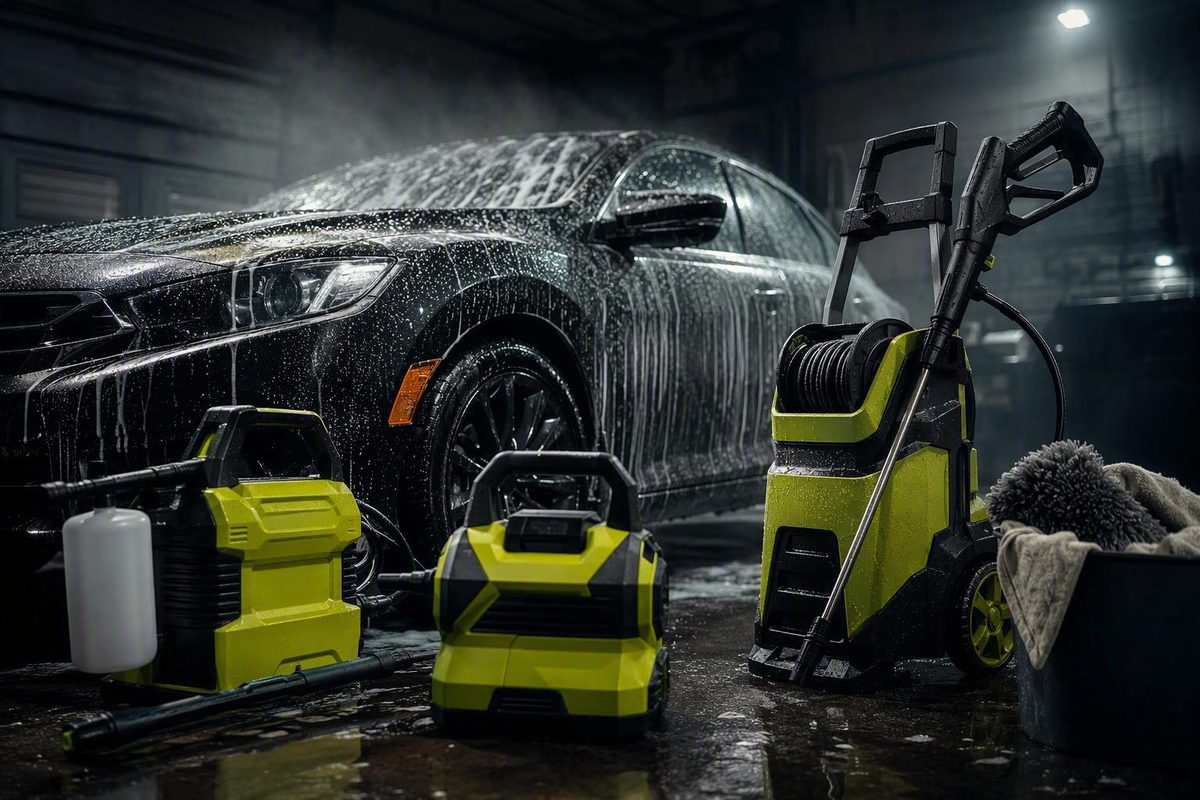
For washing a car at home, a corded pressure washer is the better buy: $80–$250 delivers 1,600–2,300 PSI with unlimited runtime, while Ryobi’s July 2026 cordless kits cost $189–$259 for 700–1,000 PSI and 11–30 trigger-minutes per charge. The cordless Power Cleaners earn their place only where a cord cannot reach—or where there is neither an outlet nor a spigot (Power Tool Insider).
That verdict is specifically about washing at home. A street parker, apartment resident, campsite user, or boat owner may rationally trade pressure and runtime for access. A driveway owner with an outlet does not need to make that trade.
The Case for Cordless Convenience
The consensus view is not baseless. A handheld cleaner starts quickly, stores in less space, and can siphon water from a bucket. It avoids the pressure-washer body, electrical cord, high-pressure hose, and fixed garden-hose connection associated with a conventional setup.
Ryobi’s Power Cleaner category also covers legitimate light work: pollen, loose dirt, fresh mud, wheels, bikes, boats, campers, windows, and patio furniture. For a five-minute rinse at an apartment lot or boat ramp, portability can matter more than maximum output.
Battery ownership strengthens that case. An existing Ryobi 18V ONE+ owner can buy the reported 700 PSI PCLPC07 for $129 bare rather than the $189 kit. A 40V owner can consider the reported 1,000 PSI RY40HPPC01 at $189 bare instead of $259 with its 2.0Ah battery. In those cases, the battery and charger are sunk costs rather than new expenses (Power Tool Insider).
The consensus fails when it treats that convenience as evidence that cordless is the stronger car-washing value. At an outlet-equipped parking spot, the buyer pays more for the complete cordless kits, receives less than half the pressure available from many corded electrics, and accepts a battery deadline that the corded machine does not have (Power Tool Insider).
Select your package, battery and trigger time; the checker shows whether cordless finishes and which side wins for your inputs.
Compare one selected battery charge with the trigger time your wash and rinse require. Cost per usable minute is purchase price divided by the minutes the setup can actually supply in this session.
Corded wins: the 40V kit stops one minute short and costs more per usable minute.
The 2.0Ah pack reaches six minutes into the seven-minute rinse. A corded washer is available at this parking spot.
The battery completes the wash and stops 6 minutes into the rinse.
All Reported Battery and Package Outcomes
| Tool / Package | Battery | Price | PSI / GPM | Rated Time | Default 15-Min Wash | Default $/Usable Min |
|---|---|---|---|---|---|---|
| 18V bare | 4.0Ah | $129 | 700 / 0.8 | 11 min | Stops 4 min short | $11.73 |
| 18V bare | 6.0Ah | $129 | 700 / 0.8 | 16 min | Finishes | $8.60 |
| 18V bare | 8.0Ah | $129 | 700 / 0.8 | 21 min | Finishes | $8.60 |
| 18V kit | 4.0Ah | $189 | 700 / 0.8 | 11 min | Stops 4 min short | $17.18 |
| 18V kit + owned 6.0Ah | 6.0Ah | $189* | 700 / 0.8 | 16 min | Finishes | $12.60* |
| 18V kit + owned 8.0Ah | 8.0Ah | $189* | 700 / 0.8 | 21 min | Finishes | $12.60* |
| 40V bare | 2.0Ah | $189 | 1,000 / 1.0 | 14 min | Stops 1 min short | $13.50 |
| 40V bare | 8.0Ah | $189 | 1,000 / 1.0 | 30 min | Finishes | $12.60 |
| 40V kit | 2.0Ah included | $259 | 1,000 / 1.0 | 14 min | Stops 1 min short | $18.50 |
| 40V kit + owned 8.0Ah | 8.0Ah | $259* | 1,000 / 1.0 | 30 min | Finishes | $17.27* |
| Corded electric | — | $80–$250 | 1,600–2,300 / — | Unlimited | Finishes | $5.33–$16.67 |
- Runtime figures are reported trigger-time ratings, not measured results from a controlled car-wash test.
- *Kit price excludes the unknown cost of a larger battery. The supplied evidence does not give that price.
- No-outlet results favor cordless access even when one charge cannot finish; a recharge or compatible second pack is then required.
Sources: reported July 2026 Ryobi launch specifications and Power Tool Insider’s 2026 cordless guide. Dollar-per-minute figures are calculated from the displayed prices and trigger times.
The New Ryobi Cleaners Lose the Specification Comparison
The two July 2026 Power Cleaners narrow the gap between handheld rinsers and entry-level pressure washers, but they do not close it.
| Model | Price | Output | Reported Runtime |
|---|---|---|---|
| 18V PCLPC07 | $129 bare / $189 kit | 700 PSI, 0.8 GPM | 11–21 min |
| 40V RY40HPPC01 | $189 bare / $259 kit | 1,000 PSI, 1.0 GPM | 14–30 min in Max |
| Corded electrics | $80–$250 | 1,600–2,300 PSI | Unlimited |
The 18V model is rated for 11 minutes with a 4.0Ah pack, 16 minutes with 6.0Ah, and 21 minutes with 8.0Ah. The 40V model runs for a reported 14–30 minutes in Max mode, reaching the upper figure with an 8.0Ah battery. Its $259 kit includes a 2.0Ah pack, not the 8.0Ah pack associated with the maximum runtime (Power Tool Insider).
These are rated figures rather than a controlled car-wash test. The supplied evidence does not give measured runtime under identical water, nozzle, temperature, battery-condition, and trigger-use conditions. It also does not establish an exact percentage by which one machine cleans faster.
The comparison still exposes the purchasing problem. The most accessible kit configurations place the shortest runtimes in the box. A wash needing 15 trigger-minutes exceeds the 18V kit’s 11-minute rating and the 40V kit’s 14-minute Max-mode rating. That means a recharge or battery swap before the rinse is complete.
A second pack costs $99 or more according to the supplied launch reporting. Adding one erodes the apparent simplicity of a cordless kit, although an owner who already has a compatible charged pack may avoid that expense.
Dollars per Usable Minute Favor the Cord
For the default 15-minute wash in the checker, the $259 40V kit supplies 14 rated trigger-minutes. Its first-session equipment cost is therefore $18.50 per usable minute, and it stops one minute short.
A corded washer priced at the bottom of the cited $80–$250 range costs $5.33 per planned trigger-minute over that same 15-minute session. Even a $250 corded unit comes to $16.67 per planned minute while completing the session without a battery change. These figures are simple purchase-price calculations, not lifetime ownership costs.
The formula is purchase price divided by the smaller of the required trigger time or available trigger time. For a corded machine, available trigger time is not battery-limited.
This metric deliberately penalizes a tool that cannot complete the job. It does not include electricity, water, detergent, battery degradation, repairs, or resale value because the supplied evidence provides no comparable figures for those costs.
Bare-tool buyers can reach a different price result. An existing 18V owner paying $129 for the tool and using a compatible 6.0Ah or 8.0Ah pack could spend less upfront than someone choosing a $250 corded washer. Corded still retains the pressure and runtime advantage, but it does not win every possible bare-tool price comparison.
That concession defines the real dividing line: cordless value depends heavily on batteries already owned or on utility access that does not exist. Complete-kit buyers with an available outlet receive less pressure and less runtime for their money.
Fifteen Trigger-Minutes Can Exceed a Rated Charge
Trigger time is not the same as elapsed wash time. Applying shampoo, agitating bonded film, changing position, and inspecting panels do not continuously run the pump. A 25-minute wash could therefore use fewer than 25 trigger-minutes.
Even so, a thorough wash and rinse can exceed the 11 minutes supplied by the 18V kit’s 4.0Ah pack or the 14 minutes reported for the 40V kit’s 2.0Ah pack. If the wash stage consumes eight trigger-minutes, the default 40V setup reaches only six minutes into a seven-minute rinse.
Larger packs improve the result. The 18V ratings rise to 16 minutes on 6.0Ah and 21 minutes on 8.0Ah. The 40V cleaner reaches a reported maximum of 30 minutes on 8.0Ah. The purchase price of those larger batteries is not given in the supplied evidence, so it should not be guessed.
A corded machine removes the battery calculation. Its practical limits become outlet placement, extension-cord rules in the manual, hose reach, water access, and the time the operator is willing to spend.
PSI and Flow Both Favor a Conventional Washer
PSI describes spray pressure, while GPM describes water flow. Pressure helps loosen contamination; flow carries loosened material away. Nominal cleaning units are calculated as PSI multiplied by GPM, although that shorthand does not predict exact cleaning speed.
The PCLPC07’s reported 700 PSI and 0.8 GPM produce 560 nominal cleaning units. The RY40HPPC01’s 1,000 PSI and 1.0 GPM produce 1,000. Comparable GPM figures for the cited 1,600–2,300 PSI corded range are not supplied, so an equivalent cleaning-unit range cannot be calculated honestly.
The available specifications still show that neither new Power Cleaner matches the corded pressure range. That matters when rinsing foam from a whole vehicle, clearing wheel wells, or moving loosened grit without repeated close passes.
More pressure is not automatically safer or better. A Power Cleaner may be easier to control around a maintained vehicle, while a pressure washer magnifies the consequences of poor nozzle choice, inadequate distance, or spraying damaged paint, decals, seals, trim, and repaired areas.
Cordless Wins Where Utilities Do Not Reach
Both new cleaners are reported as siphon-fed and supplied with 20-foot hoses, two-liter bottle adapters, nozzles, extension wands, and quick-connect couplers. Neither has an onboard water tank. Cordless therefore means free from an outlet, not free from carrying water (Power Tool Insider).
That design fits three users particularly well:
- A street parker or apartment resident whose car is beyond practical cord and hose reach.
- A boat or camper owner cleaning at a ramp, storage lot, marina, or campsite.
- A driver doing short maintenance rinses from a bucket rather than full driveway washes.
A bucket creates access but also adds weight, refilling, and cleanup. At 1.0 GPM, the 40V model’s stated flow indicates why a small portable water supply is not equivalent to a continuous spigot. The exact water consumed during a real wash depends on trigger use, and the supplied evidence provides no measured total.
The older 18V RY120350 illustrates the category’s portability. It can use a 20-foot siphon hose, two-liter bottle adapter, or garden hose, and Ryobi rates it at up to 320 PSI and 21 minutes with a 4Ah battery. Those figures apply to that older model only and should not be transferred to the 2026 cleaners (Ryobi).
Car-Wash Technique Matters More Than Maximum Pressure
Neither tool removes bonded road film by specification alone. Shampoo, dwell time, agitation, paint condition, nozzle pattern, distance, and water quality still determine the finish. A stronger rinse can remove loosened material more efficiently, but it is not a substitute for appropriate chemistry and contact washing where required.
Begin with the widest suitable fan pattern at a conservative distance. Inspect paint, trim, decals, seals, glass, repaired areas, and wheel finishes before spraying. Keep the stream moving and follow the tool and vehicle manufacturers’ instructions.
Do not use a zero-degree or pinpoint stream on a vehicle. Concentrated spray can cause injury and property damage; low nominal PSI does not make careless use safe. Consumer Reports likewise recommends avoiding zero-degree nozzles and pinpoint settings because of the hazards associated with concentrated spray (Consumer Reports).
The Power Cleaner is a sound choice for pollen, loose dust, fresh mud, maintenance rinses, wheels, bikes, boats, and campers when mobility controls the purchase. A conventional washer is the more capable choice for forceful rinsing and for owners who also clean patios, siding, or concrete.
For context, Lowe’s general guidance suggests approximately 2,500–3,500 PSI for concrete and asphalt driveways. That is not a universal minimum, but it shows why a 700 or 1,000 PSI handheld cleaner is poorly matched to embedded driveway dirt, established organic growth, or oil stains (Lowe’s).
Used Ryobi Washers Need a Recall Check
On August 28, 2025, the U.S. Consumer Product Safety Commission recalled specified serial-number ranges of Ryobi electric pressure-washer models RY142300, RY142300VNM, and RY142711VNM. The notice says a capacitor could overheat and burst, creating a projectile hazard.
Owners of a potentially affected machine should stop using it, locate the model and serial number on the motor-housing data plate, compare them with the official notice, and follow Ryobi’s process for obtaining the free repair kit (CPSC).
The recall does not apply to every Ryobi pressure washer and is not evidence of a Power Cleaner-wide problem. It is particularly relevant when evaluating a used corded machine.
The Outlet Decides the Purchase
Buy the corded pressure washer when an outlet and water supply reach the car. It provides 1,600–2,300 PSI, avoids a mid-rinse battery deadline, and can cost less than either complete cordless kit.
Buy the Power Cleaner when utility access prevents a corded machine from doing the job at all. The 18V version also makes financial sense for some ONE+ owners who already have suitable larger batteries; the same exception applies to established 40V users.
The new cleaners are capable portable rinsers, not equal replacements for conventional pressure washers. Their strongest feature is access, and buyers who do not need that access are paying to surrender pressure and runtime.