
Steam Clean Compatible Cloth Car Seats Without Soaking Them
Learn when steam is safe for cloth car seats, when to avoid it, and how to patch-test, clean small sections, dry the seat and check warning lights.
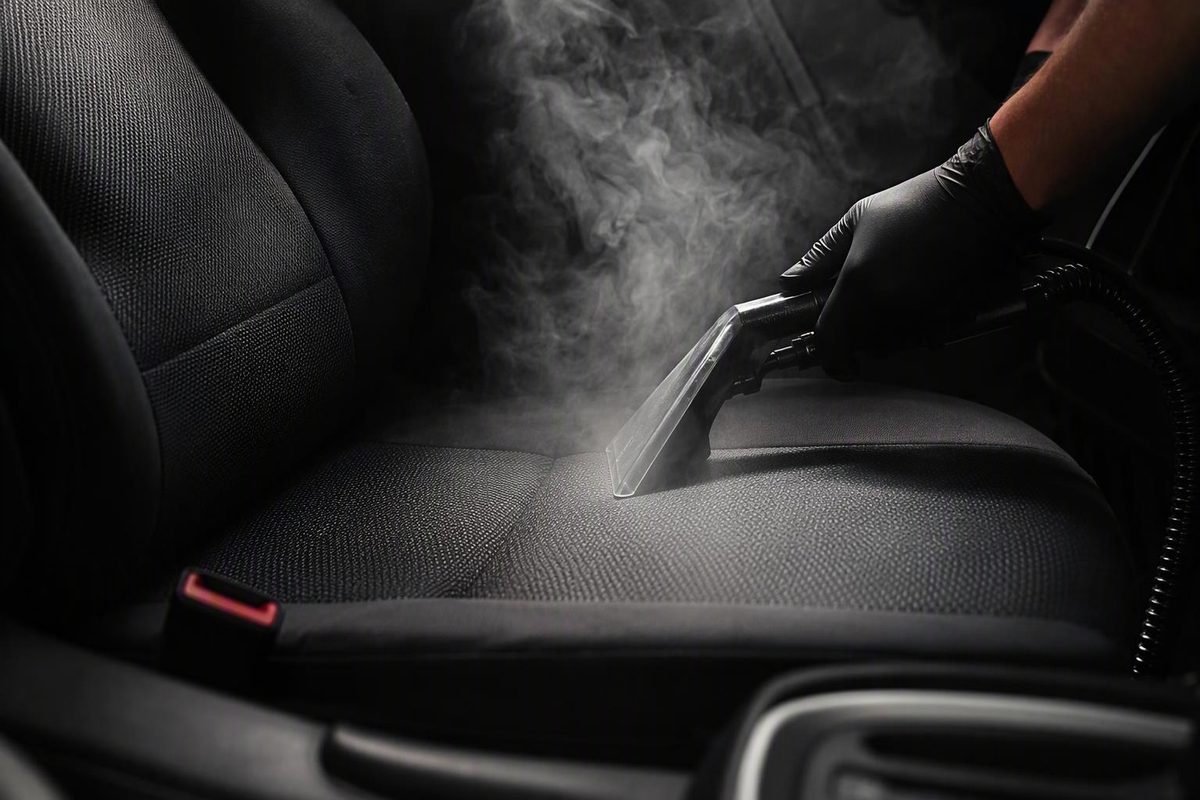
You can steam clean small stains on some cloth car seats, but only when the vehicle’s care instructions and the steamer manual permit it. Do not assume steam is safe for leather, synthetic leather, suede-like upholstery, child restraints or seats containing sensors, heaters and ventilation hardware. If the owner’s manual specifies a damp cloth and mild soap, that is not permission to use steam.
Choose the seat material and manual guidance to get the safest starting decision.
Car Seat Steam Check
Match the surface and manufacturer instructions before putting steam on the seat.
Conditional yes for this cloth seat
The manual permits the proposed method, but the fabric still needs a hidden test that is evaluated after it dries.
- Vacuum first.
- Use the lowest effective output on a small section.
- Collect released soil immediately with a clean towel.
- Stop before the cushion becomes wet.
Source: vehicle, upholstery and equipment-maker guidance cited in the accompanying article. “Permitted” means permission for the specific seat and method, not generic steamer marketing.
Steam and Extraction Serve Different Purposes
A vapor steamer supplies heat and limited moisture to loosen surface contamination. A towel must then collect the released soil. Steam is best treated as a controlled spot-cleaning method, not as a way to flush an entire cushion.
A spray extractor sprays diluted upholstery solution and vacuums the liquid back out. It is generally the more useful machine for rinsing heavily soiled, water-safe cloth.
Kärcher describes extraction as spraying water and detergent into upholstery and recovering it. Its steam method for a small stain directs the jet at an angle so contamination transfers into a microfiber cloth. The company advises testing temperature sensitivity in a hidden area first (Kärcher).
The Seat Material Determines Whether Steam Is an Option
| Seat Surface | Steam Decision |
|---|---|
| Woven cloth | Consider steam only if the vehicle manual permits an appropriate wet-cleaning method and a hidden test dries without a color, texture or shape change. |
| Leather | Prefer the vehicle maker’s leather-care method. An approved cleaner applied with a damp microfiber towel is the more conservative starting point. |
| Vinyl or synthetic leather | Check the manual rather than judging by appearance. Coatings, seams or underlying components may require low moisture. |
| Alcantara | Do not apply steam directly. Alcantara recommends low-temperature spray extraction instead. |
| Perforated, ventilated or heated seat | Use the manufacturer’s method and keep liquid out of perforations, seams and controls. |
| Unknown material | Identify the upholstery from the owner’s manual or vehicle specification before cleaning it. |
Alcantara specifically advises avoiding direct contact with steam appliances and recommends low-temperature spray extraction (Alcantara).
Vehicle guidance can also be much stricter than steamer marketing. Tesla tells Model X owners to clean its synthetic seats with warm water and mild soap on a cloth, not to spray the seat directly, and not to oversaturate areas containing seat microphones (Tesla).
Ford’s 2024 Edge instructions specify vacuuming followed by a soft damp cloth with mild soap and warn against oversaturation. Those instructions do not approve steam (Ford).
How to Steam-Clean Compatible Cloth Seats
1. Check the Vehicle and Steamer Manuals
Look in the vehicle manual under “interior care,” “upholstery” and “occupant detection system.” Do not proceed if it prescribes another method or warns against the heat or moisture the steamer would introduce.
Confirm that the steamer has an attachment its manufacturer approves for fabric. Fill and operate the machine exactly as directed. Do not put cleaner in the boiler unless the machine manual expressly permits it.
Kärcher’s SC 3 instructions, for example, say not to add detergent or other additives and warn that its steam presents a scalding hazard (Kärcher SC 3 instructions).
2. Vacuum Before Introducing Moisture
Vacuum the seat face, seams, piping and the gap between the cushion and backrest. Use light suction around loose stitching or damaged fabric. Removing crumbs and dry soil first prevents them from becoming damp residue.
Treat a defined spill before attempting the whole seat. Identify the contamination and use only a cleaner labeled for the material. Our car-seat stain guide starts with lifting excess contamination and patch-testing instead of scrubbing a spreading stain.
3. Patch-Test Through the Drying Stage
Choose a concealed area and reproduce the proposed process using the same attachment, steam setting, towel and pass speed. Blot or wipe the test area and let it dry fully.
Check the dry test area for:
- dye transfer to a white towel;
- fading, a tide mark or changed sheen;
- stiffening, fuzzing or distortion;
- lifting trim or stitching.
Do not proceed merely because the fabric looks normal while damp. Kärcher’s steamer instructions likewise say to steam a hidden textile area, let it dry and then check for color or shape changes.
4. Work on One Small Section at a Time
Use the lowest effective steam output and keep the attachment moving. If the steamer specifies a cloth-covered upholstery tool, use it as directed.
For a small spot, Kärcher’s method is to aim a detail nozzle at an angle with a microfiber towel beside it rather than firing vertically into the cushion. This encourages loosened contamination to move into the towel instead of driving moisture deeper into the seat.
After each short pass, wipe or blot with a clean, light-colored microfiber towel. Turn to a clean towel face frequently. The objective is a lightly damp surface, not a wet cushion.
Do not steam airbag deployment seams, seat-belt buckles or electrical controls. Be especially conservative around perforations and the front passenger-seat cushion.
Stop if the section becomes progressively wetter or hotter without releasing more soil. Let it dry and reassess whether the stain needs a compatible spot cleaner or controlled extraction.
5. Dry the Seat and Check Its Indicators
Blot the seat with dry towels. Ventilate the vehicle where it is safe to do so, and direct a fan across the upholstery rather than blowing hot air into it. Keep the seat unused until the cleaned surface and seams are dry. Follow any longer drying or inspection procedure in the vehicle manual.
The front passenger cushion may contain an occupant-classification sensor. Mazda lists a washed seat or spilled liquid among conditions that can prevent its sensor from classifying a passenger correctly (Mazda).
Kia says that after passenger-seat cleaning with steam or detergent, the seat should be dried properly and the passenger-airbag and airbag-warning indicators checked for normal operation (Kia).
If an airbag or restraint-system warning remains after the seat has dried, keep a passenger out of that seat and follow the vehicle manual’s service instructions.
Do Not Steam a Child Safety Seat by Default
A removable child restraint is not the same as the vehicle’s upholstered seat. Its cover, harness, buckle and energy-absorbing parts can each have different cleaning limits. Follow the exact restraint manual and care label rather than applying the vehicle-seat method above.
For example, Graco says many of its pads can be machine-washed cold and drip-dried, but its harnesses should only be surface-cleaned with mild soap and a damp cloth and must not be soaked. Its buckle receives warm water but no soap, detergent or lubricant (Graco).
Unless the manufacturer of your specific child restraint expressly permits steam on a particular component, do not use it.