
Clean Suede Car Seats by Material, Not Appearance
Identify real suede or suede-look microfiber, then vacuum, patch-test and clean with minimal moisture. Know when to stop for stains or texture changes.
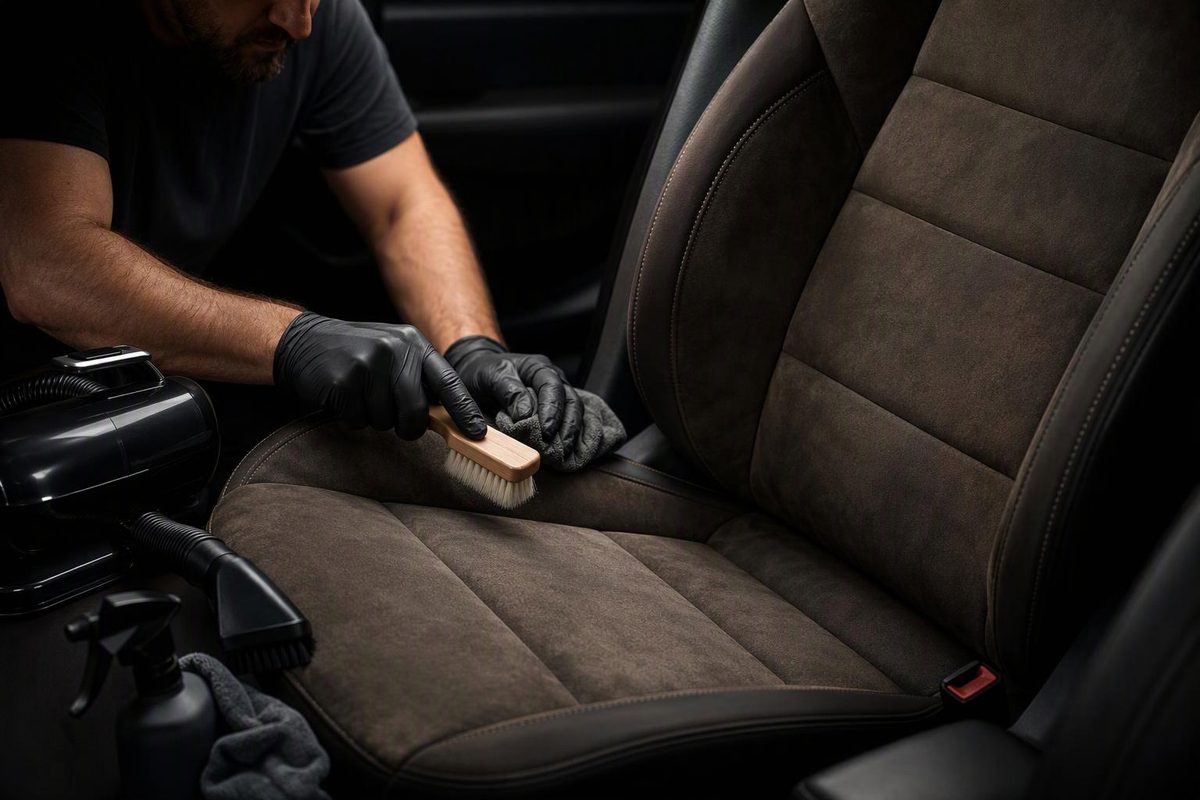
Identify the upholstery before adding water or cleaner. For confirmed Alcantara, the maker’s routine method is gentle dust removal followed by a slightly damp white cotton cloth—not soaking or vigorous scrubbing. Real suede leather needs a different approach, because wet cleaning can leave visible marks.
First, check what “suede” means on your seats
Look in the owner’s manual, upholstery specification or retrimmer’s invoice. Check the seat insert separately from its surrounding bolsters; they may be different materials.
- Alcantara: use the vehicle’s care instructions first, then Alcantara’s material-specific guidance.
- Other suede-look microfiber: follow that vehicle or fabric maker’s instructions. Do not assume every product labeled “suede cleaner” is suitable.
- Real suede or nubuck leather: start dry. Leather-care manufacturer Colourlock warns that wet cleaners carry a high risk of leaving visible stains on these sensitive leathers. Its guidance concerns leather furniture, not permission to wet-clean a particular car seat. Colourlock’s suede and nubuck guidance
- Unidentified material: limit cleaning to gentle dry dust removal until you can confirm it.
The distinction changes which chemicals are acceptable. For example, the Ford Focus manual’s suede microfiber section allows a mild soap-and-water wipe but prohibits leather-care products, household cleaners, alcoholic solutions, spot removers and steam cleaning. Those instructions are specific to the upholstery covered by that manual. Ford Focus interior-care instructions
A low-moisture method for confirmed Alcantara
Gather a vacuum with a clean, soft upholstery attachment, a soft-bristle brush, several unprinted white cotton cloths and clean water. Add a material-approved cleaner only if needed and permitted by your vehicle’s instructions.
1. Remove loose dirt before wiping
Vacuum gently, paying attention to crumbs along seams. Avoid dragging a hard nozzle across the surface. A soft brush or dry cloth is also suitable for routine dust removal; Alcantara lists all three options. Do not scrub a shiny or flattened patch harder simply because it looks dirty. Alcantara cleaning instructions
2. Patch-test the complete method
Choose an inconspicuous area of the same material. Test the water wipe or approved cleaner, including its residue-removal step, and let the patch dry before judging it.
Stop if the dry patch shows a new ring, persistent color change, stiffness or altered texture. If color transfers to the white cloth, stop rather than assuming it is dirt.
3. Wipe with a thoroughly wrung cloth
Moisten a white cloth with clean water and wring it thoroughly. It should be damp, not dripping. Gently wipe the Alcantara panel without pressing moisture into seams or adjoining trim.
Rinse the cloth as it picks up dirt, wring it again and continue with a clean face. For a general refresh, work across the whole matching panel rather than repeatedly wetting one isolated patch. Alcantara’s instructions for fixed upholstery specify wiping the whole material, avoiding excessive wetting and rinsing the cloth as necessary. Alcantara’s fixed-upholstery method
If water is insufficient, use a cleaner explicitly approved for the material and allowed by the vehicle maker. Follow its own dilution, contact time and removal directions; there is no universal suede-seat cleaner ratio. Do not leave it dwelling longer or add more liquid to force a result.
4. Dry, then brush lightly
Let the upholstery dry with ventilation before using the seat. Alcantara advises allowing it to dry overnight, then brushing delicately with a soft-bristle brush to restore the surface. Do not judge a remaining mark while the panel is still damp. The maker also advises against steam machines and vigorous rubbing. Alcantara drying and brushing guidance
Handle spills without spreading them
For confirmed Alcantara, lift thick contamination with a spoon or plastic spatula. Blot liquids with unprinted absorbent paper or a sponge. Work from the outside edge toward the center, avoid rubbing and never pour cleaner directly onto the material. Alcantara stain-removal instructions
For juice or ketchup, Alcantara specifies lukewarm water followed by a clean-water dab. For blood or urine, it specifies cold water instead. Keep both treatment and rinsing controlled with a well-wrung cloth or sponge—not a wet cushion. Alcantara’s stain-specific treatments
Do not turn stain-specific advice into a universal home remedy. Alcantara’s guide includes alcohol for certain stains, while the Ford microfiber instructions above expressly prohibit alcoholic solutions. Follow the instructions for your actual seat; a successful patch test does not override a prohibition.
When to stop
For real suede or nubuck, stay with gentle dry cleaning unless the seat’s supplier approves a specific treatment. Do not borrow sanding, solvent or shoe-cleaning techniques for an unidentified automotive surface.
Stop DIY treatment when a stain spreads, the surface becomes rough or shiny, or a dried patch remains discolored. Ask an upholstery specialist to assess greasy, worn or heavily stained areas before escalating.
If a spill has soaked the cushion or leaves a persistent odor, this surface wipe is not enough; ask an upholstery specialist to assess deeper contamination. For urine, see the separate urine-contamination guide. If mold is present, use the mold-cleaning guide to assess whether surface cleaning is appropriate.