
How to Clean Urine Off Car Seats Without Soaking Them
Blot urine, choose a cleaner for cloth or leather, follow its contact time and dry thoroughly—with stop points for soaked foam and lingering odor.
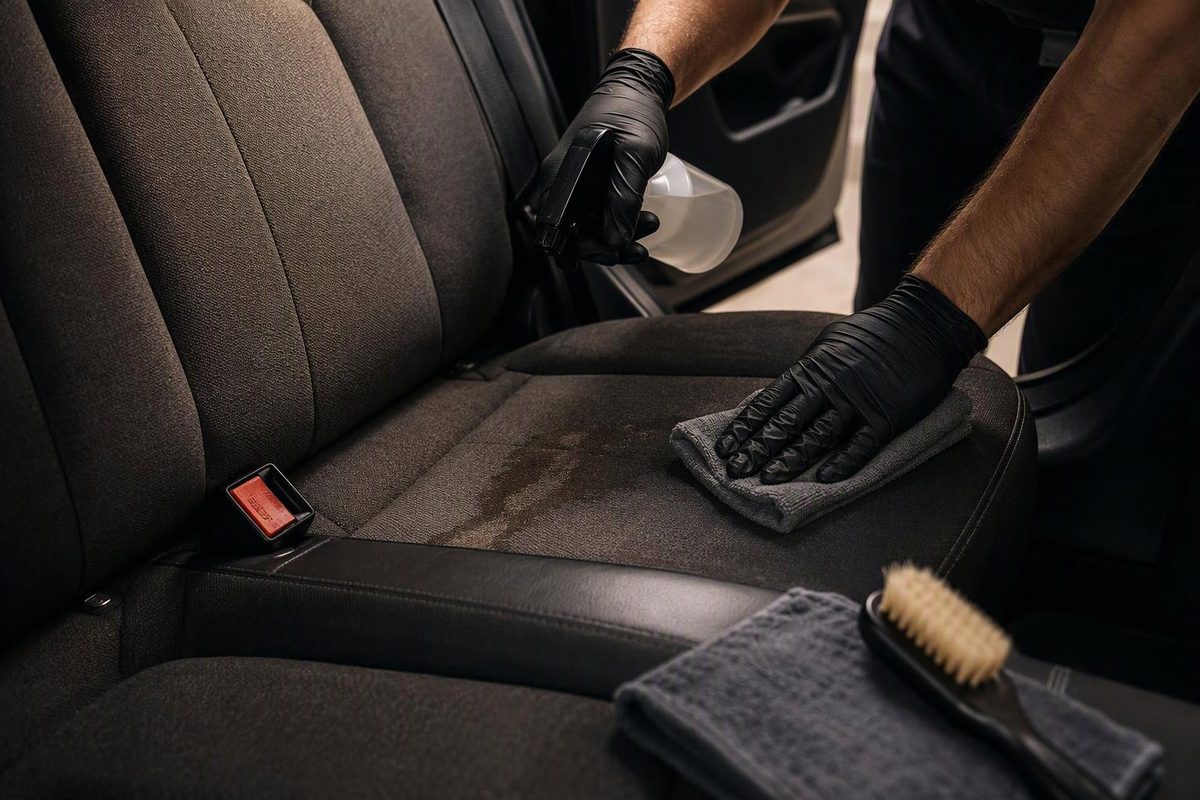
Blot fresh urine immediately, then choose the cleaning method by seat material. Cloth may need a compatible urine stain-and-odor remover; finished leather and vinyl need a gentler surface clean. In either case, avoid flooding the cushion to chase the smell.
This guide covers the vehicle’s upholstery. If the accident is in a child’s removable safety seat, use the separate instructions below.
First: absorb the spill and check the seat
Wear disposable gloves and open the doors in a safe, sheltered location. Press clean absorbent towels onto the wet patch, lift them, and repeat with dry sections. Don’t scrub or stand on the seat. For fresh pet urine on upholstery, Humane World for Animals recommends absorbing as much liquid as possible before cleaning.
Check adjacent seams, the seat-back junction and removable mats for runoff. Keep liquid away from seat controls, belt retractors and under-seat wiring. Don’t use an ordinary dry vacuum to collect liquid.
Before applying cleaner, identify the material and check the vehicle’s interior-care instructions:
| Seat surface | Cleaning route |
|---|---|
| Ordinary cloth | Start with the manual-approved cleaning method; use a urine stain-and-odor remover only if compatible with the fabric and vehicle-care requirements |
| Finished leather | The manual’s mild cleaning method or an approved automotive leather cleaner |
| Vinyl or synthetic leather | A cleaner approved for that specific material—not automatically a leather product |
| Suede, microsuede or an unidentified surface | Follow the material-specific instructions; don’t assume a pet upholstery cleaner is suitable |
Vehicle instructions matter more than a broad “upholstery-safe” claim. For example, Ford’s 2018 Mondeo Energi manual prohibits household cleaning products and soaking interior surfaces, warns against strong detergents on vehicles with seat-mounted airbags, and gives separate restrictions for leather and suede microfiber. Its cloth-cleaning method uses a soft, damp cloth with mild soap and water, followed by a clean cloth to dry.
Cloth seats: treat, remove residue, then dry
Gather white absorbent towels, a compatible cleaner, clean water and a fan. If the urine has dried, skip the initial absorption step and start with the manual-approved cleaning method. A stain disappearing does not necessarily mean the odor is gone.
If the manual permits a urine stain-and-odor treatment:
- Patch-test the cleaner. Follow its hidden-area test, including the waiting time. Check for dye transfer, a changed texture or a visible mark after drying. Stop if any appears.
- Use the label’s dilution and application method. Don’t improvise a stronger mix. Use ready-to-use products as supplied unless instructed otherwise; mix concentrates at their stated upholstery ratio. Treat the affected fabric without forcing liquid through seams.
- Allow the full contact time. There is no universal enzyme-cleaner dwell time. Biokleen’s Bac-Out instructions, for example, specify five minutes or more before blotting. This is an example of product-specific timing, not approval for every car seat. Your bottle’s directions govern your treatment.
- Remove excess and residue as directed. Blot with fresh towels. If the label requires rinsing, use a well-wrung clean-water cloth, then blot again. Use an upholstery extractor only if the vehicle, cleaner and equipment instructions permit it, and follow the machine’s upholstery procedure. Don’t extract a leave-in treatment prematurely.
- Dry with airflow. After the required treatment period, direct a fan across the surface and ventilate the cabin where weather and security permit. Keep people and pets off the treated area until it is fully dry and any product restrictions are satisfied. Don’t cover a damp seat or use its heater as a drying tool.
Stop if the cleaner requires soaking the cushion. Some household urine treatments depend on saturation: Simple Solution’s instructions call for saturating the soiled area, followed by ten or more minutes of contact and natural drying. That is not permission to saturate a vehicle seat. Choose a compatible treatment or seek professional help rather than shortening the directions and expecting the same result.
If a water ring appears, follow the manual’s panel-cleaning method instead of repeatedly wetting the ring’s edge. See our car-seat stain guide for controlled spot cleaning.
Leather, vinyl and synthetic leather: keep moisture on the surface
After blotting, apply the manual-approved cleaner to a soft cloth where its directions allow. Wipe gently, use a second barely damp cloth to remove residue if required, and dry with a clean towel. Work especially carefully around perforations and stitching; don’t pour cleaner onto the seat.
Don’t transfer the cloth-seat enzyme method to leather. Simple Solution explicitly excludes leather, and other products have their own exclusions. Conditioner is not an odor treatment; apply it only if the vehicle manual recommends it. Our leather-seat cleaning guide covers that distinction.
Avoid shortcuts—and recognize deeper contamination
Skip bleach, ammonia and improvised peroxide mixtures. Nissan warns that these can damage its interior surfaces, and excess water can encourage mold or mildew in the cushioning. Don’t mix cleaners or layer products without compatible instructions.
Steam is not the first treatment for urine odor: Humane World advises against steam cleaning urine-contaminated upholstery. Use airflow rather than concentrated heat to dry your cleaning work.
Recheck only after the seat has dried. If odor remains but the fabric tolerated treatment, repeat only as the label permits. If odor returns after drying, liquid reached the underside, or the cushion stays damp, stop adding cleaner. These are reasons to investigate deeper contamination, not proof that the foam needs replacement. Ask a detailer experienced in urine contamination to assess the cushion. Leave seat removal and electrical work to a qualified technician; have any new airbag warning checked rather than treating it as a cleaning problem.
If you mean a child’s safety seat
Follow that seat’s user guide, not the vehicle-upholstery method. Cover washing, harness cleaning and buckle care have different rules. Britax’s guidance says to follow the cover’s care label, spot-clean harness straps without submerging them, and rinse its buckles without soap. Other brands and models may differ. Reassemble and check the seat as its user guide directs before use. If urine remains in parts that cannot be cleaned as instructed, contact the manufacturer about approved replacements.