
NOVUS Plastic Polish: Use the Least Aggressive Bottle That Works
Choose NOVUS #1, #2 or #3 for automotive plastic, check for coatings, and polish scratches without making clear lenses hazier.
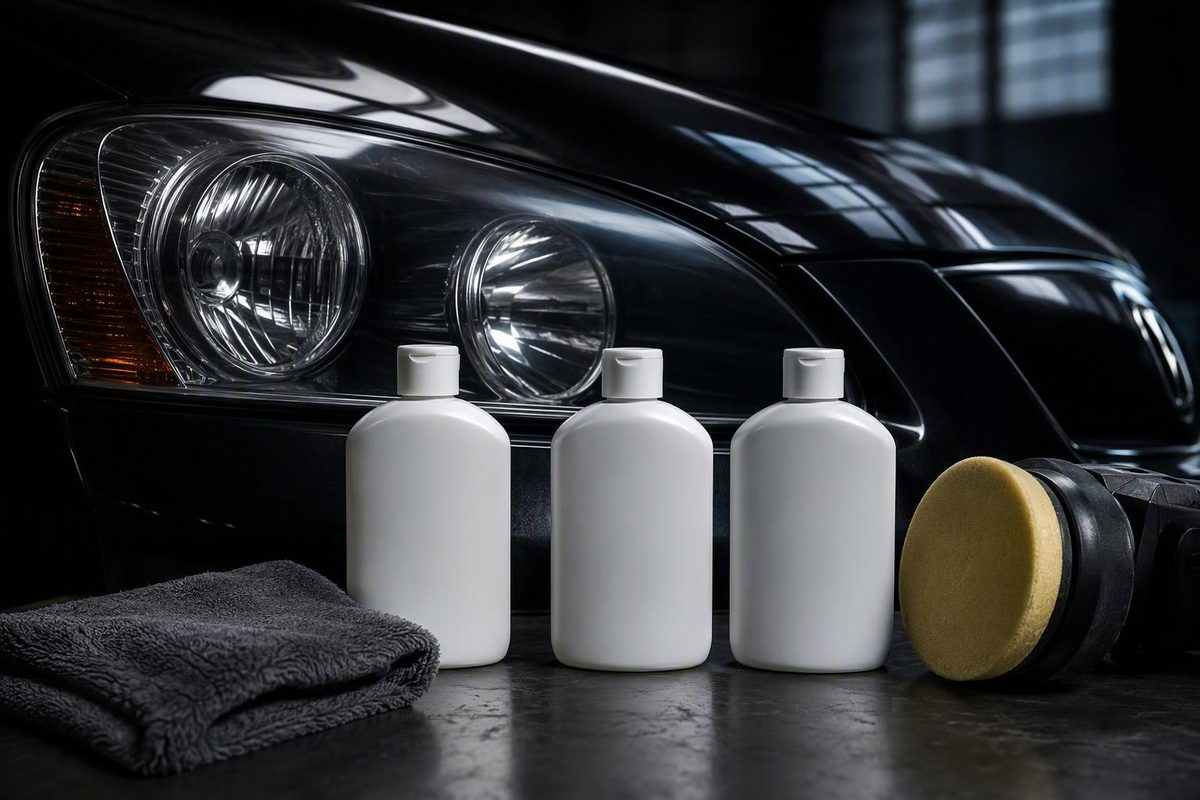
NOVUS Plastic Polish is a three-product system, but not every job requires all three products. For automotive plastic, start with the least aggressive option appropriate to the defect:
| Product | What it does | Sensible automotive use |
|---|---|---|
| NOVUS #1 Clean & Shine | Non-abrasive cleaner and finishing product | Compatible plastic with no scratches requiring correction; also the final step after #2 or #3 |
| NOVUS #2 Fine Scratch Remover | Abrasive polish for fine scratches, haze and wear | Confirmed-compatible, uncoated plastic with light surface damage |
| NOVUS #3 Heavy Scratch Remover | More aggressive scratch remover | Badly scratched, confirmed-compatible uncoated acrylic or plastic; must be refined with #2 |
The manufacturer’s instructions say NOVUS #2 and #3 are not recommended for coated plastics. Identifying the material and any coating is therefore more important than choosing a bottle by scratch depth alone (NOVUS application instructions).
Check the part before polishing
NOVUS lists auto headlamps, interiors and gauges among possible applications, and the #2 product page specifically names vehicle headlamps (NOVUS #2 product information). That is not blanket approval for every vehicle part.
Before opening a bottle:
- Confirm that the surface is plastic. Do not use plastic polish on glass, an LCD panel, vinyl, leather or painted trim.
- Check the vehicle manual. A vehicle-specific care prohibition should override a general product application.
- Determine whether the plastic is coated. If the manual or part supplier cannot confirm compatibility, do not use #2 or #3. A hidden patch test can expose an immediate problem, but it cannot prove that an unknown coating will remain durable.
- Inspect where the damage is. Exterior polishing cannot repair a crack, internal crazing, haze on the inside or a peeling surface coating.
This restraint is particularly important for headlights. Automotive polycarbonate headlamps use a hardcoat to resist weathering, scratching and chemical attack (Momentive’s automotive-lighting guidance). An abrasive polish may be unsuitable even though NOVUS names headlamps as a possible application. One Ford Ranger manual, for example, says not to use abrasives, alcoholic solvents or chemical solvents on its headlamp lenses (Ford owner-manual guidance). Check the instructions for the exact year and model rather than treating that Ford restriction as universal.
Instrument-cluster covers deserve the same caution. NOVUS lists gauges and instrument-control panels as applications, but the no-coated-plastics restriction still applies (NOVUS FAQ). Do not assume an anti-glare, hard-coated or otherwise treated lens is bare acrylic because it looks like clear plastic.
How to use each NOVUS polish
Work out of direct sun on a cool surface. Keep separate clean, soft, lint-free cloths for each liquid; our guide to cleaning rags for cars explains how task separation limits cross-contamination. Mask adjacent textured trim if polish could lodge in it.
NOVUS #1 for cleaning and finishing
Use #1 when compatible plastic needs cleaning but no scratch correction, and after polishing with #2 or #3.
- Shake the bottle and test a concealed spot.
- If the surface is dusty or gritty, apply #1 liberally and wipe with long, light strokes using a clean cloth. Do not press loose dirt across the plastic.
- Reapply with a clean section of cloth and use short circular strokes.
- Buff with another clean section until the surface is clear and slick.
NOVUS describes #1 as non-abrasive and warns against pressure during the first dirty wipe because trapped particles may scratch the plastic (NOVUS application instructions). If the part is heavily contaminated, first remove loose dirt using the vehicle maker’s approved wash method rather than asking a cloth to carry grit away.
NOVUS #2 for fine scratches
Use #2 only after establishing compatibility.
- Clean the surface and shake #2.
- Test a small, inconspicuous area. Inspect it under direct and oblique light before continuing.
- Apply #2 liberally to a clean, soft cloth.
- Work back and forth at right angles to the scratches, keeping the cloth wet with polish.
- Once the worst marks are reduced, apply #2 evenly over the surrounding area with short circular strokes and light pressure.
- Let it dry to a light haze, then buff with a fresh section of cloth.
- Finish with #1.
Do not chase one deep scratch until the surrounding plastic becomes visibly distorted. If several controlled passes leave the mark largely unchanged, stop rather than creating an optical low spot through further material removal.
NOVUS #3 only when #2 is insufficient
NOVUS positions #3 for badly damaged plastics and acrylics, particularly heavy scratches that #2 cannot remove. Test it only after confirming that the surface is uncoated and compatible.
Apply #3 liberally, then work firmly back and forth at right angles to the scratches while keeping the cloth saturated. Stop when only fine scratches remain, remove all #3 residue, and refine the entire worked area with #2. Buff, inspect and finish with #1. That sequence comes from the manufacturer; #3 is not a one-step finish (NOVUS application instructions).
Stop if the test area worsens
Stop immediately if the patch becomes milkier, develops rainbowing, changes gloss, feels tacky or reveals a sharp boundary. Those observations can indicate an incompatible surface, coating damage or uneven correction. Do not escalate from #2 to #3 simply because the first pass looks poor.
Follow the current bottle label and safety data sheet as well as the polishing directions. The February 25, 2025 SDS for NOVUS #2 uses the Danger signal word and classifies the mixture as causing skin and serious eye irritation, potentially causing cancer, and causing organ damage through prolonged or repeated exposure. Its precautions include reading all safety instructions before use, not breathing vapors, wearing protective gloves, washing after handling and keeping the product away from children (NOVUS #2 SDS). Do not assume every bottle in the system has the same hazard classification.
For an unknown automotive lens, the practical sequence is: identify the material and coating, obey the vehicle manual, test #1, then use #2 only if correction is needed and expressly compatible. Reserve #3 for confirmed-compatible, uncoated plastic with damage #2 cannot reasonably remove.