
Choose a Polisher Wool Pad by Machine and Paint Condition
Choose a wool polishing pad by machine, backing plate and defect severity, then test, refine and clean it without chasing unnecessary paint removal.
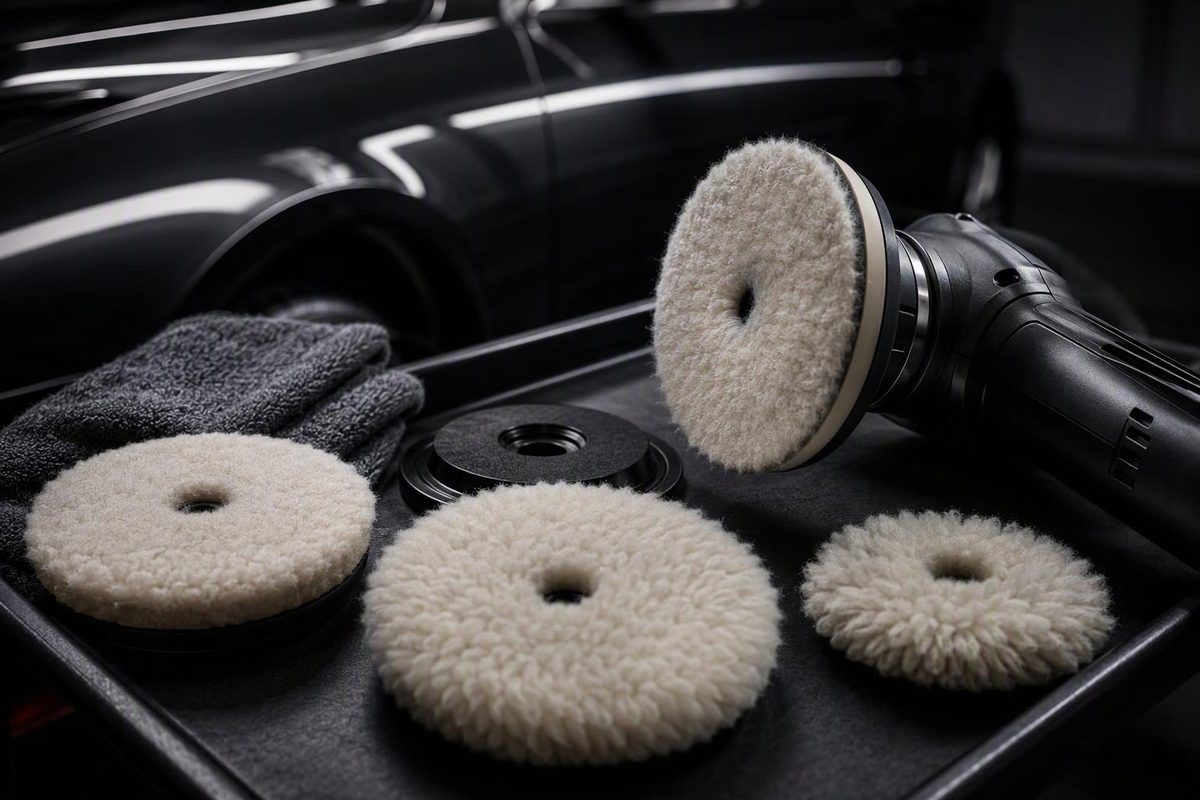
A wool pad for a polisher is a paint-correction tool, not simply a soft attachment for adding shine. With an abrasive compound or polish, it removes paint material to reduce defects. Choose it by machine compatibility and required cut—not by how fluffy it looks. Aggressive pads may leave haze that needs a separate refining step. Lake Country explains this cut-versus-finish trade-off.
For light swirls, test a less-aggressive polishing combination first. Wool becomes useful when that combination does not deliver enough correction, or when a specific medium-wool system suits the job. This guide is for intact, glossy automotive paint; do not use it as a polishing method for matte finishes, wraps or paint-protection film.
Choose the pad before choosing a speed
“Wool pad” covers several constructions and cutting levels. Foam is not automatically gentle, either: both materials include products intended for substantial correction.
| Your task | What to look for |
|---|---|
| Moderate defects on a dual-action polisher | A medium wool pad explicitly approved for that machine type |
| Heavy correction after a milder test falls short | A coarse wool pad and its recommended compound, with a refining combination available |
| Heavy cutting with a rotary | A rotary-rated wool pad; do not assume a DA wool pad is interchangeable |
| Light swirls or final gloss refinement | A less-aggressive polishing or finishing combination rather than defaulting to coarse wool |
For example, RUPES D-A Medium wool pads are designed for moderate defects on dual-action tools and use uniform 15 mm fibers over a flexible foam support. Its twisted rotary wool pads instead use 35 mm strands and were developed around its coarse rotary compound. These are different systems, not merely different sizes of the same pad.
Before buying, check four details:
- Machine motion: random-orbital DA, gear-driven DA or rotary. Use the pad maker’s stated compatibility.
- Backing-plate size: check the specified plate fit, not just the pad’s advertised face diameter. RUPES, for example, specifies a 125 mm backing plate for its 180 mm twisted rotary pad.
- Attachment: confirm hook-and-loop, quick-connect or other mounting requirements against your equipment.
- Cut and compound pairing: read the exact product description and technical sheet. Color alone does not tell you enough.
Budget for spare working pads and, where needed, a separate finishing pad. One pad loaded with residue is not a useful basis for judging the combination.
Test one section before correcting the car
Correction removes material; a remaining scratch is not an instruction to keep cutting. A typical magnetic or eddy-current gauge used on metal panels measures total coating thickness, not the remaining clear coat alone. Some ultrasonic instruments can distinguish layers, so check what your gauge actually measures. DeFelsko explains these measurement limits. Do not polish peeling paint. Unknown repair history or suspected thin areas are reasons to seek an experienced assessment before aggressive correction.
- Prepare clean paint. Wash and dry the vehicle, then assess bonded contamination before polishing. If claying is needed, use appropriate lubrication; our clay mitt guide explains where a mitt or traditional bar fits. Protect adjacent trim and avoid making edges or sharp body lines your first test area.
- Fit and inspect the pad. Center it on the approved backing plate. Do not use a pad with a separating backing, torn support or embedded grit.
- Prime according to its instructions. For the RUPES D-A Medium pad, the technical sheet specifies a thin, even layer of compound across the entire face, then small amounts for reloading. It warns that oversaturation reduces performance. That is a product-specific instruction, not a universal number of drops. RUPES technical sheet
- Work a small, manageable section. Follow the machine and compound instructions for speed and pressure. Keep the tool moving; on a broad, flat test area, keep the pad face flat rather than tilting it to chase a scratch. Excessive pressure with rotary wool can increase heat and holograms. SONAX technique guidance
- Wipe and inspect before repeating. Use a clean microfiber towel and directional inspection light. If the defects are sufficiently reduced but haze remains, test a finer pad and polish. Do not repeat heavy cutting merely to improve the finish.
Stop if heat builds rapidly, the pad becomes heavily clogged, handling changes or the finish worsens. Let the surface cool, clean or change the pad, and reassess rather than compensating with more pressure or compound.
Clean wool according to its construction
During polishing, remove residue frequently using the method approved for the exact pad. RUPES permits compressed air, a vacuum or its Claw Pad Tool for the D-A Medium pad. Follow equipment safety instructions and use suitable eye and respiratory protection when blowing out residue.
Afterward, do not assume every wool pad can be washed like a microfiber towel. Lake Country’s care instructions recommend a standard pad brush for knitted wool and a purpose-made metal spur for its traditional wool pads. They also warn that introducing water can alter wool and change buffing performance.
Where the manufacturer permits washing, use its specified cleaner and method, rinse thoroughly and air-dry. Lake Country specifies a gentle cycle and cold or warm water for machine-washable wool pads because hot water can shrink the fibers. Inspect the dry pad’s shape, backing and attachment before putting it back into service.