
Remove Car Adhesive Without Damaging Paint, Film, or Trim
Match adhesive remover to car paint, glass, plastic, PPF, wraps or fabric, then use short dwell times and firm stop points to prevent damage.
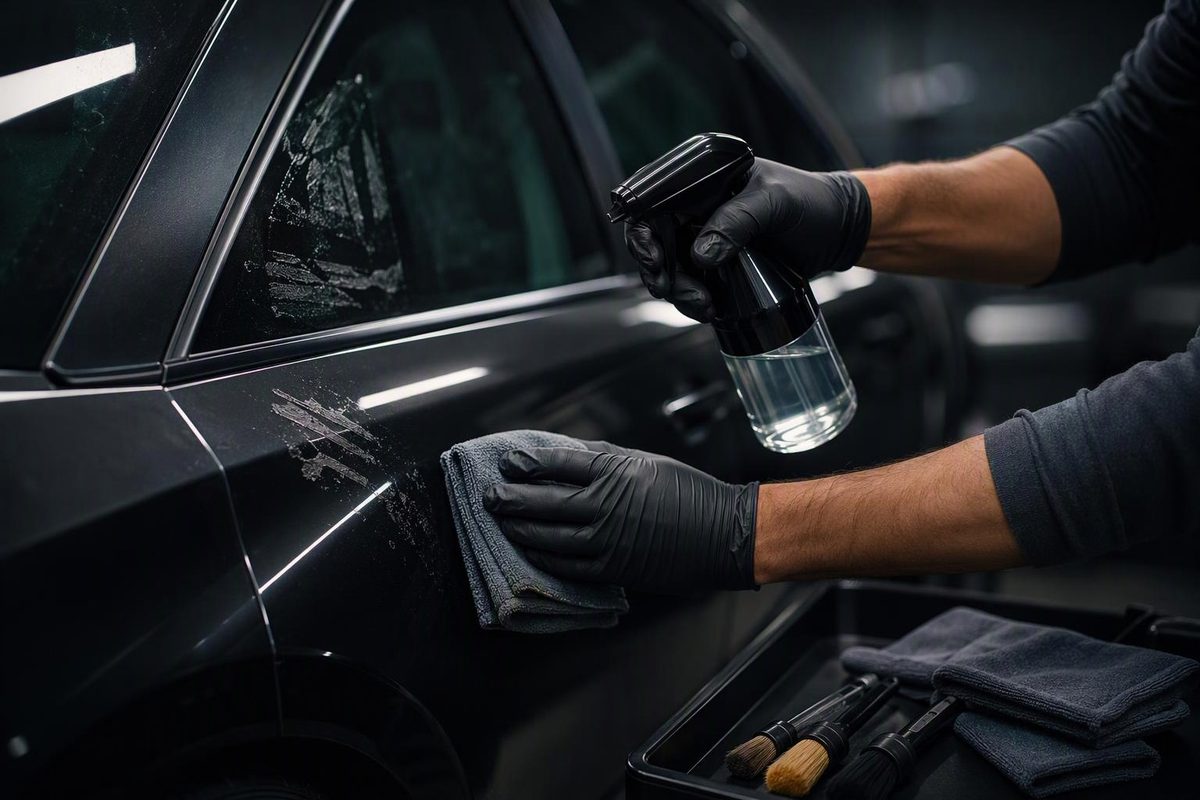
For ordinary sticker or tape residue on cured, glossy automotive paint, start with an automotive adhesive remover whose current label explicitly permits use on clear coat. Do not choose by solvent name or “citrus” marketing alone: the exact formula, surface approval and directions matter. PPF, vinyl wrap, matte paint, tinted glass, rubber and upholstery require separate approval.
Select the affected surface; the guide shows the safest starting point and when to stop.
Surface-Safe Starting Point
| Surface | Sensible Start | Stop or Check First |
|---|---|---|
| Cured glossy paint | Clear-coat-approved remover | Fresh, repaired or damaged paint |
| Exterior glass | Automotive-glass-approved product | Tint, markings, sensors or defroster lines |
| Unpainted plastic | Product that expressly names plastic | Soft-touch, textured, aged or discolored plastic |
| Rubber seal or trim | Cleaner expressly approved for rubber | Rubber is absent from the safe-surface list |
| PPF, wrap or matte finish | Manufacturer-approved method | Material or manufacturer is unknown |
| Carpet or fabric | Compatible upholstery treatment | Leather, suede, headliner or foam backing |
Source note: Surface guidance reflects the product-label and manufacturer instructions cited in the accompanying article; exact formulas and regional labels can differ.
Match the Remover to the Car Surface
One consumer example, Goo Gone Automotive Spray Gel, is labeled safe for automotive clear coat, glass, metal and plastic. Its directions call for a pretest, a few minutes of contact, wiping with a clean white cloth, and then cleaning with soap and water.
The same page excludes leather, suede, rubber and upholstery. That distinction shows why “safe for cars” does not mean safe for every part of a car (Goo Gone product directions). Check the container you actually have because formulas and regional labels can differ.
Professional products are not automatically better DIY choices. For example, 3M says its Adhesive Remover works on most cured automotive paint, glass and vinyl, but its current US page classifies that product as intended for industrial or occupational use rather than consumer use (3M product page).
Fresh, repaired, cracked or peeling paint needs more caution than intact factory paint. If you do not know whether a panel has been repainted, test discreetly and stop at the first sign of color transfer, softening or gloss change.
Unpainted plastic and rubber are separate materials, not extensions of the painted panel beside them. A remover that names plastic may still require a patch test on aged, textured or soft-touch trim. Do not use it on rubber unless the label expressly permits rubber.
For exterior glass, use a product approved for automotive glass and keep it away from materials the label does not cover. Tinted film, printed markings, sensors and rear-window defroster lines require particular care. Do not assume that a product approved for bare exterior glass is approved for those features.
Carpet and fabric need an upholstery-specific treatment permitted by both the material-care instructions and the product label. Leather, suede, headliners and foam-backed fabrics are not suitable places to improvise with a general automotive adhesive remover.
Use the Least Chemical and Contact Needed
- Work on a cool surface in shade. Read the complete label and safety directions. Keep flammable products away from flames, sparks and hot components.
- Wash away grit first. Use car shampoo and water, then dry the area. Otherwise, rubbing can drag dirt across the finish.
- Patch-test out of sight. Test the remover on the same material—not an adjacent trim piece—and let the spot dry before judging it.
- Lift loose sticker material gently. Use a fingernail or flexible plastic edge only if the material moves without force. Do not use a razor on paint, plastic, tint or rear defroster lines.
- Apply the remover exactly as directed. Confine it to the residue, observe the stated dwell time and do not let it dry unless the label permits that.
- Wipe lightly with a clean cloth. Turn to a fresh face as adhesive transfers. A suitable car-cleaning rag and clean towel rotation reduces the chance of rubbing grit or dissolved glue back over the panel.
- Repeat only if the label permits it. Do not compensate for slow progress by scrubbing harder. Stop if the towel picks up paint color, the surface becomes tacky, the finish changes gloss, or plastic swells or whitens.
- Wash and rinse the treated spot when directed. This removes oily product residue. Dry the area and inspect it under diffuse light.
If the area is smooth and no longer sticky but a flat outline remains, stop using remover. The outline may be uneven fading, staining or finish damage rather than adhesive. More solvent will not correct a difference within the finish.
Treat PPF, Wraps and Coatings Separately
Do not assume a paint-safe remover is safe for paint-protection film. XPEL’s care instructions vary by film: some protection-film guidance permits specific isopropyl-alcohol treatment for stubborn stains, its color PPF guidance rejects unapproved solvents, and its windshield-film guidance specifies a 50:50 water/isopropyl-alcohol mixture for sap and tar.
XPEL recommends professional PPF removal. If adhesive remains on the paint after the film is removed, its instructions say a general adhesive remover can help loosen that residue (XPEL product-care instructions). Identify the exact film before applying anything to it.
Use the same manufacturer-first approach with vinyl wraps and matte finishes. Products that appear harmless on glossy clear coat can alter the sheen or surface of another material. If you cannot identify the film, wrap or finish, do not experiment with a general-purpose solvent.
For ceramic-coated paint, ask the coating maker or installer whether the remover is compatible with the coating. Even uncoated clear coat may need protection afterward: 3M explicitly identifies wax as one of the materials its remover can dissolve. Once the panel is clean and residue-free, renew wax or sealant according to that protection product’s directions.
Solvent Safety Is Part of Surface Safety
Do not substitute acetone, lacquer thinner or another strong shop solvent merely because it dissolves glue. Surface compatibility belongs to the complete product and its directions, not to one ingredient.
“Citrus” also does not mean harmless. Goo Gone Automotive’s page identifies petroleum distillates and warns that the product is harmful or fatal if swallowed. A 3M safety data sheet for a separate aerosol specialty adhesive remover classifies that product as extremely flammable and directs users to work outdoors or in a well-ventilated area while wearing specified protection (3M safety data sheet).
Follow the label and safety information for your exact remover, including its ventilation, protective-equipment, storage and disposal directions.
For tree resin rather than label glue, use the more specific sap-removal sequence: wash away grit, soften the deposit and escalate only to a surface-labeled remover.