
How to Tell Whether a Ceramic Coating Kit Is Actually Ready for Your Car
Confirm contents, exact-vehicle coverage for every coat, prep and cure requirements, maintenance needs, and return limits before opening the kit.
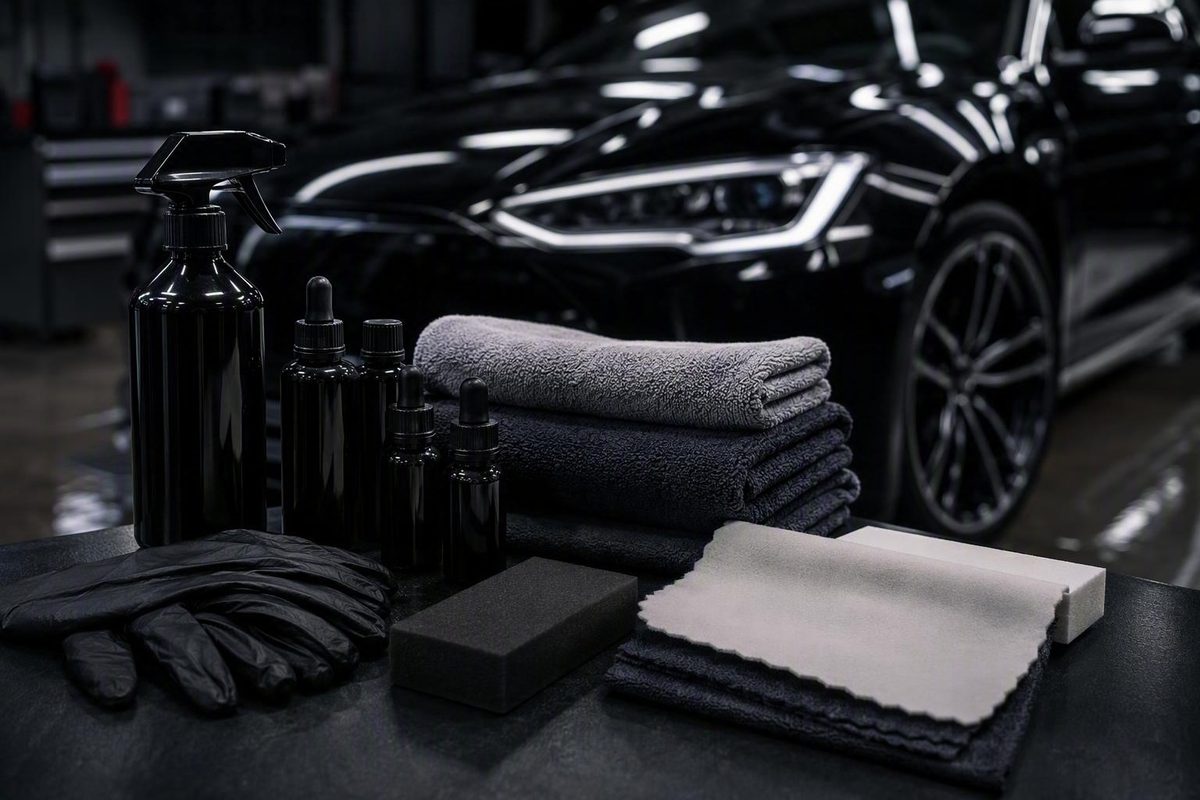
A DIY ceramic coating kit is ready to buy only when you can confirm its contents, coverage for your exact vehicle and required number of coats, preparation demands, application and curing conditions, ongoing maintenance, and return restrictions. A vehicle-size label, coating bottle, and applicator do not necessarily make a complete project kit. If coverage or curing requirements remain unclear, pause the purchase rather than filling those gaps with generic advice.
The quick buying test: five questions a kit must answer
Use this pass-or-pause checklist before ordering:
- What is actually in the box? Separate the coating and included applicators from wash chemicals, decontamination products, paint-correction equipment, safety supplies, extra towels, and maintenance treatments.
- Will the supplied volume cover your vehicle? Confirm coverage for the exact vehicle and the prescribed number of coats—not merely one coat or an unspecified “car.”
- What paint preparation is required? Determine whether the instructions require washing, decontamination, correction of visible defects, and a final surface-preparation step.
- Can you meet the application and cure conditions? Obtain current requirements for temperature, humidity, ventilation, recoating, initial curing, rain exposure, driving, and washing.
- What happens after application—or if you change your mind? Account for the maintenance routine and read the return policy before opening the product.
A coating bottle and applicator may be enough to spread the liquid, but that does not mean they are enough to finish the job. The paint may require decontamination or correction, while the application process may call for additional towels, protective equipment, suitable lighting, and a protected place for the vehicle to cure.
Keep three types of information separate while comparing products:
- A specification is a concrete detail such as bottle volume, kit contents, or the number of supplied towels.
- A manufacturer performance claim predicts an outcome such as gloss, water behavior, scratch resistance, or service life.
- Independent evidence evaluates that outcome outside the seller’s marketing, using disclosed methods and conditions.
The Glidecoat Auto 9H kit provides a useful worked example of this audit. The available evidence supports examining that kit, but it does not support ranking it—or any other product—as the best DIY ceramic coating kit.
Worked kit audit: what the Glidecoat Auto 9H box includes
“Kit” should not be interpreted as “everything required.” Glidecoat documents the following contents for its mid-size configuration, while several project needs remain separate or uncertain.
| Documented in the mid-size kit | Still needed or must be verified |
|---|---|
| 50 ml of Auto 9H | Wash and drying supplies |
| 16 oz of Surface Wipe | Chemical and mechanical decontamination products |
| Four microfiber towels | Paint-correction tools, products, and equipment if defects are present |
| Two application sponges | Protective equipment required by current safety documentation |
| — | Maintenance treatment |
| — | Any additional towels or applicators the project requires |
| — | Confirmed coverage for the exact vehicle and required coats |
Source for documented quantities: Glidecoat Auto Ceramic Kit product page.
Glidecoat offers configurations labeled for mid-size cars and SUVs and for pickups and large SUVs, with optional ALPHA versions. These labels identify product configurations. They do not prove that a particular bottle contains enough product for every vehicle in its category, nor do they establish that ALPHA performs better than the standard version.
Most importantly, the manufacturer page does not provide verified square-foot or vehicle-level coverage for the 50 ml bottle when the recommended minimum of two coats is applied. Before ordering, ask the manufacturer or seller to confirm in writing that the chosen configuration will cover your exact vehicle for every required coat.
Paint preparation determines whether the car is ready
Coating preparation is more extensive than washing and drying. A normal wash may remove loose dirt while bonded contamination, scratches, swirl marks, haze, or other visible imperfections remain.
Glidecoat instructs users to clean and decontaminate the surface and correct scratches, swirl marks, and other visible imperfections before applying the coating. The manufacturer also says that even a new vehicle should be free of surface blemishes. In other words, the coating should not be presented as a substitute for paint correction: the desired finish is expected to exist before the coating is applied. (Glidecoat Auto Ceramic Kit product page.)
Assess the finish under good, even lighting and choose the appropriate path:
- Proceed with preparation if the finish is already acceptable and you can complete the specified cleaning, decontamination, and surface-preparation work.
- Correct the paint first if defects are present and you have the necessary tools, products, and skill.
- Consult a professional detailer if you cannot create the blemish-free surface the manufacturer calls for.
The correct approach depends on the vehicle’s surface condition. The available evidence does not support prescribing one polishing machine, abrasive sequence, or correction method for every car.
Application workload: small sections, immediate buffing, and two coats
Glidecoat’s process is an example for this particular product, not a universal method for every ceramic coating. Other formulas may impose different spreading, leveling, recoating, safety, and curing requirements.
For Auto 9H, the documented sequence is:
- Complete the required cleaning, decontamination, and correction of visible defects.
- Use the supplied Surface Wipe according to the current product directions.
- Apply the coating to an area measuring approximately 3 by 3 feet.
- Immediately buff that area with a clean microfiber towel.
- Continue around the vehicle in an orderly sequence.
- Apply at least two coats while following the current recoat directions.
The section size and minimum number of coats come from the Glidecoat Auto Ceramic Kit product page. Two coats increase both product demand and workload, reinforcing the need to confirm coverage before buying.
Immediate buffing also makes clean towels, adequate lighting, deliberate panel progression, and uninterrupted working time important practical considerations. The direction does not establish a universal flash window, however, and it does not provide a general method for correcting coating that has already hardened.
Verify before opening
Obtain the current instructions and safety documentation for the exact formula and kit. Confirm:
- Permitted temperature range
- Permitted humidity range
- Ventilation requirements and personal protective equipment
- Recoat interval
- Initial curing conditions and duration
- When the vehicle may be exposed to rain
- When the vehicle may be driven
- When it may receive its first wash
Do not substitute cure times from another brand, an older formula, or the standard version for an ALPHA version unless the manufacturer explicitly states that the instructions are interchangeable.
Calculate the real commitment, not just the kit price
The manufacturer page displayed the mid-size kit at $109.95 and listed a range of $109.95 to $209.95 across configurations. Treat these as time-sensitive manufacturer-page prices rather than permanent retail prices. The available evidence does not establish that a separate promotional price is currently available. (Glidecoat Auto Ceramic Kit product page.)
Use this worksheet to estimate the full project cost:
| Project item | Your cost |
|---|---|
| Mid-size kit | $109.95 displayed price |
| Wash supplies | $_____ |
| Chemical decontamination | $_____ |
| Mechanical decontamination | $_____ |
| Paint-correction products and equipment | $_____ |
| Extra applicators and towels | $_____ |
| Personal protective equipment | $_____ |
| Maintenance products | $_____ |
| Estimated total | $_____ |
The box price can understate the actual commitment because the preparation instructions may require products and equipment that are not documented as included. Paint correction may add substantial work and additional supplies if the finish is not already acceptable. DIY application also should not automatically be assumed cheaper than professional work without pricing both options.
Maintenance belongs in the calculation as well. Glidecoat recommends washing every two to four weeks and applying Auto Shine and Shield every four to six months on areas receiving heavy sun exposure. These intervals are manufacturer recommendations; the product page does not independently establish how much the maintenance treatment extends coating durability. (Glidecoat Auto Ceramic Kit product page.)
Treat durability, gloss, and review scores as claims—not guarantees
Documented contents and application directions tell you what the manufacturer provides and asks you to do. They do not prove that the advertised results will occur under typical ownership conditions.
The manufacturer page makes claims concerning an 18-to-24-month lifespan, scratch resistance, UV protection, hydrophobic behavior, gloss, and color restoration. The available evidence does not disclose enough testing methods, environmental conditions, comparison controls, or independent results to establish those outcomes in real-world use. (Glidecoat Auto Ceramic Kit product page.)
The page also displayed a 5.0 rating based on four seller-hosted reviews. Such a small group of reviews on a commercial product page may offer individual experiences, but it cannot establish typical durability, application difficulty, or customer satisfaction.
When evaluating another DIY ceramic coating kit, use this evidence hierarchy:
- Complete technical instructions and safety documents. These determine whether you can apply the exact product correctly and under suitable conditions.
- Independent testing with disclosed conditions. Look for the tested surface, preparation method, number of coats, curing environment, exposure, wash routine, and evaluation criteria.
- Detailed long-term owner reports. Give more weight to reports that identify climate, storage, mileage, preparation, and maintenance.
- Seller-hosted star ratings. Use them to identify possible recurring issues, not as proof of representative performance.
Do not turn “9H” in a product name into a promise that the coating will prevent scratches, chips, or other physical paint damage. A product label is not a substitute for a clearly defined test or warranty.
Final decision table: buy, verify, or consider professional help
| Decision | When it fits | Next step |
|---|---|---|
| Buy after verification | The paint is acceptable; the seller confirms enough volume for the vehicle and required coats; complete application, safety, and cure instructions are available; and you can perform the preparation. | Save the current instructions, prepare the workspace, and inventory every supply before opening the kit. |
| Verify before buying | Coverage, environmental limits, safety precautions, recoat timing, or curing milestones are missing. | Obtain written clarification for the exact kit and formula. Do not rely on directions for another product. |
| Consider professional help | Substantial defect correction is required, or you cannot create the blemish-free surface expected before application. | Price professional correction or installation before committing to the DIY project. |
The terms shown with the kit require return contact within 14 days, an RMA, and saleable condition; opened or used products are generally not returnable. Eligible refunds may also be reduced by return-shipping costs and a 15% restocking fee, according to the return terms on the Glidecoat Auto Ceramic Kit product page.
Read those terms before breaking a seal and retain any written coverage or application answers supplied by the seller. If coverage for the required coats or the product’s curing requirements remains unanswered, stop the purchase rather than substituting assumptions.