
Choose a Legal Low-Water Wash Without Damaging Your Paint
See whether a bucket, shutoff nozzle, rinseless wash, waterless spray, or commercial wash fits UK and US drought restrictions—and your car.
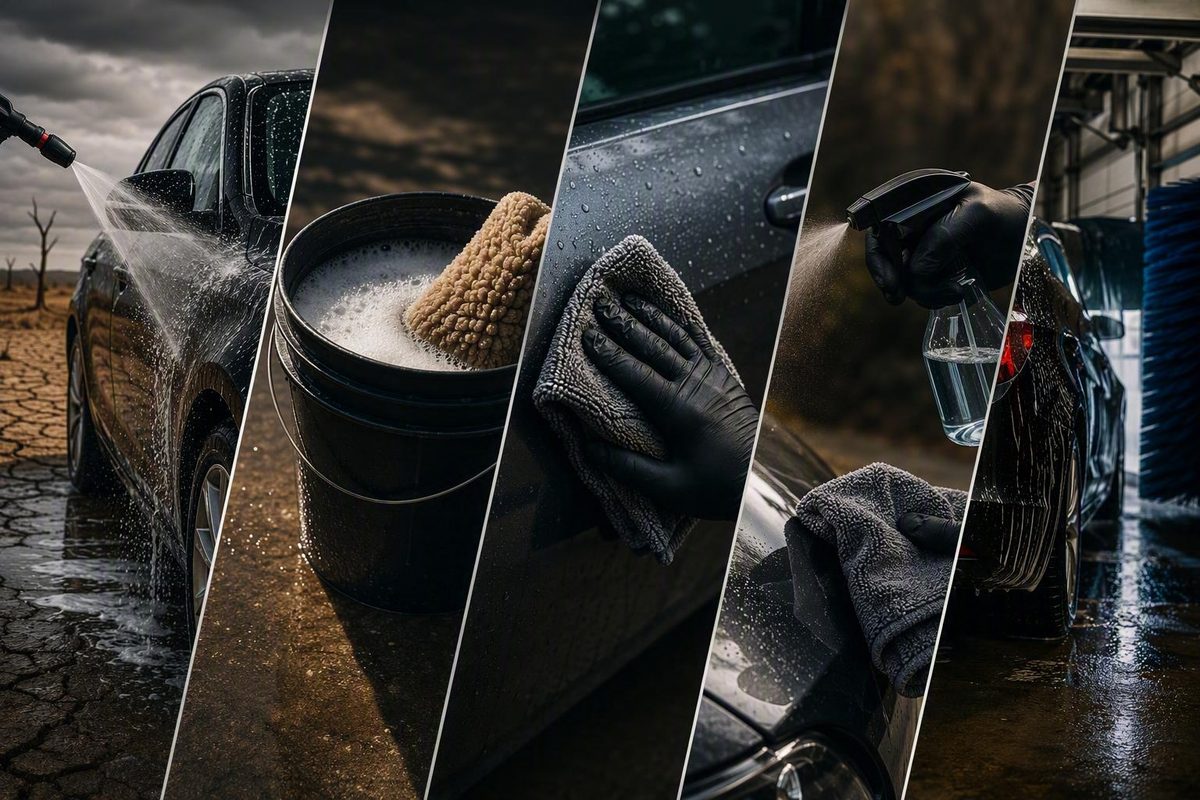
You can wash a car during some water restrictions, but the legal method depends on the exact wording. Under a UK-style hosepipe ban such as Bristol Water’s, do not hose a private car; use the expressly permitted bucket-and-sponge method. Under Corpus Christi Stage 2, use a handheld hose with a positive-shutoff nozzle or a bucket holding no more than five gallons. If the order prohibits residential vehicle washing rather than hose use, use a permitted commercial wash or postpone. Waterless cleaning uses the least water at the wash site, but it is suitable only for very light contamination and is not automatically exempt from a washing ban.
Choose the restriction, equipment, and dirt level; then enter your own measured water use to compare methods.
Select the rule that applies, the best equipment you have, and the vehicle condition. The result interprets only the example rules shown here; the current official notice still controls.
Enter measured gallons for your own equipment. Published notices reviewed here do not provide universal consumption figures. Waterless is shown as 0 gallons of user-added water at the wash site; product manufacture and towel laundering are excluded.
| Method | Rule Consideration | Gallons Per Wash | Total |
|---|---|---|---|
| Continuous or ordinary hose | Often targeted by hose restrictions | gal | — |
| Two-bucket wash | Bucket size and activity may be regulated | gal | — |
| Rinseless wash | Still uses water and may count as washing | gal | — |
| Waterless maintenance wash | Only for very light contamination | gal | 0 gal |
To measure a hose, collect or meter the water used during your normal wash rather than relying on an assumed flow rate. The Corpus Christi five-gallon figure is a legal bucket-capacity ceiling, not an estimate of universal wash consumption.
Sources: Bristol Water hosepipe-ban notice; Corpus Christi Stage 2 FAQ, current as of August 4, 2026. Water-use entries are supplied by the user; unknown values are shown as —.
Restriction stages can be activated, changed, or lifted. Reopen the official supplier or local-government notice immediately before washing. A low-water product does not override a prohibition, and permission to use water does not settle separate stormwater rules.
Match the Method to the Restriction Wording
“Water restrictions” is not a single legal standard. The controlling rule may regulate hose use, all outdoor water use, residential vehicle washing, the water source, or a combination of these.
A hose-specific restriction may leave bucket washing available. Bristol Water’s restriction notice says a hosepipe must not be used to clean a private motor vehicle while the temporary ban is in force, while a bucket and sponge may be used. The page gives an August 27 start date but does not clearly display the year or an end date, so the current status still needs to be confirmed directly.
Bristol Water announced its first hosepipe ban in 50 years on August 25, 2026. At that point, bans affected more than 20 million UK residents. Those figures describe the wider restriction period, not a universal rule for every UK address; each supplier’s operative notice controls.
Corpus Christi uses different wording. Its Stage 2 FAQ, marked current as of August 4, 2026, permits home vehicle washing on any day with either a handheld hose fitted with a positive-shutoff nozzle or a bucket holding no more than five gallons. Commercial car washes may be used as usual. Those provisions apply to users of city-provided water during that stage. See the Corpus Christi Stage 2 FAQ.
A broader order can prohibit driveway or residential vehicle washing itself. In that case, switching from a hose to a bucket, rinseless solution, or waterless spray may not help. “Rinseless” and “waterless” describe processes, not legal exemptions.
| Restriction Wording | Usually Viable | Not Established By That Wording |
|---|---|---|
| Hosepipe use prohibited | Expressly allowed bucket method | Pressure washer or another hose-fed setup |
| Shutoff hose or limited bucket allowed | Specified hose or compliant bucket | Unlisted equipment |
| Residential washing prohibited | Permitted commercial facility | Bucket, rinseless, or waterless washing at home |
| Rule unclear or outdated | Postpone or obtain clarification | Any assumed exemption |
Identify the Rule for the Property
Start with the property’s actual water supplier, not only the city, county, or postcode. A local-government page may direct customers of another utility to follow that supplier’s rules.
Use a water bill, landlord record, or official lookup to identify the supplier. Open its current restriction notice and confirm the active stage. A drought plan explains the framework, but the current notice establishes what is in force.
Corpus Christi’s 2025 Drought Contingency Plan, amended June 2026 illustrates the distinction. The plan applies to users of city-provided water, authorizes designated officials to initiate or terminate stages, requires public notification when restrictions change, and distinguishes city water from auxiliary supplies. The plan alone does not establish the current vehicle-washing rule; the stage-specific FAQ does.
Read the provisions covering “vehicle washing,” “car washing,” “outdoor use,” “hosepipe,” “bucket,” “shutoff nozzle,” “pressure washer,” “commercial car wash,” “exemption,” and “waste.” Check whether permission depends on the day, time, frequency, necessity, location, or source of the water.
Do not assume rainwater, reclaimed water, a private well, or another auxiliary supply is exempt. The order may regulate the activity, the potable supply, or both.
If windows, mirrors, lights, cameras, sensors, or a number plate need safety-related cleaning, look for explicit essential-use or health-and-safety language. A safety concern does not automatically authorize a full wash. Ask the enforcing authority for written clarification where the exception is uncertain.
Choose the Lowest-Water Legal Method
There is no sourced universal gallons-per-wash figure for a continuous hose, two-bucket wash, rinseless wash, or commercial wash in the notices reviewed here. Consumption changes with vehicle size, equipment, flow rate, technique, dirt level, and the definition of a wash. The estimator above therefore uses measurements you enter rather than invented averages.
A waterless process uses no user-added wash or rinse water at the vehicle, making it the lowest site-water option by definition. The product contains liquid, and towel laundering consumes water elsewhere, so “waterless” does not mean that no water exists anywhere in the process.
A rinseless wash uses diluted bucket solution but eliminates the separate hose rinse. It generally provides more cleaning capacity than spraying and wiping with a ready-to-use waterless product. A bucket wash caps the water immediately available, although the actual total depends on the number and size of buckets filled. Corpus Christi’s five-gallon figure is a legal bucket-capacity limit under its Stage 2 rule, not a claim about the water required to clean every car.
| Vehicle Condition | Suitable Low-Water Choice | When to Reject It |
|---|---|---|
| Dust, pollen, fingerprints | Waterless, if legal | Visible particles or gritty resistance |
| Light-to-moderate road film | Rinseless, if legal | Gritty lower panels or embedded dirt |
| Mud, sand, salt crust | Permitted rinse or facility | Home rinsing is prohibited |
| Heavy brake dust | Separate tools or facility | Safe removal needs prohibited equipment |
The firm paint-safety rule is not to wipe mud, sand, salt crust, or other abrasive deposits from paint with a waterless product. If the necessary pre-rinse is prohibited, use a confirmed permitted commercial or self-service wash or wait.
A Shutoff Nozzle Does Not Authorize Every Hose-Fed Tool
Where a rule permits a handheld hose with a positive or automatic shutoff nozzle, the flow must stop when the trigger or valve is released. The hose may also need to remain attended.
Do not infer that a pressure washer is allowed merely because the notice permits a bucket or handheld hose. A pressure washer may fall under separate language governing powered equipment, tap connections, hosepipes, or outdoor water use. Use one only when the notice clearly covers the setup or the authority confirms it.
Where a hose is allowed, fit the specified device rather than assuming any spray head qualifies. This nozzle type guide explains the hardware, but equipment selection cannot establish legal permission.
Pinellas County provides another example of qualified permission. It allows vehicle washing “if necessary” when a shutoff nozzle or water-efficient device is used and separately prohibits wasteful practices such as leaving a hose unattended. It also directs customers served by another supplier to follow that supplier’s rules. Because “necessary” is not defined on the page, the permission should not be treated as unrestricted. See Pinellas County’s restriction page.
Use Rinseless Washing for Manageable Road Film
Proceed only if residential washing, the bucket water, any hand-pump sprayer, the location, and wastewater handling are permitted.
Prepare the rinseless solution at the label dilution. Keep clean wash media separate from towels that have touched wheels, lower panels, or the ground. Multiple towels let you retire a contaminated face rather than putting captured dirt back onto the paint.
Park in shade and let the panels cool. Inspect the roof, glass, horizontal panels, lower doors, bumpers, wheel arches, and areas behind the wheels. A car can be suitable for rinseless cleaning across the upper panels while remaining too gritty along the sills and rear bumper.
Fully saturate a clean towel or suitable wash medium. Clean one small section using gentle passes, rotate to a fresh face as it collects contamination, and dry the section immediately with a separate towel. Work from cleaner upper sections toward dirtier lower areas. Use dedicated media on the wheels.
Stop if the towel catches, encounters particles, or cannot release the contamination without pressure. Careful technique can reduce marring risk, but no low-water process is scratch-proof. Paint condition, contamination, towel cleanliness, product dilution, and hand pressure all affect the result.
Reserve Waterless Washing for Very Light Dirt
A waterless maintenance wash is appropriate for dust, pollen, fingerprints, or a very light film—not mud, sand, salt, gritty lower panels, or heavy brake dust. It is also lawful only when the active order permits the activity.
Work on cool paint in shade. Inspect each panel under good light, then apply enough product to wet and lubricate a small area. Wipe gently in straight passes with a clean microfiber face. Rotate or replace the towel as soon as it collects dirt, and use a second clean towel for the final buff.
Stop if you see particles, feel a sandy texture, encounter grabbing under the towel, or find that the dirt smears instead of releasing. Pressing harder converts a marginal cleaning method into an abrasive one. Move to a permitted rinseless wash, allowed pre-rinse, commercial facility, or postponement.
Follow the product label and the vehicle’s finish-care instructions, particularly on matte paint, wraps, coatings, and repaired areas. The complete process is covered in the waterless procedure.
Commercial Washes Can Be the Legal Paint-Safe Option
A commercial or self-service wash is often the practical choice when residential washing is prohibited or abrasive contamination needs removal. Corpus Christi’s Stage 2 FAQ expressly allows commercial car washes to operate as usual.
Do not assume every commercial wash is exempt, uses less water than every home method, or reclaims wash water. Confirm that the facility may operate under the active restriction. If water use and discharge affect the choice, ask whether it reclaims water, where wastewater goes, and whether it can remove mud, salt, or sand without a prohibited pre-clean at home.
A June 11, 2026 report said Durham’s forthcoming Stage 2 restrictions would prohibit driveway car washing and direct drivers to commercial facilities. That was a dated secondary report rather than proof of the current rule, so Durham’s official notice would still need to be checked. The report described enforcement progressing from a verbal warning and notice to $100 and $250 fines, followed by possible service disconnection. See the Durham Stage 2 report.
Corpus Christi’s FAQ describes violations as Class C misdemeanors punishable by fines of up to $500 per day, with possible water-service disconnection after a second offense at the same premises. Pinellas County states that its utility must issue a $193 citation for violations beginning April 17, 2026, with the amount doubling for each additional violation. These are jurisdiction-specific examples, not universal penalty schedules.
Keep Wash Water Out of Storm Drains
Water conservation and wastewater control are separate obligations. Even a low-volume wash can produce liquid containing detergent, dirt, grease, oil, automotive fluids, metals, rust, and rubber.
Permission to wash does not necessarily allow that water to enter the street or a storm-drain inlet. Colorado Springs’ car-washing guidance recommends controlling water with a bucket or trigger nozzle and, where appropriate, washing over a permeable surface such as gravel or grass.
Use a permeable surface only if local rules permit it and the site is suitable. Keep wash water away from neighboring property, sensitive areas, streets, and drains. With a rinseless wash, use only the solution needed, contain the towels and remaining bucket liquid, and follow local disposal instructions.
Before starting, confirm the current supplier and stage, the exact vehicle-washing language, the permitted equipment and water source, and any day or time conditions. Verify exemptions rather than assuming them. If the car is too dirty for the legal home method, use a permitted facility or postpone the wash.